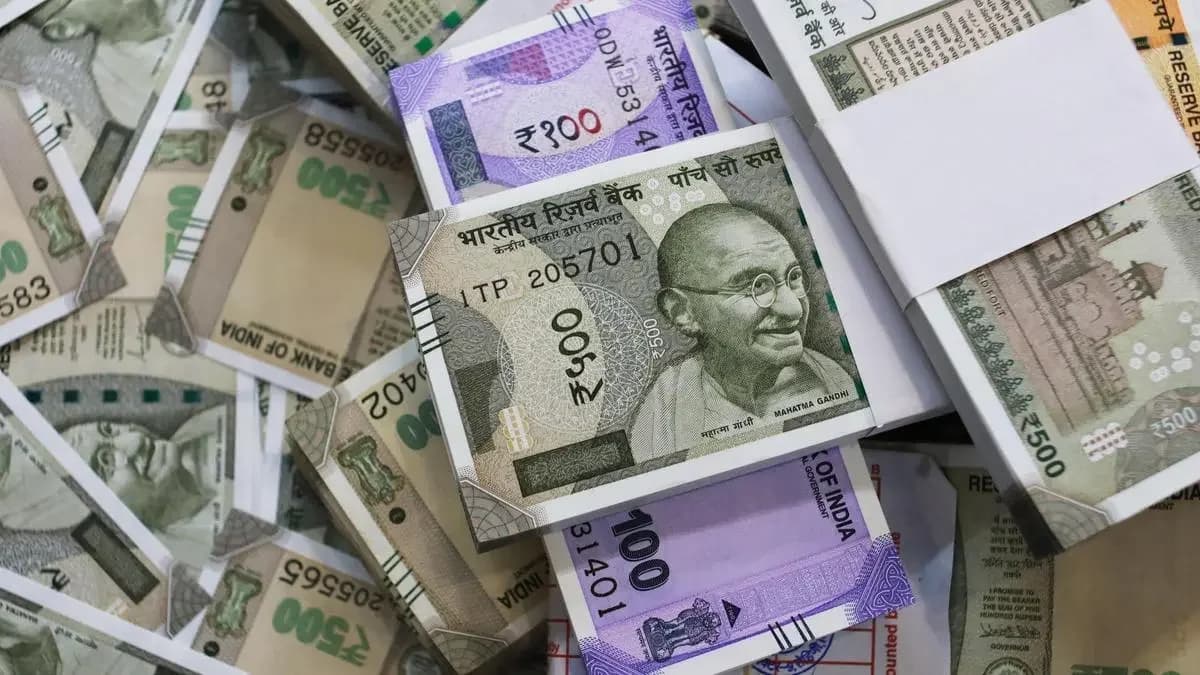
The Indian rupee fell 19 paise to 94.75 against the US dollar during early trade on Wednesday, weighed down by the strength of the American currency in the overseas market. According to The Hindu, the rupee opened at 94.67 and touched 94.75, registering a loss from Tuesday's close of 94.56. Forex traders said whenever fresh foreign inflows enter the country, the central bank is likely to use the opportunity to rebuild its reserve position rather than allowing the rupee to strengthen too much, adding to the currency's weakness. The latest decline comes as the US Dollar Index (DXY) strengthened to 101.34, up 0.15%, continuing to hold above the 101 mark after the Federal Reserve maintained a cautious stance in its latest policy meeting. CR Forex Advisors MD Amit Pabari noted that the global dollar is also adding pressure, stating that as long as the dollar stays firm globally, the rupee is likely to remain under pressure.
Expectations of a Federal Reserve rate hike after data released yesterday showed US job openings rose to a two-year high in May, indicating labor demand remained resilient despite signs of softer hiring, is keeping the dollar supported. As reported by Business Standard, markets now price in around an 80% chance of a Federal Reserve rate hike in September, with investors looking ahead to the latest US monthly jobs report for fresh insights into the strength of the labor market and the outlook for Federal Reserve policy. The rise in US Treasury yields dampened demand for Asian currencies and weighed on risk sentiment, with the 10-year US yield rising 4 basis points in Asian trading to 4.4650%, adding to Tuesday's 6 basis points increase. Losses in Asian currencies were led by the Korean won and the Indonesian rupiah, while regional equities and US equity futures dipped.
The rupee's recovery is primarily driven by sharp retreat in oil prices to pre-Iran war levels, with crude oil prices cooling to Brent crude trading higher by 0.38% at $73.23 per barrel in futures trade, as reported by The Hindu BusinessLine. According to Anil Kumar Bhansali, Head of Treasury and Executive Director, Finrex Treasury Advisors LLP, continued normalisation of oil flows through the Strait of Hormuz following the US-Iran ceasefire and diplomatic engagement kept it at the lower side at USD 73.15 per barrel this morning. However, uncertainty prevailed over the progress of US-Iran peace talks keeping a geopolitical risk premium in the market, according to Anil Kumar Bhansali. This development has significantly eased pressure on the currency, which remains deeply dependent on crude oil imports with the nation importing nearly 88-90% of its crude oil requirements. As reported by Dalal Street Investment Journal, a landmark study analyzing the period between 2019 and 2024 reveals that a USD 10 rise in crude oil prices costs India approximately USD 16.4 billion annually.
The Indian benchmark indices opened in the green with BSE Sensex climbing 182.42 points to 76,661.36 and NSE Nifty 50 up 49.90 points to 23,916.85 in early trade, according to The Hindu BusinessLine. Foreign institutional investors sold equities worth ₹2,556.75 crore on a net basis on Tuesday, reflecting continued foreign capital outflows. On the domestic macroeconomic front, India's fiscal deficit touched 9.6% of the FY27 budget target at the end of May, with the fiscal deficit at ₹1.62 lakh crore in value terms at the end of May 2026, as per data released by the Controller General of Accounts (CGA). Analysts at Goldman Sachs have raised their 2026 growth forecast for India by 30 basis points and lowered their inflation projection by 20 basis points, as reported by The Economic Times.
From a technical standpoint, spot USD/INR faces immediate resistance at 95.10, while a breakdown below 94.40 will act as key support, according to HDFC Securities Research Analyst Dilip Parmar. Over the past two-and-a-half weeks, the rupee has broadly traded in a 94.10–94.90 range, with downside seen capped by likely Reserve Bank of India intervention. The central bank has been selling dollars ahead of the 95 level, making it a key threshold to watch, as traders said. The 94.80–95.00 near-term support zone is "definitely" looking vulnerable, a currency trader at a bank said, adding that a break past that level could add pressure on the rupee, trigger stop-loss orders and prompt exporters to hold out for further depreciation. As long as the dollar stays firm globally, the rupee is likely to remain under pressure, according to CR Forex Advisors MD Amit Pabari.