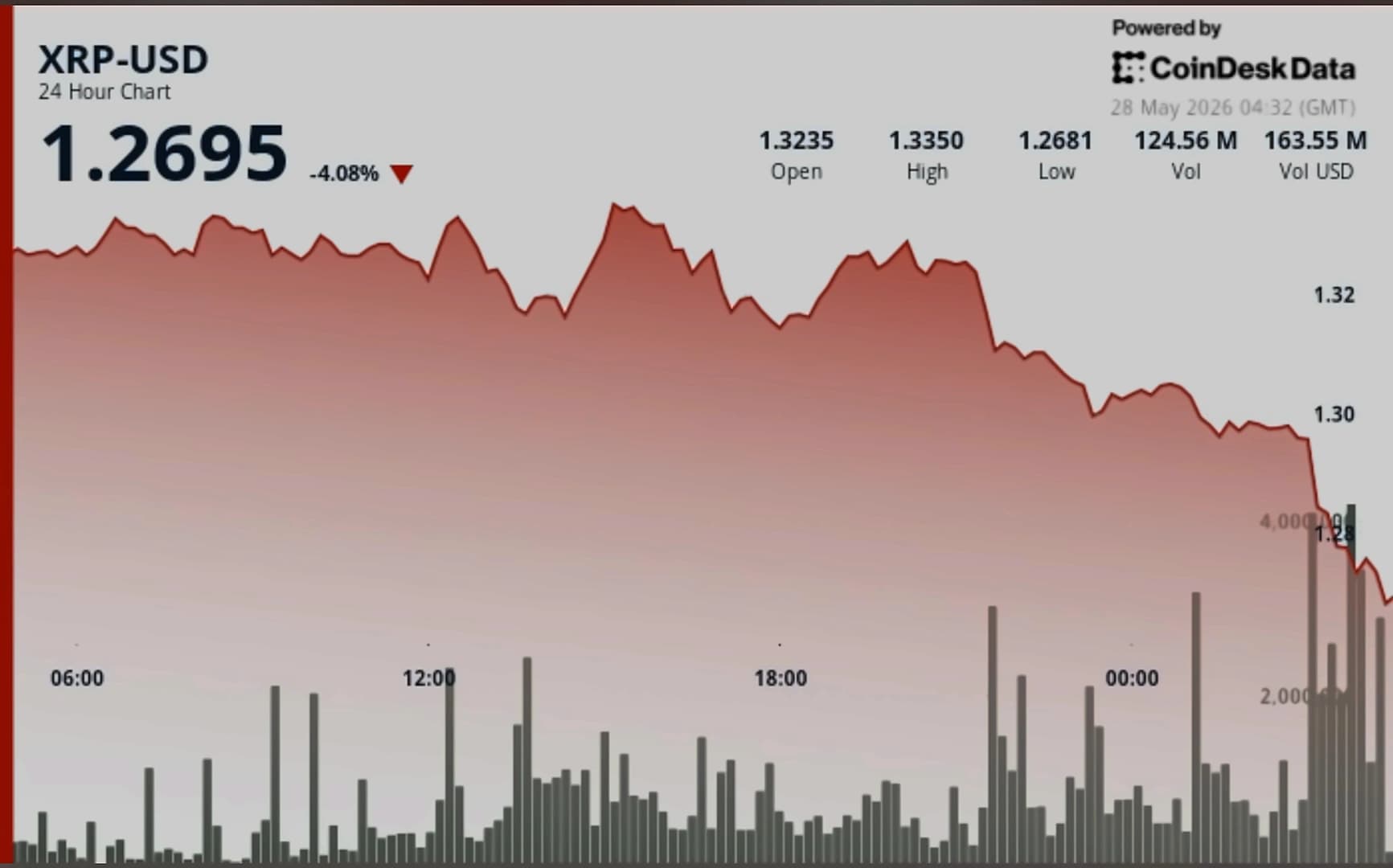
XRP is currently trading at $1.38 after a 2% gain over the last 24 hours, climbing back toward the critical $1.45 resistance level that has repeatedly rejected the cryptocurrency since late April. The coin had been trading in the $1.35-$1.39 range since the start of May but is now settling around $1.38, showing signs of recovery after breaking below the $1.40 level following the end of a significant ETF inflow streak. The latest price action reflects XRP's 23% average return in May, which has made traders curious about its potential to trade above $1.45 despite facing a substantial sell wall. The cryptocurrency had maintained stability between $1.40 and $1.44 throughout April, supported by daily inflows of $5 to $17 million, but this consistent demand failed to break the key $1.45 resistance level. The 4-hour chart reveals a clear shift in structure, with price losing momentum after rejecting a key supply zone near $1.50 and failing to reclaim mid-range levels.
The primary obstacle to XRP's price advance is a massive 1.16 billion XRP tokens clustered specifically at the $1.44-$1.46 break-even price range, representing the densest concentration of underwater holders in the entire market. According to Glassnode data, roughly 60% of XRP's circulating supply—about 36.8 billion XRP—is held at an average cost basis of $1.44, with millions of holders who bought earlier this year waiting for a chance to break even. The $1.44-$1.46 zone is the most crowded price point for sellers, where holders who bought there earlier this year are waiting to exit at break-even. Every time XRP has approached $1.45, those holders don't hesitate to exit, adding selling pressure as XRP's momentum builds, which is why the coin has struggled to hold gains at or near the $1.45 level. The technical setup shows XRP trading below major exponential moving averages, which strengthens the bearish bias as the cryptocurrency loses momentum after rejecting key supply zones.
The ETF market dynamics have shifted dramatically, with total XRP ETF inflows crossing $1.30 billion since launch, creating a clear gap in daily buying power that previously held XRP above $1.40. The weekly inflows reached $55 million in the week of April 17, marking the strongest single week on record, while daily inflows of $3.59 million on April 29 showed continued institutional interest. The April streak of 20 consecutive inflow days, with a peak of $17.11 million, was sufficient to hold the price between $1.40 and $1.44 but not break the $1.45 resistance level. For the price to challenge resistance again, a sustained return of daily ETF inflows above the previous $5-$17 million range will be required. The CLARITY Act—which would clarify XRP's status as a commodity under U.S. federal law—is one major catalyst for the XRP price, with expectations of the bill's passage in May helping XRP's momentum in April, resulting in a modest 2% gain after three months of consecutive monthly losses. Near-term catalysts include the Q1 13F institutional holdings filings due in mid-May and the markup deadline for the CLARITY Act on May 21.
Support from policymakers has significantly improved XRP's momentum, with lawmakers like Senator Thom Tillis and Senator Cynthia Lummis backing the CLARITY Act's passage, while U.S. Treasury Secretary Scott Bessent, Securities and Exchange Commission Chair Paul Atkins, and Coinbase CEO Brian Armstrong have pressured the Senate to fast-track the bill to Trump's desk for signing. If the Senate Banking Committee marks up the bill by the second week of May, it could bring in the institutional buying that XRP needs to clear $1.45. The Middle East tensions between the U.S. and Iran have played a key role in XRP's bearish performances since the start of Q1, with investors turning to safer bets like gold and oil when disagreements escalated in February and March. However, the ceasefire since early April has helped XRP trade above $1.50 before profit-taking pulled it back. Recent developments include Iranian news media reporting that Iran sent a 14-point peace proposal—through Pakistan intermediaries—to the U.S. last week, with one negotiation point being that both countries should reach a peace deal within a 30-day window. If tensions ease and a deal is reached, risk appetite returns to the market, which could help XRP push through the sell wall and sustain above $1.45.