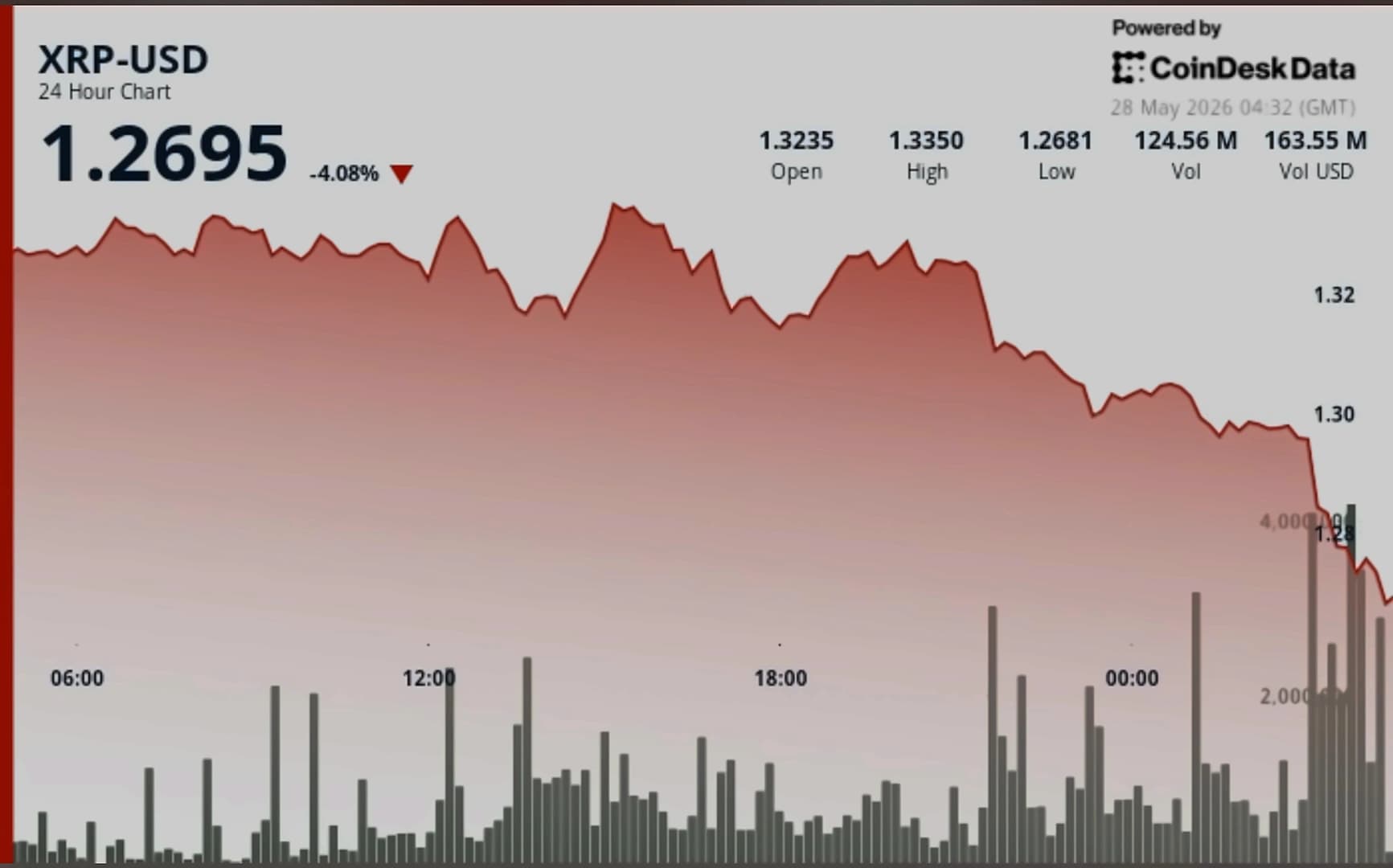
XRP has broken below the critical $1.40 support level on strong selling volume, marking a fundamental shift in market structure where the previous floor has become immediate resistance. According to Ainvest News, this breakdown represents a classic liquidity event where the market's structure has fundamentally changed, with price now consolidating just under $1.40 after a sharp drop to $1.38. The immediate focus shifts to two key levels: a move back above $1.40 would signal the breakdown failed, while the next critical support sits at $1.37. A confirmed break below this level would open the path toward the $1.32-$1.28 zone, directly challenging the ETF inflow thesis and testing whether institutional accumulation can hold against accelerating technical weakness.
Despite the technical breakdown, XRP ETFs have accumulated $1.53 billion in assets under management and 773 million XRP in custody less than six months after their launch, creating a clear divergence from recent price action. According to Ainvest News, XRP ETFs posted their strongest month of the year in April, attracting $81.63 million in net inflows through April 27, even as the price fell from its January peak. The largest disclosed holder is Goldman Sachs, which disclosed a $153.8 million position across four separate XRP ETFs in its Q4 2025 filing, accounting for roughly 73% of the top 30 institutional holders' combined exposure. This deliberate diversification across issuers suggests a long-duration, structural allocation rather than tactical trading, with the next major data point arriving in mid-May when institutional 13F filings will test whether major holders maintained their positions through the subsequent price slide.

The technical failure is occurring within a constrained liquidity environment where Bitcoin dominance has pushed toward 60%, signaling a rotation that directly limits demand for assets like XRP. According to Ainvest News, this capital rotation away from altcoins creates a backdrop where institutional money flow contrasts sharply with price action signals. The $1.37 support level represents the primary risk, as a confirmed loss would challenge the ETF inflow thesis and test whether institutional accumulation can hold against accelerating technical weakness. The immediate trigger for a potential shift is a daily close back above the $1.40 level, which would signal the recent breakdown failed and potentially reignite short-term momentum.
XRP ETFs experienced their strongest month of 2026 in April, recording net inflows of $81.63 million through April 27, marking a complete reversal from the $31.16 million outflows in March. According to Lead Markets, this surge brought cumulative ETF inflows to approximately $1.29 billion, signaling a significant shift in institutional sentiment toward the cryptocurrency. The institutional adoption is accelerating rapidly, with Goldman Sachs disclosing a $153.8 million position - the largest publicly disclosed institutional XRP holding. A recent Coinbase and EY Parthenon survey reveals that 18% of institutions already own XRP, with another 25% planning to invest in 2026. JP Morgan estimates potential inflows of $4-8.4 billion in the first year alone, indicating substantial institutional interest in the tokenized finance infrastructure.
According to Ainvest News analysis, the immediate focus remains on the $1.40 resistance level as the key to reclaiming recent breakdown territory, while acknowledging that XRP remains sensitive to Senate Banking Committee developments on the CLARITY Act and broader market sentiment. The technical pattern completion at $1.3428 support, combined with improving institutional adoption and regulatory clarity, suggests potential for a bullish reversal. However, recent Santiment data shows XRP's positive social sentiment entering historically elevated levels, often associated with short-term "FOMO zones" that have previously aligned with local tops rather than sustained breakouts. For a decisive bullish continuation, XRP needs to attract fresh capital reflected in rising open interest and stronger spot participation alongside price recovery, while maintaining support above the $1.28-$1.30 zone. The current market structure shows institutional buying at $1.35-$1.40 levels while retail participants chase prices at the peak of emotion, creating a dangerous combination of overheating sentiment and record institutional appetite.