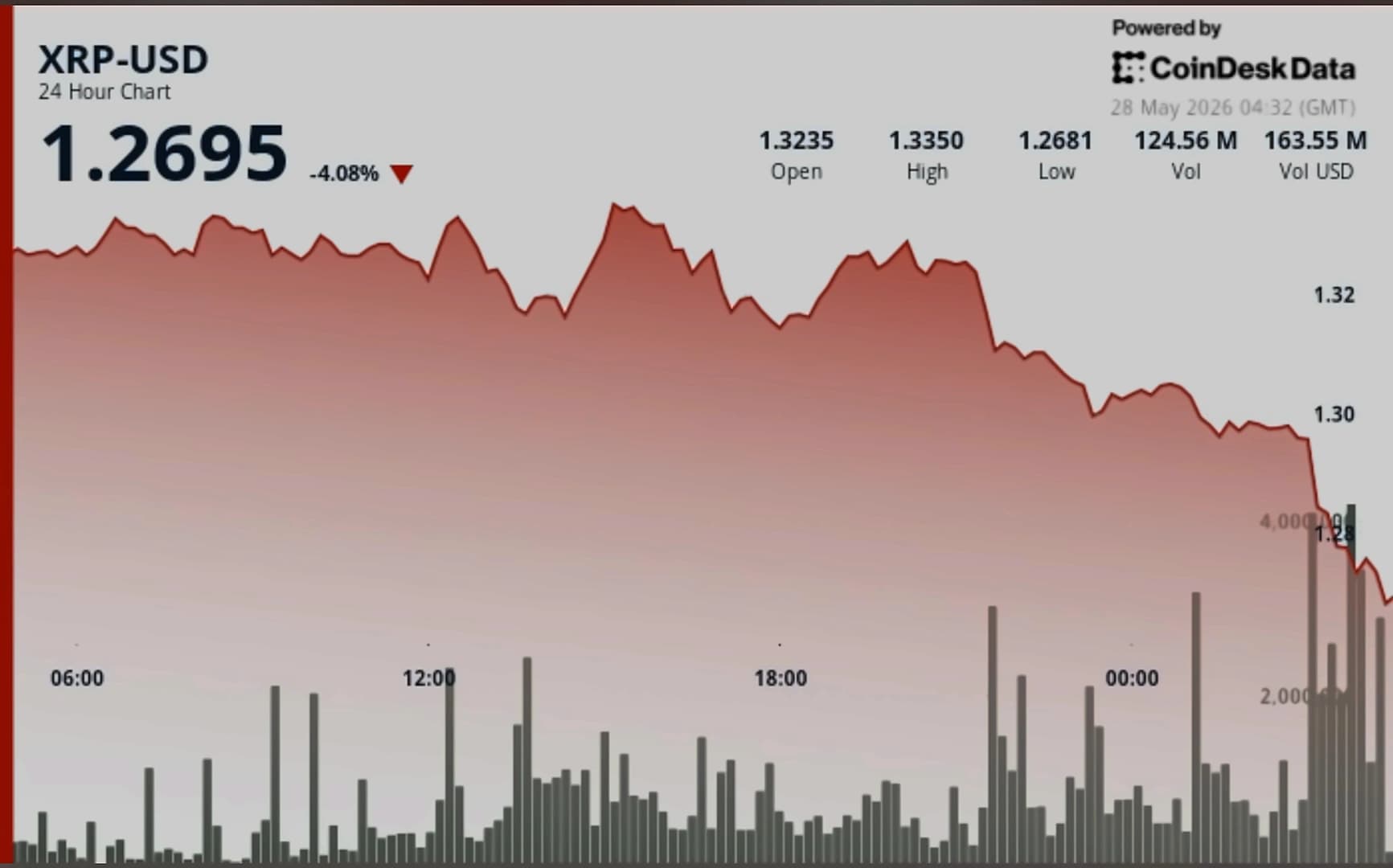
XRP fell from $1.3457 to $1.3366 during the 24-hour session while trading inside a relatively tight 1.9% range. According to reports from Crypto.news, the move came after a failed breakout attempt near $1.3620, where elevated volume quickly reversed into selling pressure. The cryptocurrency later broke below the $1.35 level and consolidated near session lows around $1.336 into the close. This breakdown reinforced short-term bearish momentum after weeks of tightening price action within a narrow trading range.
$1.30-$1.31 represents the key support zone that traders are now watching closely, as reported by Crypto.news. Losing this area would likely accelerate downside momentum toward the next major support level around $1.14. Meanwhile, $1.35 has become the immediate resistance area that XRP needs to reclaim to stabilize near-term structure. The cryptocurrency is now trading beneath several key moving averages, with resistance near $1.36 continuing to reject upside attempts. Technical analysts are now drawing Fibonacci retracement levels showing potential targets around $3.055 and $3.438 for a complete reversal pattern, while immediate support holds between $1.30-$1.35.
XRP's 12-hour chart paints a bearish head and shoulders pattern with the left shoulder forming in early March, followed by the head peak in mid-March, and the right shoulder completing in mid-May, mirroring the left shoulder structure. The neckline sits around $1.18, with the bearish pattern breathing down XRP's neck. According to Crypto.news, analysts remain split on XRP's structure, with some calling the latest move a confirmed symmetrical triangle breakdown while others still frame it as late-stage compression before a larger breakout. The repeated tests of support tend to weaken buyers over time, and XRP is now drifting back toward the same $1.30 area that traders have treated as the line between consolidation and broader breakdown risk.
On-chain data reveals a dramatic shift in market dynamics with Glassnode's Exchange Net Position Change metric showing XRP outflows surged over 300% since mid-May. The metric read -7,144,942 XRP on May 15 and dropped to -29,372,431 XRP by May 24, marking a 300%+ surge in outflows over nine days. As reported by Crypto.news, whale activity cooled sharply during the period, with large transaction counts falling more than 57% over nine days. However, recent institutional developments show massive institutional news with Brad Garlinghouse appointed to CFTC Innovation Advisory Committee and the XLS-85 Token Escrow launched on XRPL mainnet on February 12th. This institutional legitimacy development could significantly impact XRP's long-term trajectory.
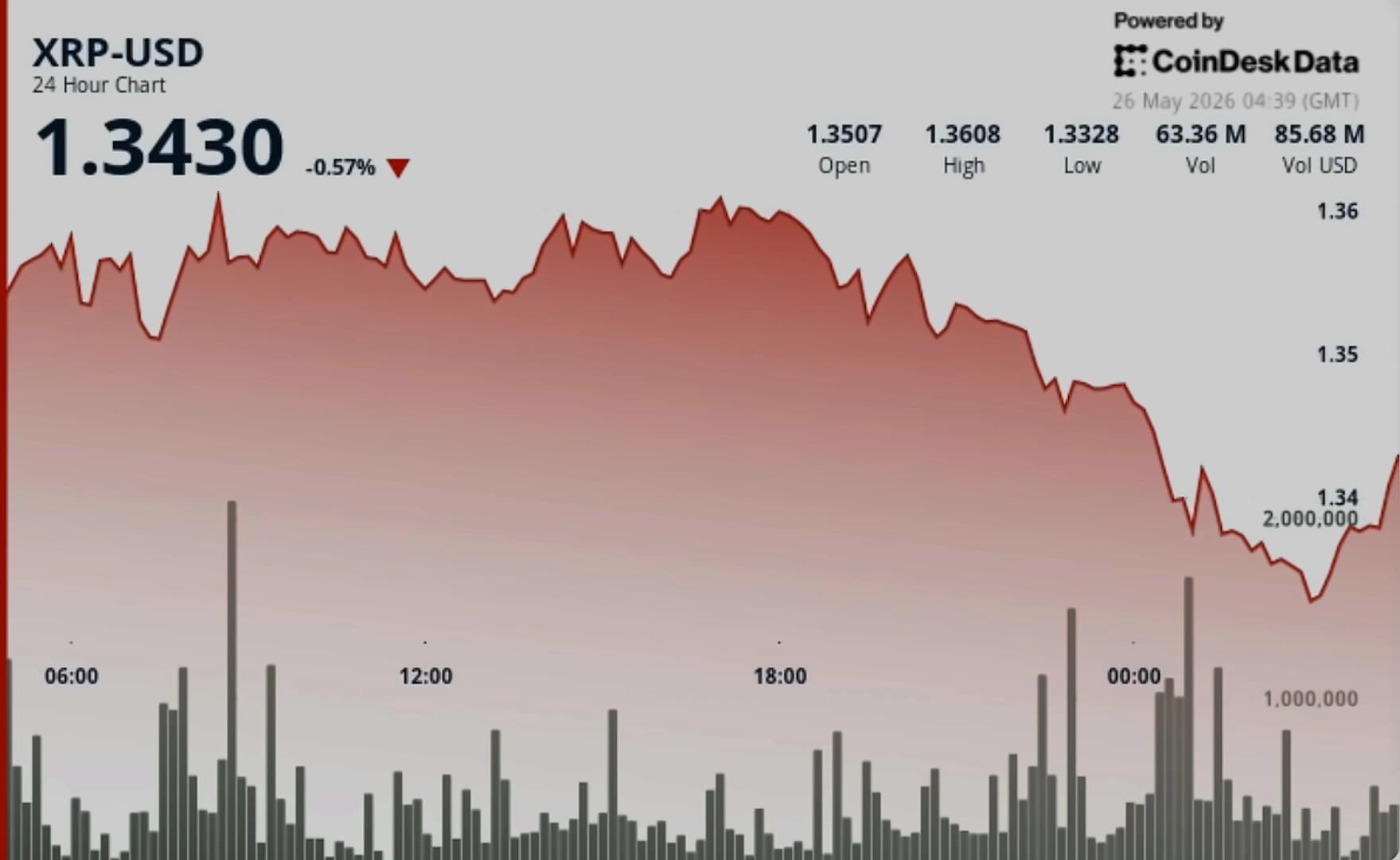
Derivatives data reinforces the range-bound thesis with Santiment data showing XRP open interest dropped from $1 billion to $914.19 million since May 15. Total funding rates on long positions also dropped from 0.008% to 0.003%, representing a 62% drop in long funding rates that reduces the risk of cascading long liquidations. The trend has been steady rather than spiky, pointing to a deliberate buying campaign. XRP trades at $1.35 on May 25 with the chart still in the bearish setup. A move below $1.34 followed by $1.28 increases drop risk, while bigger weakness emerges below the $1.21 and $1.18 levels. The 300% surge in outflows and reduced derivatives leverage suggest potential for a tug of war between accumulation pressure and bearish pattern formation.