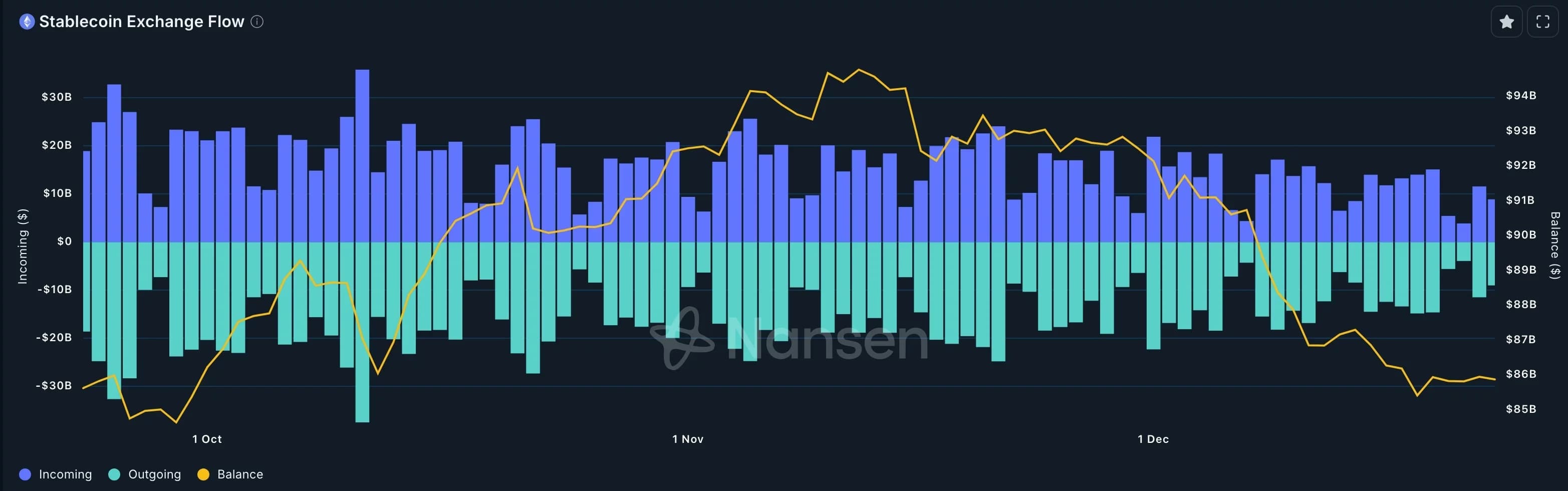
The stablecoin market has undergone a fundamental transformation, moving from issuance competition to distribution battles. According to reports from CoinDesk, the total stablecoin market has reached approximately ₹26.4 lakh crore ($316 billion) as of mid-2026, with Tether's USDT holding 59% market share at ₹16.4 lakh crore ($187 billion) and *Circle's USDC at 24% with ₹7.5 lakh crore ($75 billion)**. The structural shift is that stablecoin competition has moved from issuance, which is now commoditized, to distribution: who controls the payment rails, merchant integrations and regulatory licenses that determine where a stablecoin can actually be spent. As market cycles evolve, the next bull run is expected to be driven by institutional flows via ETFs and macro rate cuts, with stablecoin supply growth spiking above 30-day averages serving as key indicators.
According to NGPES, a French fintech group building regulated payment infrastructure between traditional finance and digital assets, stablecoin infrastructure investment could reach $7 billion to $8 billion in 2027 as institutional capital moves toward regulated payment, settlement and compliance systems supporting digital currencies. The projections form part of the company's outlook for a stablecoin market where investment is increasingly directed toward payment rails, institutional custody, treasury platforms, compliance technology and reserve management systems. NGPES President Suren Hayriyan stated that "The investment story around stablecoins has fundamentally changed. Five years ago, investors were asking which stablecoin would win. Today, they are increasingly asking which regulated infrastructure will enable institutional adoption." The company based its projections on publicly announced venture investments, strategic financings and infrastructure transactions across the stablecoin sector, with deal sizes estimated to have increased between 30% and 40% during 2025 and potentially another 25% to 30% in 2026.
On August 17, 2026, the US Treasury Department published a Notice of Proposed Rulemaking (NPRM) relating to section 3 of the GENIUS Act, defining who must obtain a federal license to issue stablecoins in the United States. The text opens a 60-day public consultation with a response deadline set for mid-October 2026. Treasury Secretary Scott Bessent justifies the current approach, stating these new rules must provide companies with regulatory certainty necessary to innovate and strengthen the dollar's role as the world's reserve currency. The GENIUS Act must come into force on January 18, 2027, but no final rules have yet been finalized, creating a rare situation for financial regulation of such magnitude. The regulatory clarity is essential for unlocking institutional capital and legitimizing decentralized finance for mainstream users.
Institutional adoption has already moved into payment and banking systems, with Standard Chartered launching USDC access for eligible institutional clients in July through its banking platform, allowing them to mint and redeem the stablecoin without maintaining a direct Circle account. Around the same period, BNY added USDC services covering minting, redemption, custody and transfers through its Digital Asset Custody platform. According to NGPES, transaction activity relative to circulating supply could increase about 130% to 140% during 2026 and as much as 200% in 2027. Industry estimates cited by the company put identifiable real-world stablecoin payment activity at about $390 billion during 2025, covering goods and services, remittances and corporate settlements. A Paybis report found in June that stablecoins represented 86% of its crypto volume, while B2B clients generated 97.8% of stablecoin volume through April, with the company's survey finding that 22.5% of businesses already used stablecoins for cross-border payments or planned to do so within 12 months.
According to NGPES, global stablecoin market capitalization could rise to about $450 billion by 2027, with the company expecting it to approach $450 billion in 2027 and potentially reach between $2 trillion and $3 trillion by 2030 under a high-adoption scenario. However, recent market data shows stablecoin capitalization has fallen to approximately $305 billion, indicating some market consolidation. The company expects payment and settlement activity to remain the more important measure as stablecoins find uses in cross-border payments, corporate treasury management, business-to-business settlement, remittances and tokenized financial markets. Latin American payment volumes could rise between 55% and 65% in 2026 before increasing another 45% to 50% in 2027, while African markets could see stablecoin payment volumes rise 65% to 80% in 2026 and another 50% to 65% in 2027**. White-label stablecoin infrastructure could account for 15% to 20% of issuance volume by the end of 2026 and between 25% and 30% by the end of 2027**, allowing financial institutions to offer stablecoin products using existing regulated infrastructure.