Solana experienced a significant operational disruption when a routing failure at Teraswitch's Miami facility caused 28.83% of the network's staked tokens to go offline, bringing the smart contract blockchain close to complete operational failure. The incident left only 4.51 percentage points, or roughly 19.9 million SOL, before hitting the crucial 33.34% finality threshold where finality would have stopped entirely. As reported by AMBCrypto, the glitch originated from a bad internet route at Teraswitch's Miami facility and subsequently spread through an internal relay in Amsterdam, affecting 12 sites from London to Tokyo while North America remained unaffected. According to Solana Foundation technology executive Jacob Creech, 597 of 699 staked Solana validators kept voting while the network continued producing blocks normally, with affected validators recovering within 40 minutes. The incident highlighted how quickly a single routing failure can cascade across multiple global data centers, demonstrating the interconnected nature of Solana's validator infrastructure.
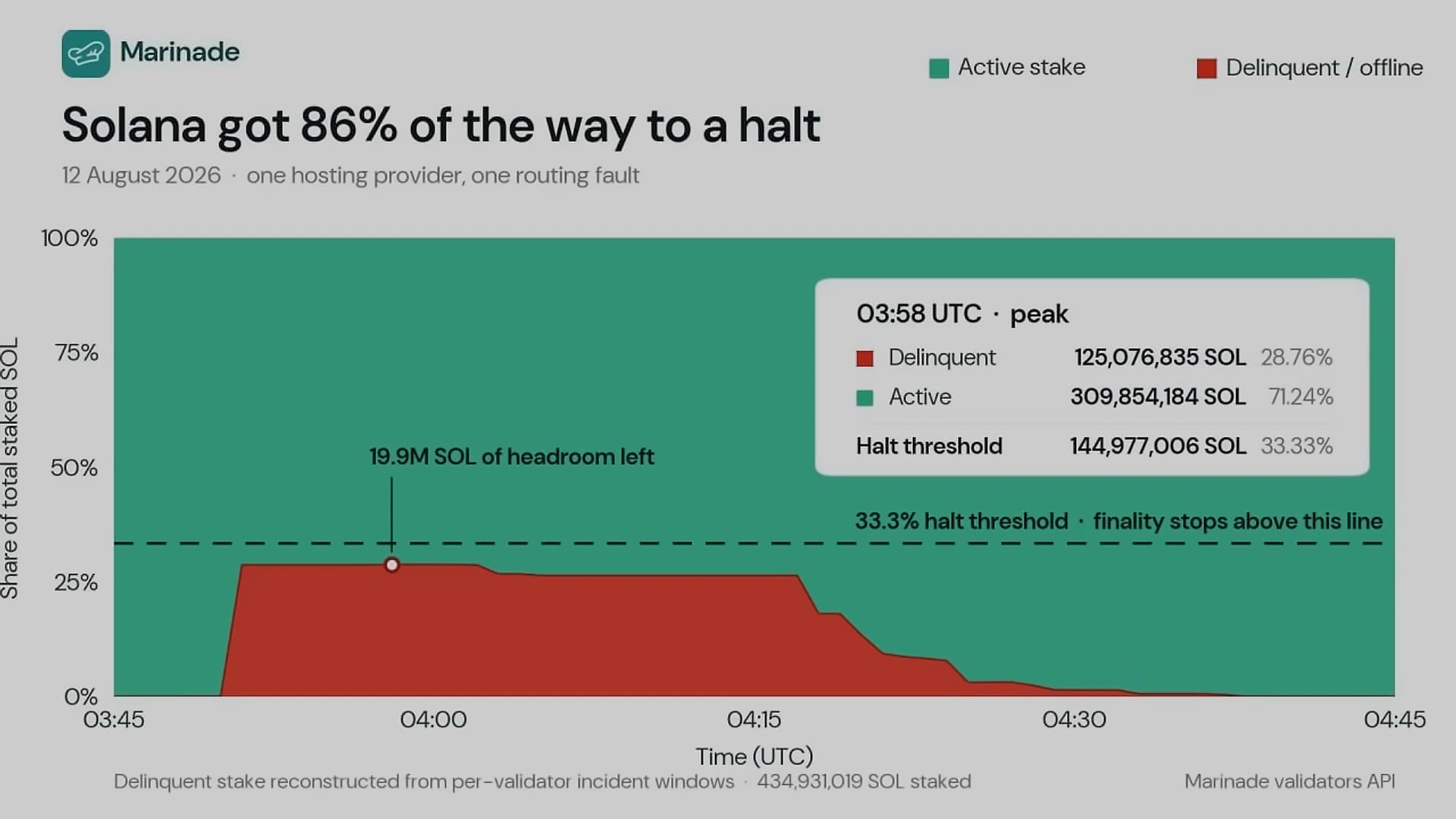
The incident affected approximately 90 validators and collectively resulted in 333 SOL in lost rewards, which is a relatively small amount that will be covered by validator bonds. The company resolved the issue within approximately 10 minutes, with full recovery taking 40 minutes total. Despite the near-freeze incident, SOL trades near $76.46, up 0.6% on the day, as the market largely shrugged off the operational disruption. As reported by Solana Foundation, validators in the Solana Foundation Delegation Program were unaffected, and the network's official status page recorded no mainnet incident on August 12 and showed 100% Mainnet Beta cluster uptime over the previous 90 days.
The incident revealed significant concentration risks in Solana's validator infrastructure, with one single network operator identified as AS20326 controlling 27.34% of all locked tokens. During the fault, 94% of that stake went offline at once, exceeding the Solana-prescribed safety limit of 25% per autonomous system number. Other companies lost an additional 14 million tokens in the same short period, with Marinade Finance noting that provider labels clearly miss some shared points of failure. Most affected validators, including major operator Helius, remained offline for the full 33 minutes because their backup systems failed to activate, with only three of 74 validators successfully switching to secondary sites. This incident serves as a warning about network centralization risks for one of the leading smart contract blockchains with $4.3 billion locked in DeFi.
Despite operational challenges, Solana continues to advance its infrastructure capabilities with the expansion of DoubleZero Edge, which has integrated real-time order book data from Kalshi's CFTC-regulated prediction markets. This integration delivers Level 1 and Level 2 order book data directly to institutional traders, enabling faster and more precise trading decisions compared to standard APIs. The integration uses a dedicated fiber transport layer to deliver live exchange and onchain data simultaneously to traders, mimicking the data distribution model used by traditional financial exchanges like NYSE and Nasdaq. Over 63% of Solana's mainnet stake has already migrated to DoubleZero, highlighting strong adoption and signaling deeper collaboration between Solana and Kalshi's tokenized markets. The move blurs the line between traditional financial infrastructure and blockchain technology, enhancing execution quality for sophisticated traders.