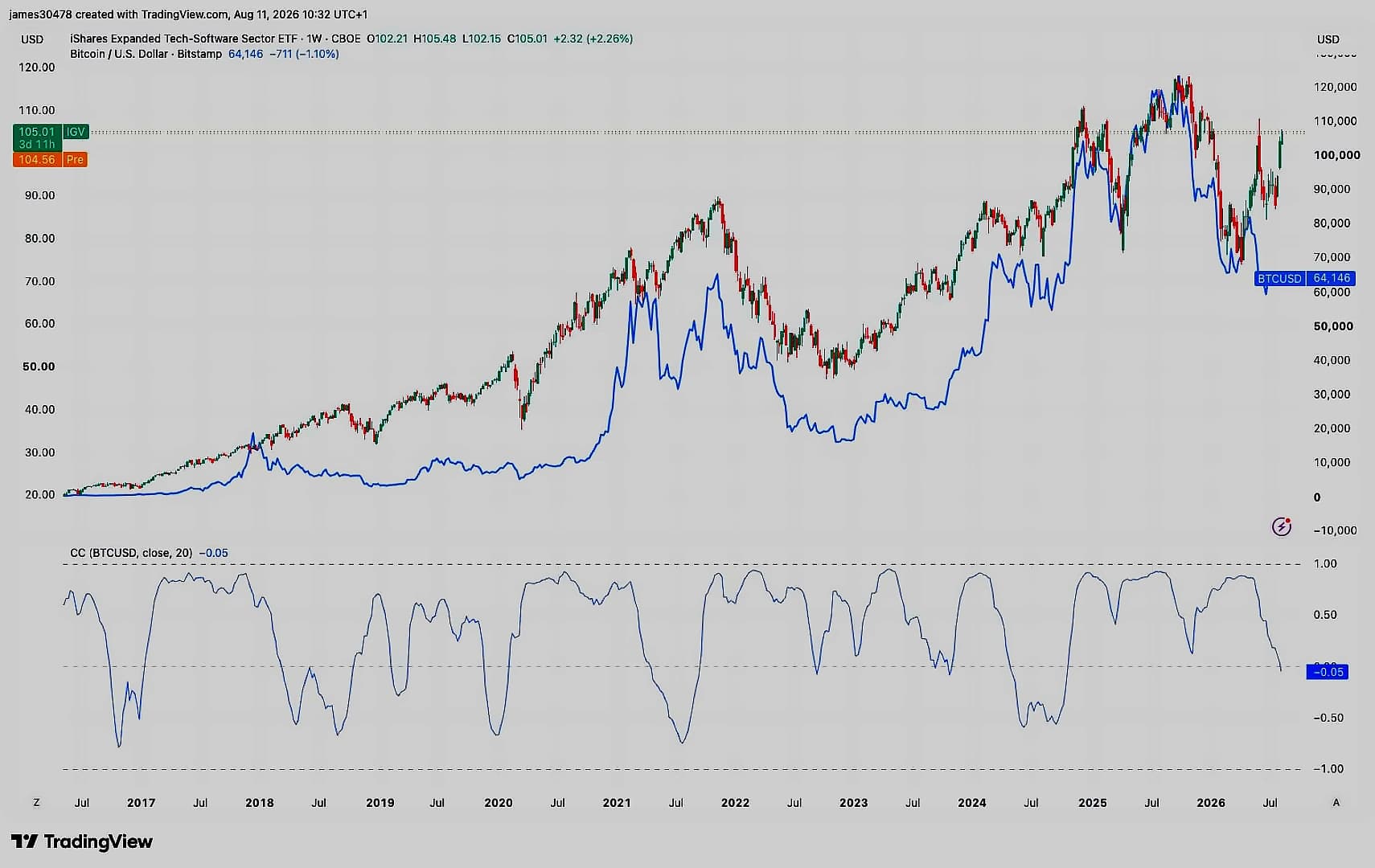
Software stocks are breaking away from bitcoin's traditional correlation pattern, with IGV hitting a one-year high against bitcoin at the 0.0016 mark. According to reports from CoinDesk, this represents a significant shift from their years-long relationship, as bitcoin and IGV traded largely in lockstep until May 2024. The 20-day rolling correlation has turned negative for the first time since May 2024, marking a fundamental change in their relationship dynamics. This divergence is particularly striking given that IGV is down just 1% in 2026 while bitcoin has dropped 29% over the same period, a gap that would have looked implausible just a couple of years ago when the two moved almost in step. The 0.0016 ratio between IGV and bitcoin represents the highest reading in a year, according to CoinDesk data, meaning software equities are gaining ground against bitcoin at a pace not seen since last summer.
The divergence is evident in their respective performance metrics. IGV has surged 40% from its April 2026 low when fears of an AI-driven "SaaS apocalypse" swept the sector, while bitcoin remains down 29% in 2026. As reported by CoinDesk, the ETF is now just 13% below its all-time high, while bitcoin is around 50% below its all-time high. This performance gap reflects the market's tendency to treat bitcoin as a software-like risk asset, with the contrast being particularly stark given that IGV climbed 40% from its April 2026 low following the AI-driven selloff, while bitcoin has failed to recover from its decline. The recovery has been forceful enough that IGV now sits just 13% below its all-time high, compared with bitcoin's roughly 50% gap from its own peak. Recent data shows that Datadog (DDOG) has significantly outperformed the broader market, gaining 99.2% over the past year while the S&P 500 Index rallied 21.3%, and 91.8% year-to-date compared with the index's 13.3% gain.
Datadog's impressive performance demonstrates the broader strength in cloud software stocks. With a market capitalization of approximately $83.3 billion, the New York-based company has delivered exceptional results as a cloud-based observability and security platform. Revenue grew 35.6% year over year to $1.12 billion in Q2 FY2026, while non-GAAP net income per share rose 41.3% to $0.65. The company has raised its full-year revenue guidance to $4.45 billion to $4.47 billion and non-GAAP net income per share of $2.50 to $2.54. For the current fiscal year ending in December 2026, analysts expect DDOG's diluted EPS to increase 57.1% to $0.66. Despite strong earnings that topped expectations, shares fell 19% on the day of Q2 earnings release before rebounding 2% in the following session, as investors focused on a flagged usage decline from its largest customer. The company has surpassed consensus EPS estimates in each of the past four quarters, demonstrating consistent earnings momentum.
According to CoinDesk analysis, similar negative-correlation episodes have appeared during bitcoin's 2018 bear market, the Covid shock in 2020, and China's bitcoin mining ban in summer 2021. Each time, bitcoin eventually caught up and the correlation turned positive again. However, the current situation differs as bitcoin was dragged into the software selloff after IGV dropped 40% from its fourth-quarter 2025 peak. The 20-day rolling correlation between bitcoin and IGV has turned negative for the first time since May 2024, meaning the two assets are now frequently moving in opposite directions rather than together. The question remains whether this represents a lasting split between digital assets and technology equities, or whether historical patterns will repeat with bitcoin eventually catching up to the broader tech trade. As CoinDesk notes, the divergence started in May 2024, with IGV rallying after fears of an AI-driven SaaS apocalypse eased, while bitcoin declined - a pattern that has continued through 2026.