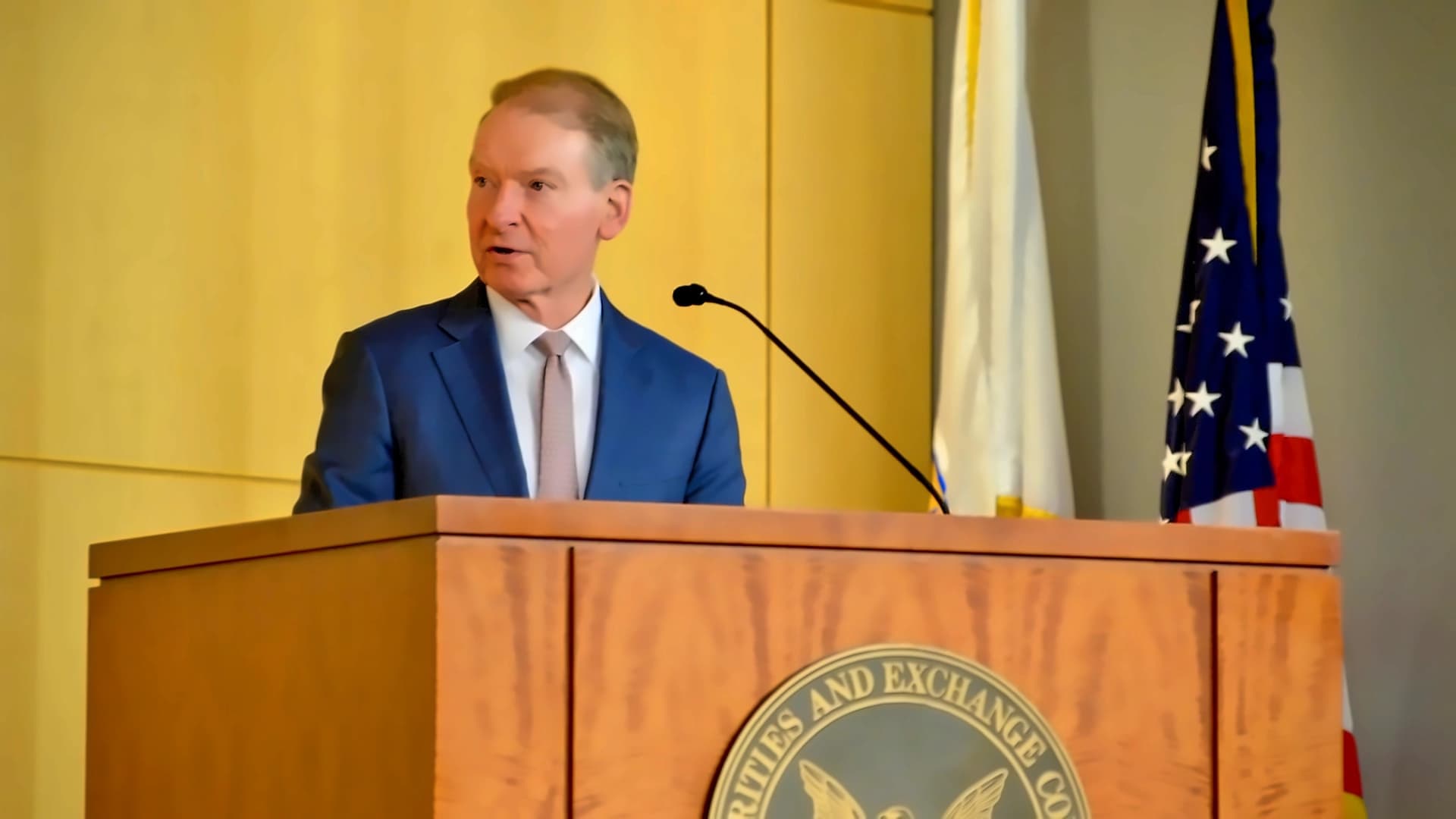
The U.S. Securities and Exchange Commission has officially released new rules on October 1 establishing a compliance pathway for crypto asset custody for investment advisers and regulated funds, while the Commodity Futures Trading Commission is proposing a pair of related rules to govern trading of crypto that's leveraged, margined or financed on Monday. According to reports from CoinDesk, the SEC proposal aims to provide clear regulatory guidance for investment firms handling digital assets, replacing the uncertainty created by outdated custody rules. SEC Chairman Paul Atkins admitted this week that federal securities rules have failed to keep pace with Bitcoin's rapid growth since its launch in 2008, emphasizing that the new framework would give investment advisers and funds a clear regulatory pathway for crypto asset custody. As Atkins stated, the proposal would provide a clear regulatory framework for the custody of crypto assets, giving investment advisers and funds a compliant pathway where none existed before - replacing the grey of uncertainty created by custody rules crafted for a bygone era. The CFTC's new rules, dubbed Regulation Crypto Asset Transactions (Regulation CTX) and Regulation Crypto Asset Markets (Regulation CAM), establish a new category of platforms known as crypto asset markets (CAMs) that would handle transactions with leverage, margin or financing, while the SEC's framework covers registered investment advisers, registered investment companies and business development companies, removing custody barriers that restrict crypto-related investment advice.
The new rules would clarify several key aspects of crypto custody operations, establishing specific operational requirements for qualified institutions holding customer crypto assets. The proposal amends the Investment Advisers Act and the Investment Company Act to create clearer custody rules for digital assets, allowing registered investment advisers and regulated funds, including mutual funds, to hold crypto under a framework built for today's market instead of decades-old guidance. The framework covers recordkeeping, federal disclosures, and audit standards for investment advisers and regulated funds. The proposal would also allow advisers to let clients self-custody crypto assets under specific conditions and formally authorize state-chartered trust companies to serve as custodians, expanding beyond the traditional banks and broker-dealers that held that role. However, as reported by CoinDesk, the conditional self-custody provision requires advisers to first determine that no permitted custodian is available for a given crypto asset, and repeat that determination quarterly - creating a scarcity exception rather than a standing election between equally available custody options. This quarterly record-keeping requirement ensures that advisers document their efforts to find qualified custodians and the specific circumstances justifying self-custody. The decisive test is how an independent party reconciles onchain control, books and client entitlements - requiring more than just wallet balances to establish actual custody, as a copied private key can move assets without leaving physical evidence.
The CFTC's comprehensive approach establishes crypto asset markets (CAMs) as a new category of platforms that would handle transactions with leverage, margin or financing, while crypto activity associated with leverage, margin or financing would fall into the CFTC's regulatory world under the rules. According to CFTC Chairman Mike Selig, the agency is proposing two regulatory pathways as a 'comprehensive regulatory framework' — one that directly handles transactions and another that governs the firms hosting the activity. The new crypto asset markets would be narrow form of the existing designated contract markets (DCMs) that are CFTC-regulated exchanges, with many of the major platforms already registered as designated contract markets (DCMs) such as Coinbase, Crypto.com and Bitnomial, and also prediction markets Kalshi and Polymarket. The CFTC's actual delivery exemption will also allow for transactions to be exempt that involve the real exchange of assets in less than 28 days. The new CAM regulatory status is meant as an option that exchanges can pursue, akin to the tailored types of charters available in the regulated banking sector, but they'll be held to the kind of standards already in place for other registrants, including a prohibition against listing products that could be vulnerable to manipulation and 'proof-of-reserves' demands for exchanges that keep customer assets in omnibus accounts. Selig described the framework as an option for firms seeking a single federal market regulator, noting that participating exchanges could offer retail customers margined, leveraged or financed crypto trading, activities he distinguished from ordinary spot transactions on state-licensed platforms. Under the proposed rules, the CFTC would establish a new category of CFTC-regulated trading venues called a 'crypto asset market' for exchanges that offer leveraged or margined trading to retail customers, with those platforms subject to specific requirements including anti-market-manipulation controls and a 'proof of reserves' obligation. The CFTC is also proposing that registered futures commission merchants intermediate customer trades on the new category of exchanges, and any exchange offering a leveraged transaction would have to clear that product with CFTC staff, with the agency not stipulating specific leverage limits.
The CFTC has opened public comment on Monday for new crypto trading rules that exchanges could choose to join, with Chairman Mike Selig citing FTX's $8 billion fraud as the reason to act early. As reported by CoinDesk, the notice covers retail crypto trades made with borrowed money or platform financing, which federal law already requires to run on a CFTC-regulated exchange, but the agency now wants crypto-specific rules, including a new exchange category called a 'crypto asset market'. Selig emphasized that "Under my leadership, the Commission will take every necessary step to establish regulations that are designed to prevent, rather than only prosecute after the fact, fraudulent schemes such as FTX." The CFTC regulates futures and other bets on commodity prices, yet the one FTX unit it oversaw kept customer money safe, while about 130 sister companies went bankrupt. According to the Wall Street Journal, Selig stated that the rules would not force crypto onto CFTC platforms, as the agency lacks that power without Congress, where the stalled CLARITY Act failed in the Senate. The proposed rules make use of a specific authority the CFTC has to oversee margined or leveraged spot assets, with the CFTC having long sought authority to regulate spot cryptocurrency markets — which currently operate in a regulatory grey area — but only Congress has the ability to provide the regulator with that purview. The new rules would allow registered exchanges to offer retail traders leverage and margin, which state money transmitter licenses, the kind FTX relied on, do not allow. In return, under the proposed framework, registered exchanges must keep customer money separate, watch for manipulation, and limit conflicts of interest. The proposed framework comes after Congress failed to move forward with the Clarity Act, a major cryptocurrency bill that sought to establish a clearer regulatory framework for the roughly $2 trillion crypto market.
The regulatory advancement has received overwhelmingly positive reception from industry analysts and market participants. Analyst Dan Gambardello described the proposal as "the unlock institutions have been waiting for," noting that "for years, old rules built for stocks and bonds left firms with no compliant path to hold Bitcoin and other crypto for clients." ETF analyst Nate Geraci called the update "a breath of fresh air for regulators to support innovation & actually let the crypto industry breathe." Current third-party custodians like Coinbase and Fidelity already support ETFs and funds with Bitcoin and Ethereum, and the rules will help harmonize rules and expand coverage for smaller and new crypto assets. The proposal comes as funds and ETFs hold 1.44 million BTC, or 7% of the supply, but individuals still dominate at 66.6%, or 13.9 million BTC. The regulatory clarity is particularly significant given that until now, there has been fragmented regulatory clarity for third-party custodians to support crypto assets, with the proposed rule changing the current status quo and expanding coverage beyond major players. The public comment period remains open for 60 days after Federal Register publication, allowing stakeholders to provide feedback on the proposed framework. Bitnomial has already launched leveraged retail spot crypto trading in December 2025 and is the first crypto-native US exchange to hold all three CFTC licenses for this business, with Kraken parent Payward agreeing in April to buy Bitnomial for up to $550 million. However, analysts have noted that without legislation, regulations could be vulnerable to the shifting political climate and court challenges, creating lingering hazards for the crypto industry.
The custody rules release coincides with Commissioner Hester Peirce's official departure this Friday, marking the end of her tenure as head of the agency's Crypto Task Force, while the CFTC is currently led by only Republican commissioners as President Donald Trump still hasn't offered any nominees to fill each five-member commission. According to reports, Peirce, who has led the Crypto Task Force since its inception, will leave on Friday to become a professor in Virginia, leaving the SEC with just two commissioners. The impasse in Congress has put the onus on US President Donald Trump's crypto-friendly regulators, particularly the Securities and Exchange Commission and the CFTC, to give the industry the regulatory clarity it has long argued it lacks. CFTC Chairman Michael Selig stated at a Fordham University event that "For years, entrepreneurs building on the new frontier of finance faced uncertainty about whether there was a place for them in our markets. We are giving them an answer." However, the CFTC's effort may continue to leave a significant gap because of the regulator's missing authority to oversee spot markets - the direct trading of crypto in which the assets change hands in their original form at current market prices, without leverage or margin considerations. Since the Digital Asset Market Clarity Act stalled in the U.S. Senate last month, the CFTC has been moving forward on crypto policies to make up for the absence of a new U.S. market structure law. Following the Senate's failed CLARITY Act vote, House Financial Services Committee Chair French Hill and House Agriculture Committee Chair Glenn Thompson supported agency action under existing law, while noting that Congress alone could provide lasting statutory certainty.