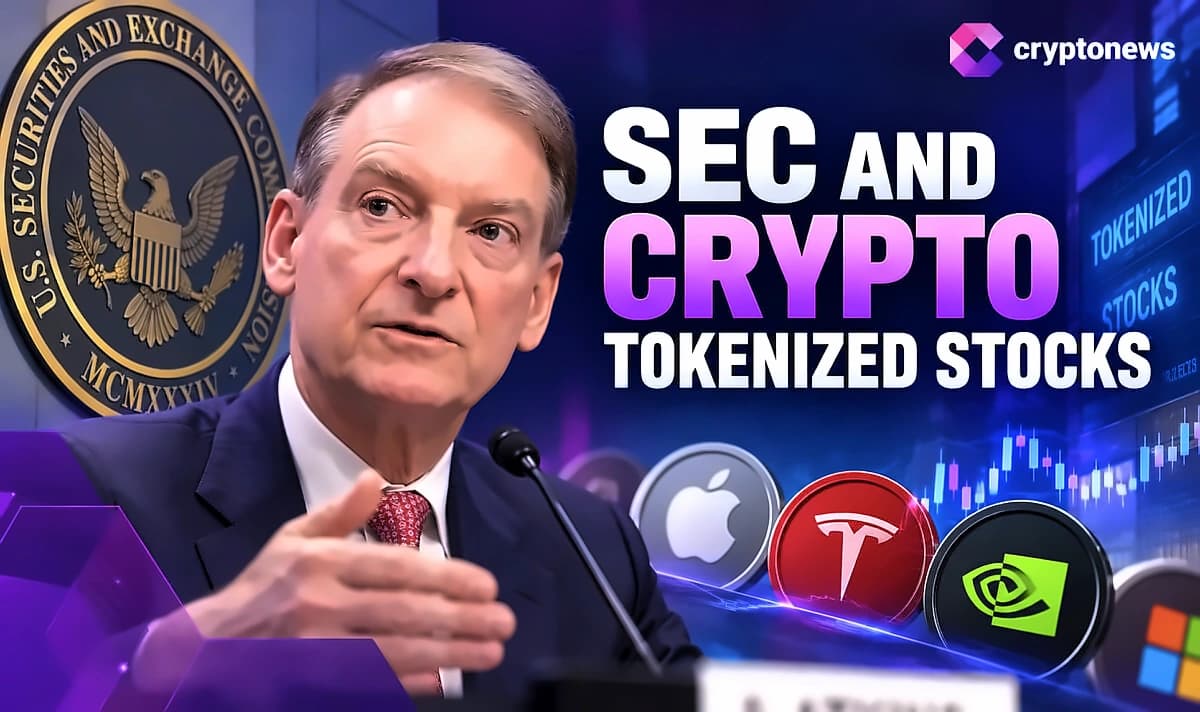
The U.S. Securities and Exchange Commission has issued a five-year exemption allowing blockchain platforms to list and trade tokenized stocks through permissioned automated market makers and liquidity pools. According to the latest SEC statement, this formal pathway follows the U.S. Senate's failure to advance the Digital Asset Market Clarity Act, which fell short of the 60 votes needed to proceed. The exemption comes with eligibility requirements, trading caps, transparency rules, and other safeguards that keep the experiment inside a controlled perimeter, ensuring this is not a blanket green light for open-access decentralized finance. The SEC's goal remains greater clarity on how existing securities law applies to crypto assets, not a redesign of what counts as a security in the first place. SEC Chair Paul Atkins described the exemption as designed to resolve challenges that have prevented responsible innovation from taking root in the United States while providing investor protections and market integrity standards.
TD Cowen expects limited near-term adoption of tokenized stocks despite the new SEC framework, with Reid Noch, vice president of U.S. equity market structure at TD Cowen writing that "U.S. investors already have efficient access to the underlying shares, and tokenized venues must offer a compelling benefit to offset limited liquidity and additional operational complexity." The SEC framework allows trading through automated market makers (AMMs) rather than traditional order books, with AMMs holding pools of assets and using preset rules to price trades, potentially allowing stock tokens to trade around the clock. However, Noch notes that round-the-clock trading does not necessarily mean better trading, as thin liquidity can produce poor prices. Issuer interest remains minimal, with TD Cowen's conversations with dozens of issuers revealing minimal interest in tokenizing their stocks outside crypto-adjacent companies such as Figure. Figure's Nasdaq-listed FIGR shares trade alongside blockchain-native FGRS shares, yet 99.9% of Figure's notional trading took place through its traditional listed shares during a 24-hour period examined by TD. For American investors, TD Cowen's concern centers on whether tokenization improves a market that already offers deep liquidity, low-cost brokerage services and fast electronic execution. Blockchain-based venues could extend stock trading into nights, weekends and holidays, but U.S. exchanges generally operate their main sessions between 9:30 a.m. and 4 p.m. Eastern Time on weekdays, with several brokers already providing premarket and after-hours access.
The five-year exemption covers tokens representing direct security ownership, requiring dividend and voting rights for token holders and a 30-day issuer notice for third-party tokenizations. As reported by Reuters, the framework excludes derivative-like security tokens and debt instruments that do not convey direct ownership, potentially leaving out some offshore-style products. The exemption applies to tokens that represent actual ownership of underlying securities rather than synthetic products, with tokenized shares must carry the same rights and privileges as the traditional share it represents. Tokenized National Market System stocks must grant holders the same rights and privileges as matching traditional shares, including economic interest, dividends, voting power, and liquidation rights. Synthetic tokens that offer stock exposure through derivatives do not qualify, according to an SEC official. Before a third party tokenizes a company's shares, the SEC framework requires the proposed venue to notify the issuer. The company then has 30 days to object, according to the TD Cowen paper. Listed businesses therefore retain some control over whether unrelated operators create blockchain versions of their securities, with trading unable to proceed when an issuer objects. Each approved venue will face limits on the number of stock symbols it can support and the amount of trading activity it can process, giving the SEC a controlled setting to observe onchain stock markets.
Perpetual futures are emerging as the stronger demand story for crypto-based stock exposure, with TD finding that 96% of Nvidia-related notional volume in a Binance snapshot came from perpetual futures, compared with 4% from spot products. "As we continue to outline, we see perpetual futures as the stronger demand story," Noch wrote, noting that platforms are expected to continue expanding these products internationally and domestically, reflecting retail investors' interest in leverage. This trend suggests that crypto traders who want stock exposure may find perpetual futures more compelling than tokenized stocks, despite the new regulatory framework. Recent filings support the comparison, with Coinbase submitting proposals for 50-plus stock perpetuals tied to companies including Nvidia, Microsoft and Tesla on September 18. The exchange plans to offer 24-hour trading from Monday through Friday if U.S. regulators clear the contracts, providing leveraged price exposure without voting rights, dividends or ownership of the referenced shares. Earlier in September, Ondo Finance also asked the SEC and Commodity Futures Trading Commission to apply existing security-futures rules to stock perpetuals, with its Panama-based affiliate having processed $8 billion in cumulative volume within about six weeks, according to Ondo's regulatory submissions.
The SEC's five-year experiment gives DeFi-style trading venues, tokenization firms and liquidity providers a new U.S. pathway while leaving synthetic stock tokens outside the framework. As reported by CoinDesk, firms such as Securitize, Bullish and Superstate as well as qualifying custodial models like Dinari are positioned to benefit from the exemption. Synthetic products from Robinhood, Kraken and Ondo that only provide price exposure fall outside the framework and may need to change their product if they want to enter U.S. markets. Goldman Sachs analysts identified Coinbase as a potential beneficiary because the company already operates tokenization, custody, stablecoin and blockchain infrastructure that could support onchain equity markets. Coinbase's international tokenized stocks are backed one-for-one by real shares held in regulated, bankruptcy-remote custody, with holders having a senior beneficial claim on the underlying equity. Coinbase President Emilie Choi said during the Goldman Sachs Communacopia conference that the products already carry dividend rights and that voting options are being added. Securitize CEO Carlos Domingo told CoinDesk he expects the framework to accelerate "native tokenized securities" and eventually create multiple onchain liquidity venues for them.
Under the SEC's Innovation Exemption, approved users can trade blockchain versions of shares listed on US exchanges with specific operational constraints. Tier 1 securities, covering stocks in the S&P 500, Russell 1000 and certain highly traded exchange-traded products, are limited to 75 symbols on a TSV and 0.25% of each stock's prior-month average daily share volume. Tier 2 is capped at 250 symbols and 2.5% of prior-month average daily volume. The exemption prohibits initial share offerings, margin, and other forms of borrowed trading, ensuring the system remains conservative. A repeat breach of a stock's volume ceiling requires the venue and affiliated TSVs to stop trading that tokenized stock for three months. The framework requires smart contracts used by qualifying venues to be auditable and public while running on public, permissionless distributed ledgers. Access to the actual TSV must remain permissioned, and venues must stop token trading whenever the underlying stock is halted on its primary listing exchange. For example, Tesla — one of the most highly traded stocks — has an average daily volume of about 40 million shares. By this definition, a qualifying venue could theoretically facilitate trading in up to roughly 100,000 tokenized Tesla shares a day, which is about $36.6 million at a $366 share price. Goldman Sachs does not expect the exemption's first phase to pull substantial trading volume away from Nasdaq or Intercontinental Exchange, citing the SEC's volume caps, symbol limits, issuer objections and AMM market structure as constraints on the experiment.