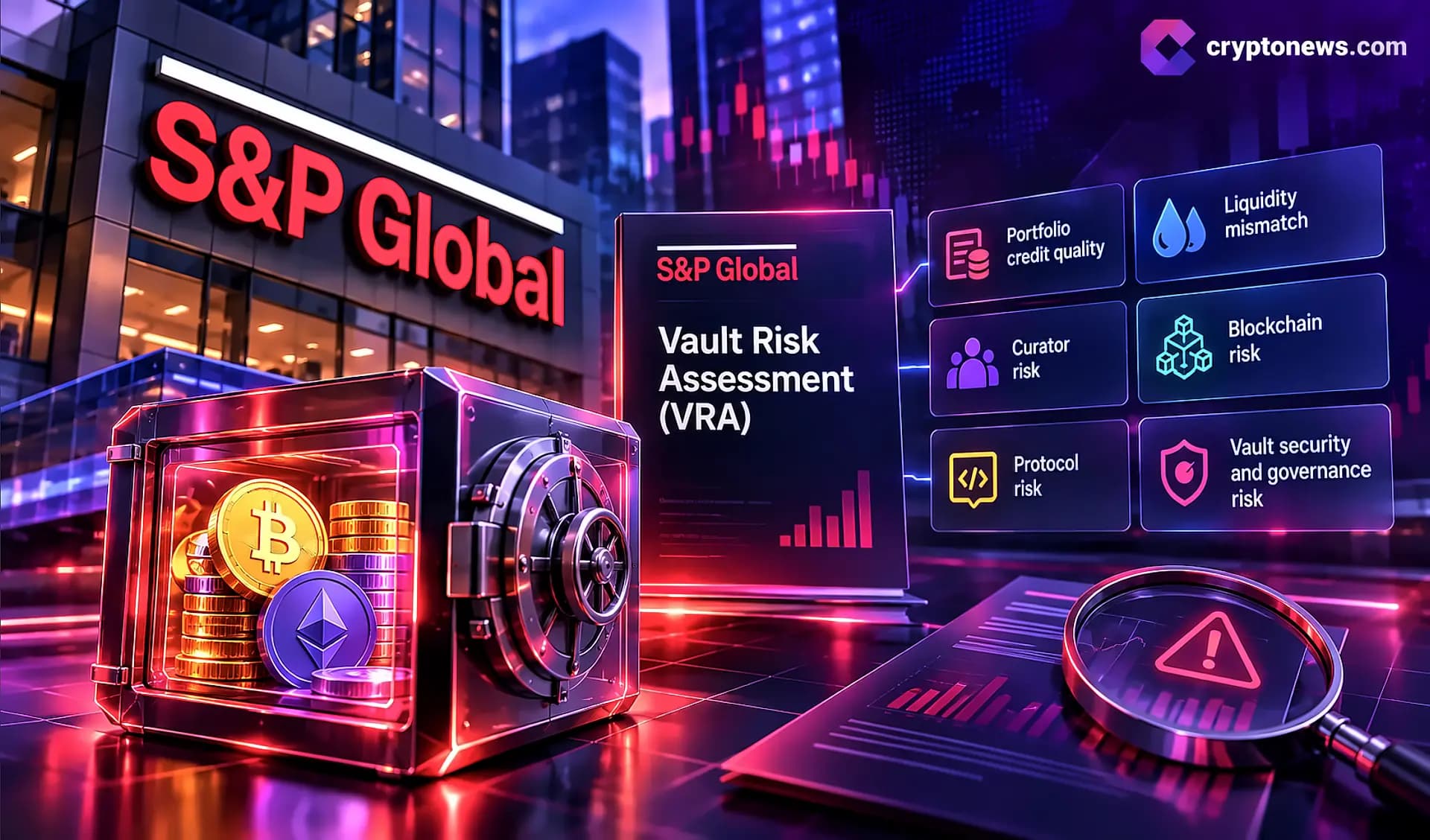
S&P Global Ratings has launched its Vault Risk Assessment (VRA), targeting the rapidly expanding blockchain lending market. According to reports from S&P Global, deposits in blockchain-based lending vaults reached approximately $10 billion in September 2026, representing a dramatic increase from $1.5 billion two years earlier. This growth trajectory implies an expansion of about 6.7 times between September 2024 and September 2026, as reported by S&P Global. The framework was officially launched on October 4, 2026, with no individual vaults receiving assessments at launch. S&P Global emphasizes that these $10 billion in deposits represent a significant milestone where counterparty questions become critical for institutional investors, with the market now holding enough capital to warrant standardized risk measurement.
The VRA provides a forward-looking assessment of six key risks that could impair investor positions in blockchain lending vaults. As reported by S&P Global, the framework evaluates portfolio credit quality, liquidity mismatch, curator risk, blockchain risk, protocol risk, and vault security and governance risk. The assessment uses a familiar letter-based scoring system with a "(v)" suffix to distinguish it from traditional credit ratings. An AAA(v) assessment represents the lowest risk level, though S&P emphasizes that even strong assessments do not guarantee against losses. The framework specifically excludes yield considerations and focuses on relative impairment risk rather than creditworthiness. Curators are the firms that decide where a vault deploys its capital, and their choices can determine whether depositors get their money back during market shocks. S&P Global's James Wiemken noted the inherent complexities and varying disclosure standards in this nascent market create a clear need for a standardized, independent risk perspective.
Digital asset vaults operate by pooling investor deposits and deploying them on blockchain networks according to defined strategies. According to S&P Global's description, these vaults function similarly to managed fixed income funds, with strategies that may be automated through smart contracts, directed by human managers, or operated through a combination of both approaches. Depositors receive share tokens representing their proportional claim on the vault's assets and accrued returns, creating tokenized ownership structures for onchain lending exposure. The $10 billion held in such structures as of September 2026 represents significant growth from the previous $1.5 billion two years earlier, with each assessment providing a forward-looking view of how likely investors are to suffer losses. The vaults are essentially blockchain-based bond funds that gather deposits and lend them to borrowers, though disclosure standards still differ from vault to vault across the sector.
S&P Global President Yann Le Pallec emphasized the company's response to growing demand for independent risk assessments connecting traditional finance with decentralized markets. As reported by S&P Global, the assessment moves beyond transaction transparency toward risk transparency, designed to help institutions strengthen investment governance and vault selection processes. The launch represents a significant development as one of the three dominant credit-rating agencies now treats DeFi lending as worthy of standardized measurement, lowering diligence friction for institutions. The VRA extends S&P's wider push into digital assets, following the company's September agreement to acquire auditor OpenZeppelin and take a stake in data provider Kaiko. Earlier, S&P issued the first credit rating for a DeFi protocol, Sky Protocol, formerly MakerDAO, and rated a structured finance deal backed by Bitcoin. Independent grades could make crypto lending vaults easier to pitch to banks and funds that require third-party risk checks, with the real test being whether curators start competing on S&P scores rather than headline yields.
The framework launch comes during a constructive period for cryptocurrency markets, with Bitcoin trading near $86,568 and Ether around $2,727 as of October 5, 2026, according to Cointelegraph reports. The broader Fear and Greed index stands at 69 in "Greed" territory, indicating positive market sentiment that typically pulls more capital toward on-chain yield opportunities. However, the assessment framework clarifies risk but does not eliminate fundamental challenges, as smart-contract bugs, oracle manipulation, governance concentration, and correlated collateral exposure remain difficult to capture in a tidy score. Recent market events demonstrate this reality, with vault risks already turning into real losses in August when a Term Labs governance exploit drained roughly $8.5 million from its vaults. Regulators have also taken notice, with SEC Commissioner Hester Peirce warning in July that crypto vaults and lending protocols may fall under federal securities law. Depositors should treat vault ratings as one input among many, as the custody question still involves handing control to contracts and admin keys, creating different risk profiles compared to holding assets directly.