Ripple CEO Brad Garlinghouse has explicitly stated he is 'not one of these people who's an XRP maximalist' and is 'bullish on a bunch of cryptos, for a bunch of reasons' when asked why someone should choose XRP over top coins like Solana and hold it for the next five years. In his latest remarks shared during a May 7 CoinDesk Live interview at Consensus Miami, Garlinghouse emphasized that 'a happy customer is #1' and described XRP and stablecoins as alternative ways to address payment needs, with customer satisfaction determining which approach makes sense. His qualification was explicit, stating that 'it could be that XRP is the best bridge asset for that purpose, or it could be that, no, a stablecoin is going to solve that problem better'. This represents a continuation of his January 22 interview position, where he used cross-border transfers as an example, saying 'a stablecoin is going to solve that problem better' in some cases. The comments have resurfaced as XRP holders debate whether Ripple's institutional growth can eventually support extreme price targets of $10, $100, $589 and $1000.
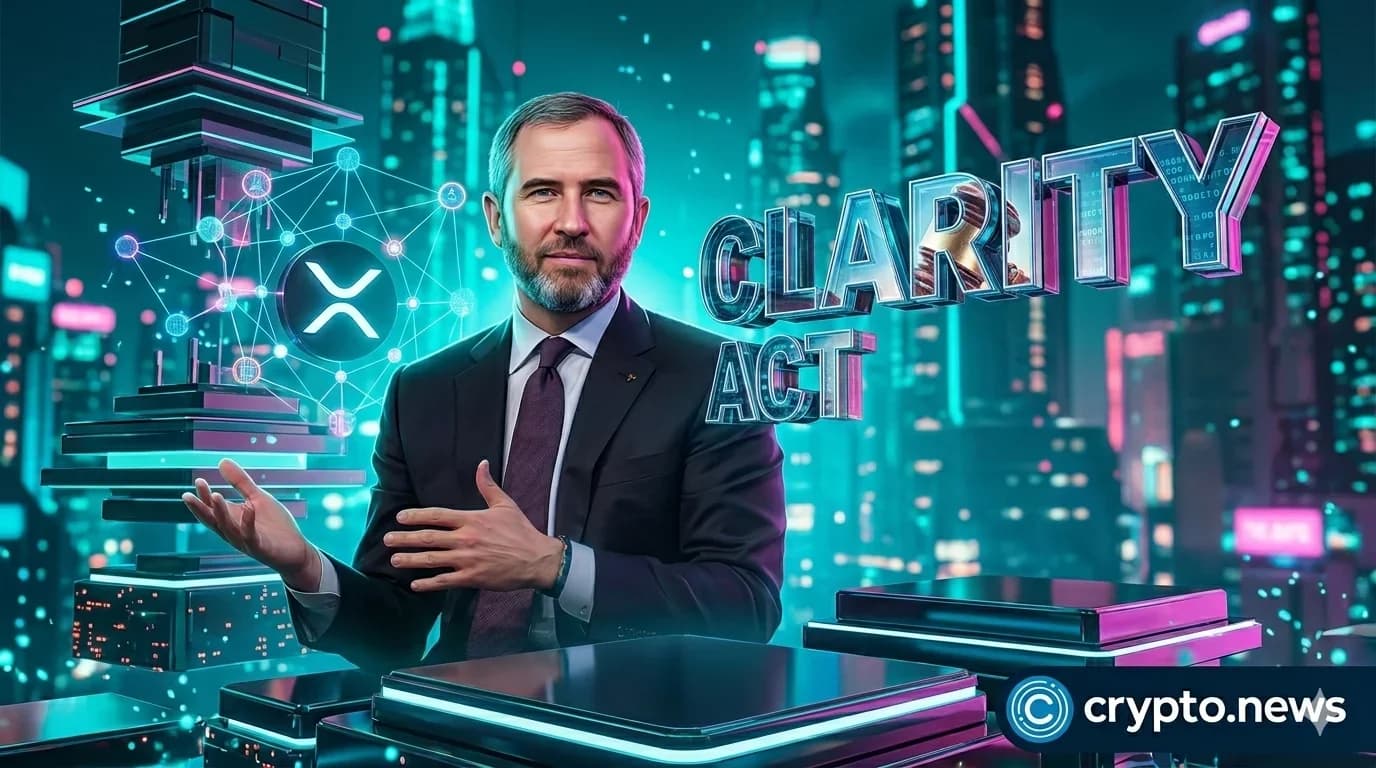
Garlinghouse laid out his case for XRP's value in the simplest terms possible when asked how the token's value connects to actual network transaction volume. 'XRP has a fixed supply, and Ripple's job is to keep growing demand against that fixed number,' he explained, pointing to basic supply and demand economics. The Ripple CEO emphasized that what actually drives a currency's value over time is trust, utility and velocity, or how liquid it is. He argued that the most liquid currencies tend to become the most valuable ones, because liquidity is what makes people want to hold an asset in the first place. For XRP, this means Ripple's focus is on pushing more real usage and liquidity through the token rather than relying on speculation alone. Garlinghouse pointed out that people tend to forget XRP was once the second most valuable cryptocurrency by market cap, before the SEC filed its lawsuit against Ripple. For him, that history is a reminder of where XRP already stood once, and part of why he remains confident it can get back there as Ripple's institutional partnerships and the token's real-world utility continue to expand.
Ripple's current payment infrastructure supports the flexibility Garlinghouse described, with the company's official Ripple Payments page stating businesses can settle transactions using RLUSD, USDC, USDT or fiat, depending on their requirements. According to Ripple documentation, the settlement layer is 'decoupled from any single issuer's token,' allowing new stablecoins to be added without rebuilding the payment infrastructure. The platform handles collections, digital-asset conversion and payouts across more than 60 markets and has processed more than ₹8,400 crore ($100 billion) in payment volume. As reported by crypto.news, Ripple CTO Emeritus David Schwartz described RLUSD as capable of acting as a bridge in some transactions while distinguishing its centralized controls from XRP's neutral asset structure. The network's flexibility means an institution using Ripple Payments could potentially settle through any currency without XRP becoming the principal asset. The same logic is playing out across the broader industry as stablecoins expand their footprint in payment rails beyond any single network.
The market responded to Garlinghouse's remarks with XRP falling approximately 6% for the day, dropping below $1.50 at the time of the report's release. The price movement coincided with Garlinghouse's remarks, reigniting interest in XRP's market positioning beyond payment narratives. XRP currently trades near $1.54 with around 62.88 billion tokens in circulation, creating a significant challenge for extreme price predictions. To reach the $10 target, XRP would need to rise roughly 550% from current levels, while $100, $589 and $1,000 targets imply valuations in the trillions. The debate over XRP's role in Ripple's payments business comes as one of the community's most extreme price theories gains renewed attention, with Dom Kwok, co-founder of developer education platform EasyA, recently posting that '$1,000 is more likely than ever'.