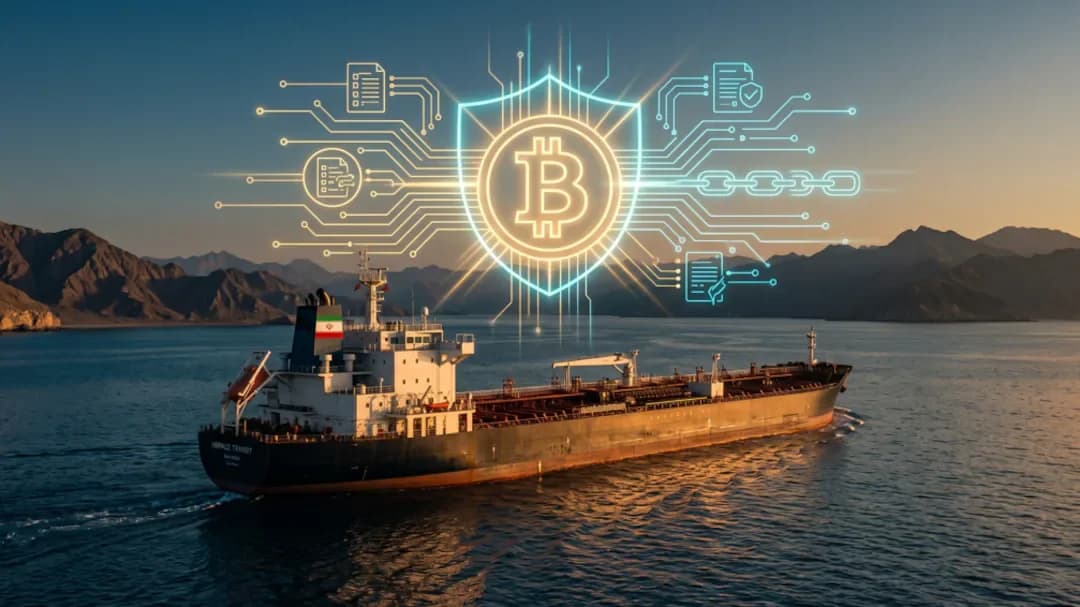
Iran's Ministry of Economic Affairs and Finance launched Hormuz Safe, a state-backed Bitcoin-settled maritime insurance platform, around May 16-18. According to reports from the semi-official Fars news agency citing documents from Iran's Ministry of Economy and Financial Affairs, the service provides Iranian shipping companies and cargo owners with digital insurance policies that are cryptographically verifiable, with premiums and claims settled in Bitcoin. Coverage begins from the moment of confirmation, with a signed digital receipt issued to the cargo owner. The platform is initially restricted to Iranian entities, explicitly excluding vessels linked to states involved in the US-Israeli conflict. As per Fars news agency, the service is described as providing "cryptographically verifiable insurance policies for shipments passing through the Persian Gulf, the Strait of Hormuz, and the surrounding waterways, with payments settled in Bitcoin."
The Hormuz Safe launch coincided with Iran's formal establishment of the Persian Gulf Strait Authority (PGSA), a new government body designed to manage traffic through the strait, collect transit fees, and designate approved shipping routes. An Iranian lawmaker made clear the mechanism would be exclusive, stating that only vessels and parties cooperating with Iran would be permitted to use the route, with those linked to US or Israeli military operations explicitly banned. According to X, the PGSA is described as the "legal entity and representative authority of the Islamic Republic of Iran for the management of traffic through the Strait of Hormuz." This dual launch represents Tehran's systematic construction of institutional architecture for long-term control over the waterway, rather than preparing for an imminent reopening. The formalization signals a structurally bearish signal on any near-term reopening timeline for oil markets.
With more than 1,500 commercial vessels trapped in the Persian Gulf as of early May, according to the US military, and oil producers cutting output as onshore storage fills, the pressure for a resolution remains acute. Iran and Oman held talks last week on a joint safe passage mechanism, though no agreement has been announced. However, the Bitcoin insurance scheme faces significant challenges in attracting foreign shipping participation due to US sanctions exposure. The website for Hormuz Safe does not appear to be accessible outside Iran, further limiting its global reach. According to X, Iranian and Omani officials held meetings last week to discuss joint efforts to "develop a mechanism" for safe passage, with Iran's foreign ministry spokesman Esmail Baghaei confirming these discussions.
Officials project that coverage could generate annual revenues exceeding $10 billion if Hormuz Safe captures meaningful traffic through the Strait of Hormuz, which handles roughly 20% of global seaborne crude. The Strait serves as a critical chokepoint for energy trade, making this Bitcoin-based insurance platform potentially significant for global trade finance. The move represents a potential redefinition of how sanctioned economies interact with crypto infrastructure, though its effectiveness remains questionable given Bitcoin's price volatility and the challenges of using cryptocurrency for insurance liability calculations. As per Fars news agency, the service is positioned as another means for the government and Islamic Revolutionary Guard Corps to raise funds through formalized traffic management and toll systems.
Iran has effectively shut the Strait of Hormuz since February 28 when the US and Israel began airstrikes against the country. The government and IRGC have been looking to formalize control over the waterway, including imposing tolls and other fees. An Iranian lawmaker, Ebrahim Azizi, head of Iran's parliamentary commission for national security, stated that "only commercial vessels and parties cooperating with Iran will benefit" and that "the necessary fees will be collected for the specialized services provided under this mechanism." The US has responded by blockading Iranian ports, while Trump issued fresh threats on Sunday telling Tehran to "better get moving, FAST, or there won't be anything left of them." The U.S. and Iran have been observing an uneasy ceasefire since early April, with the two sides repeatedly rejecting each other's demands and unable to agree on how to restart peace talks.