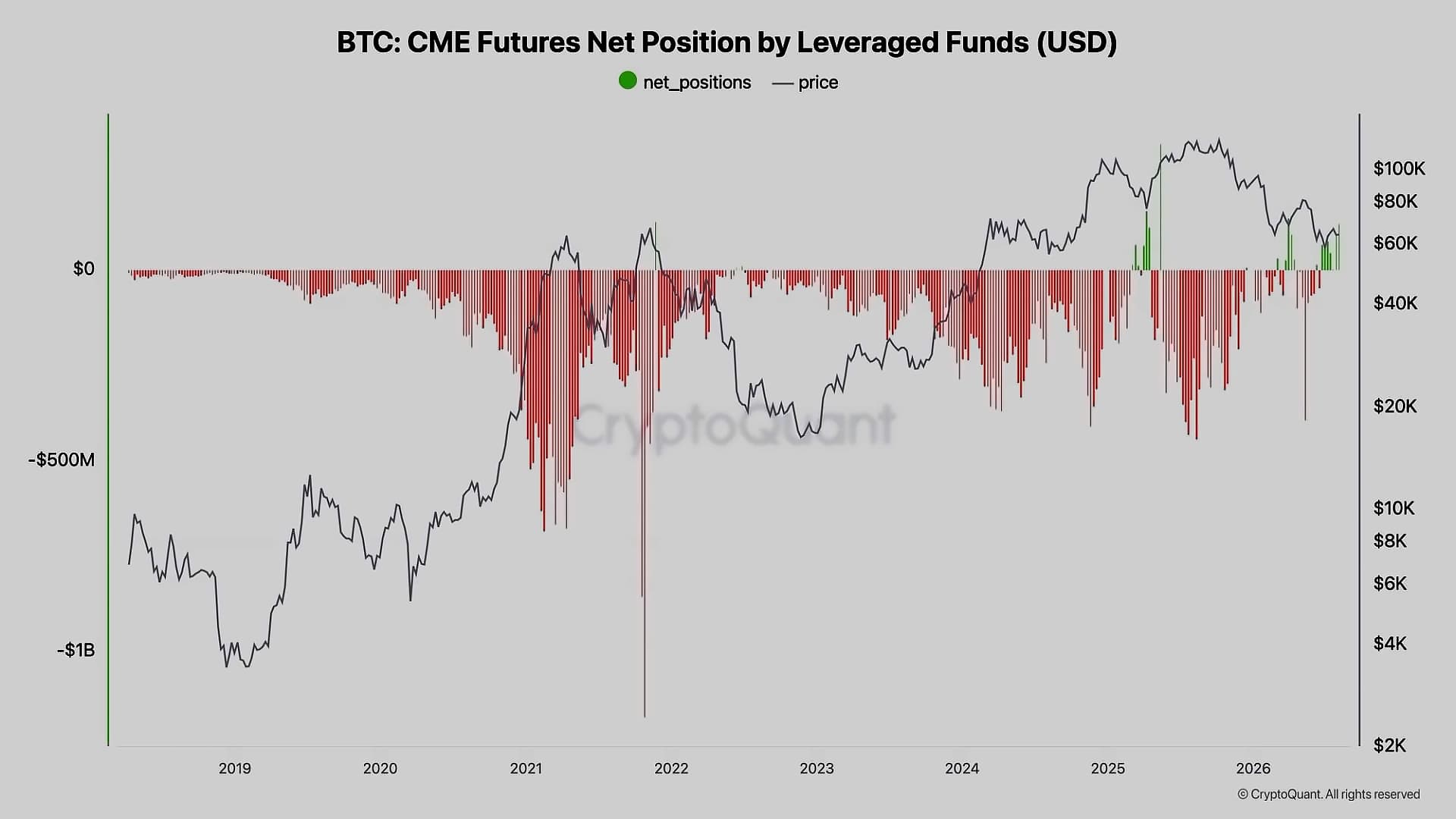
Hedge funds trading on the Chicago Mercantile Exchange have executed a rare strategic reversal, flipping from net short to net long positions in bitcoin futures after years of structural short positioning. According to CryptoQuant CEO Ki Young Ju, this represents a significant shift in institutional sentiment toward bitcoin, with professional traders now betting on the cryptocurrency's upward price movement. The change marks a departure from traditional carry trade strategies that have dominated hedge fund bitcoin futures positioning for an extended period. As reported by BigGo Finance, this historic reversal signals that "Wall Street elites in suits are betting on the upside," suggesting that professional traders' confidence in Bitcoin's price appreciation potential is strengthening. As the world's largest regulated Bitcoin futures trading platform, the CME's positioning data has long been regarded as an authoritative barometer for observing institutional behavior, with this collective flip from short to long by hedge funds not only reflecting a passive adjustment following the failure of arbitrage strategies but potentially foreshadowing the assembly of a new wave of active bullish momentum.
The historic positioning shift stems from fundamental changes in the bitcoin futures basis trade economics. As reported by CryptoQuant, the annualized three-month bitcoin futures basis has fallen to approximately 3%, falling below the roughly 3.8% yield available on two-year U.S. Treasury notes. This inversion has made the traditional basis trade less attractive, as traders now face lower returns and additional funding, margin, and execution risks. The basis trade, which involves buying spot bitcoin or exchange-traded funds while simultaneously selling futures, has historically kept hedge funds' reported futures positioning negative for years. According to BigGo Finance, the "nature of the basis trade requires holding a short position, investors cannot simultaneously maintain a net long position in the futures market while deploying this strategy." Therefore, the current emergence of a net long stance directly indicates that some funds have terminated their carry trades and pivoted to directional bets. The economic incentive for traditional arbitrage trades has significantly diminished, as when the risk-free return on U.S. government debt surpasses the returns from futures arbitrage—which carries financing costs, margin pressures, and execution risks—the motivation to maintain large short positions declines markedly. For a long time, the annual yield of three-month Bitcoin futures contracts remained at a very high level, making arbitrage exceptionally attractive compared to traditional debt instruments, but recently, the corporate profitability of basis trading has dropped to around 3 percent annually, which has proven to be lower than the yield on two-year U.S. Treasury bonds.
Despite the hedge fund positioning shift, market data suggests that real institutional demand remains subdued. The Coinbase Premium Index, which measures whether Bitcoin trades higher on Coinbase than offshore platforms, has stayed below zero since early May, sitting near minus 0.08. This negative premium indicates that American buyers are not paying up for Bitcoin, with the index also making lower highs and lower lows since July 22. As reported by CoinDesk, this split between hedge funds' bullish futures positioning and weak US spot demand creates a concerning dynamic for the rally's sustainability. The disconnect between paper bets and actual buying activity suggests that while professional traders are positioning for Bitcoin gains, institutional investors are not backing the move with real capital. This divergence between futures and spot markets highlights the importance of examining multiple data points beyond just positioning metrics to assess true market momentum.
Additional market data reveals concerning structural weakness that may limit the sustainability of the current rally. Open interest across all exchanges sits near $23 billion, close to the lowest level of the past year. This represents a sharp decline from approximately $48 billion in October 2024, with the total recovering only slightly from a late-June low near $20.5 billion. According to CoinDesk, this thin open interest suggests that new money and borrowed bets are not entering the market, indicating weak participation from traders. The flip side of low open interest is that if the bullish hedge fund bets prove incorrect, forced selling would be minimal, creating what traders call a "long flush" that does little damage. However, this also means that any rally would have limited upside potential, as the market lacks the fuel of substantial new money entering. Bitcoin was trading near $65,254 as the data circulated, showing little change on the day, reflecting the cautious market sentiment amid these conflicting signals.