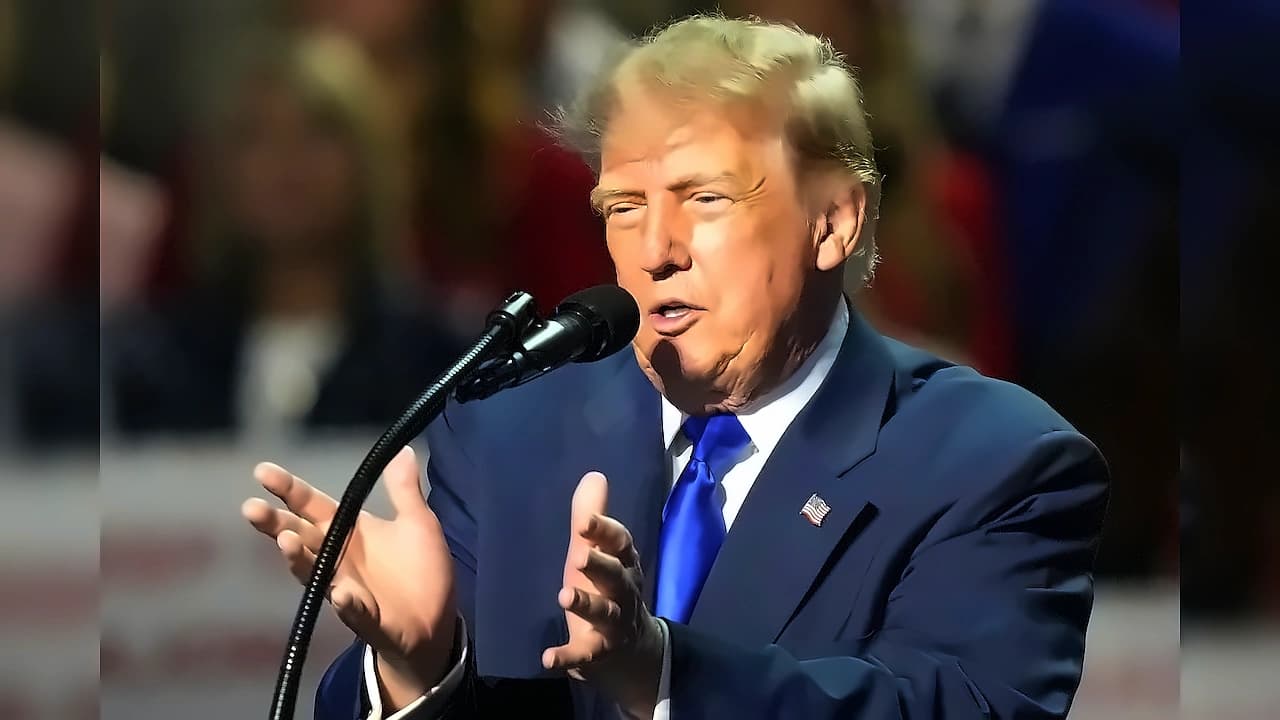
President Donald Trump has pledged to 'never let crypto down' as cryptocurrencies have wiped $1 trillion from their market capitalization during his second term. According to reports from Finbold, Trump published a lengthy Truth Social post accusing former SEC Chair Gary Gensler and an 'Anti-Crypto Army' of nearly destroying cryptocurrencies in the U.S. before declaring he 'saved' the industry. The president shared that 'Builders and Entrepreneurs are coming BACK to the United States where they belong,' and declared that America is the 'crypto capital of the world.' Trump also promised to fully codify favorable legislation that cannot be undone by subsequent administrations. However, Bitcoin suffered a sharp $2,000 rejection immediately after Trump's most explicitly pro-crypto statement, with the asset flushing materially lower within hours of the announcement.
Trump has recently signed an executive order 'to restore integrity to America's financial system,' directing federal regulators, including the Treasury Department, to tighten fraud screening and customer identification protocols for undocumented immigrants accessing financial services. As reported by Crypto.news, the White House cited 'gaps in customer identification practices' exploited by criminal networks. Policy analysts note this directive could functionally push a large, cash-dependent population further outside traditional banking, and toward crypto rails, stablecoins, and Bitcoin ATMs. The order extends Trump's crypto-friendly posture into payments infrastructure, creating a long-term tailwind for digital asset adoption. This represents the same pressure that Eric Trump and Donald Trump Jr. have publicly cited as the origin story of World Liberty Financial, stating they were 'debanked' out of necessity.
The overall digital assets market capitalization has crashed by slightly more than $1 trillion from $3.45 trillion to $2.44 trillion between January 20, 2025 – the inauguration – and press time on May 28, 2026. As reported by Finbold, Bitcoin is down 28.53% from $102,573 to $73,307 within the same timeframe. However, Bitcoin reached its new all-time high near $125,000 and the total market capitalization of digital assets hit $4.15 trillion during Trump's first year back in office. The latest market data shows Bitcoin bounced from a six-week low of $72,600 and has stabilized in the $73,400–$73,900 range, with nearest support at $73,400 and immediate resistance at $75,900. A clean break above that level opens the door to $78,000 and then $79,300, with Bollinger-band resistance capping the near-term upside around $81,200.

Ripple CEO Brad Garlinghouse has declared victory over what he calls the 'anti-crypto army,' claiming the opposition has been defeated by courts, voters, and President Donald Trump. According to reports from crypto.news, Garlinghouse posted that the anti-crypto forces lost in court, at the ballot box and in the Trump White House, arguing that attacking digital assets 'never made policy, legal or political sense.' The Ripple CEO framed this as a proxy battle over whether the U.S. would embrace or exile crypto innovation. Trump's latest pledge reinforces this narrative, with the president specifically targeting Gensler and his regulatory approach as part of the 'anti-crypto army' that Garlinghouse has been fighting. Bessent's recent comments further validate this political victory claim, with the Treasury Secretary emphasizing that 'all the nonsense that happens, all the things you read about, that's because it's the wild, wild west offshore' and advocating for bringing digital assets onshore.
Behind the victory lap lies a legislative grind that will determine future crypto regulation in the U.S. Journalist Eleanor Terrett has tracked how Ohio Senator Bernie Moreno and other Republicans are pushing structural crypto bills, while the Trump administration presses Congress to pass the Digital Asset Market Clarity Act (CLARITY Act) on an accelerated timeline. As reported by crypto.news, one widely circulated briefing suggested the White House set an informal March 1, 2026 deadline to line up votes, with Treasury Secretary Scott Bessent calling clear federal rules 'exactly what we need' to stabilize volatile markets. However, analysts still view the Clarity Act as far from the finish line, with Jaret Seiberg from TD Cowen's Washington Research Group noting that the bill would need conflicts of interest standards applying to the U.S. President to gain enough Democratic support to pass. The legal framework for cryptocurrencies remains incomplete and has seen multiple delays, with the version unveiled early in 2026 leading to sharp disagreements among prominent voices including Cardano's Charles Hoskinson, Coinbase's Brian Armstrong, and Ripple's Brad Garlinghouse.