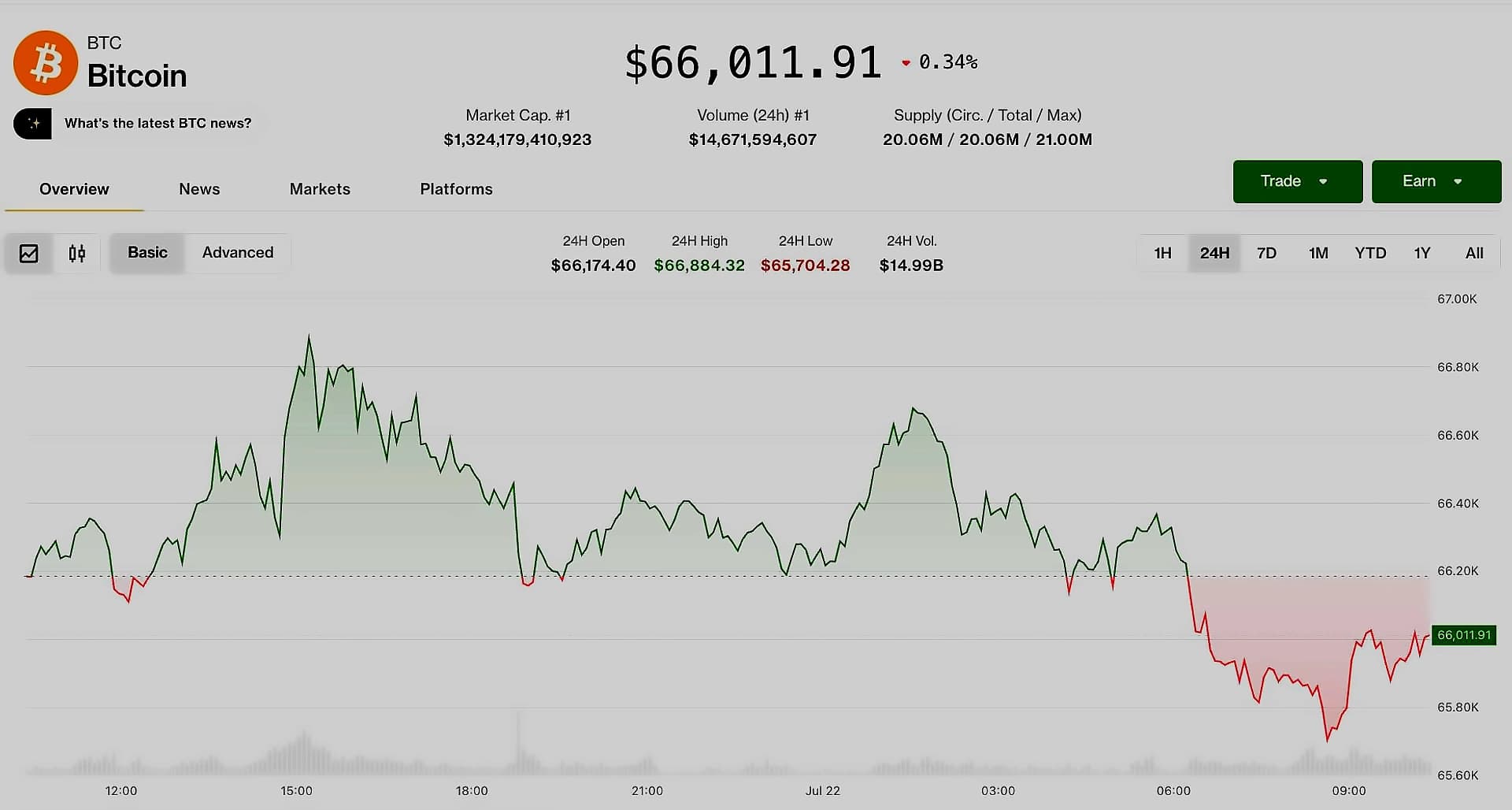
Cryptocurrency markets experienced significant selling pressure as investors engaged in widespread profit-taking activities. Bitcoin dropped to $62,500 in latest trading, falling below the $64,000 support level that technical analysts had identified as crucial. The decline came as the Federal Reserve held interest rates steady at 3.50% to 3.75% in its first meeting under new Chair Kevin Warsh, with the FOMC voting unanimously 12-0 to maintain current policy levels. Major cryptocurrencies including Ethereum, XRP, and Dogecoin also declined, with over $440 million in crypto futures liquidated across exchanges in the past 24 hours, reflecting high market volatility. The overall crypto market capitalization slipped to $2.16 trillion, down 2.31% from previous levels, as reported by CoinMarketCap.
New Federal Reserve Chair Kevin Warsh ended his first FOMC meeting without changing interest rates and avoided providing clear guidance on future policy cuts. According to the New York Times, Warsh used phrases such as 'first principles,' 'alternative frameworks,' and the Fed's 'remit' during his press conference, marking a significant shift from Jerome Powell's more direct communication approach. Warsh confirmed he was the only Fed policymaker who did not submit a projection for the dot plot, putting more focus on how he plans to guide markets without giving a clear path for future rate cuts. The Fed statement noted that economic activity was expanding at a solid pace while inflation remained above its 2% target, with some price pressure coming from supply shocks and energy costs. Warsh also announced a broad review of the central bank's work, naming five task forces covering inflation, communications, economic data, productivity and the labor market that may begin work in the coming weeks.
BlackRock offloaded more than 1,000 BTC in a single Thursday session via its IBIT fund, causing combined spot Bitcoin ETF net flows to reach approximately -1,410 BTC on the day, according to 99Bitcoins analysis. Beyond BlackRock's Bitcoin IBIT redemptions, HODL and WisdomTree's Bitcoin fund shed another 68 BTC on the same day. This follows earlier this month when US spot Bitcoin ETFs bled $325.69M in a single day on June 5, with IBIT again leading redemptions and Bitcoin briefly touching $59,100. In a separate wave, ETFs recorded $733.43M in net outflows in one session, their eighth consecutive withdrawal day at the time, with IBIT alone accounting for $527.84M of that figure. BlackRock's iShares Bitcoin Trust has now endured its longest multi-week outflow streak since the product launched in January 2024, bleeding more than $2.7Bn over five weeks with June month-to-date outflows standing at roughly $2.1Bn.
Despite Bitcoin's decline below $64,000, onchain data reveals Bitcoin trades 15% below its onchain 'True Market Mean' of $77,200, according to Glassnode's Wednesday report. The cryptocurrency's Short-term holder MVRV, which tracks unrealized profit or loss on coins moved in the past 155 days, has climbed to 0.90 from 0.81 but remains below the 1.0 breakeven line, with the implied cost basis for that cohort sitting near $72,600, leaving recent buyers about 10% underwater on average. Realized cap, the aggregate cost basis of coins in circulation, has contracted 1.45% over 90 days to $1.07 trillion, with the seven-day change nearly stalling at -0.18%, marking the first sign that capital outflows from the network may be slowing. Spot liquidity has turned more supportive since Bitcoin's slide toward $60,000, with Glassnode noting that Binance's order book depth has shifted decisively toward bids, with buy-side liquidity now outweighing resting sell orders by the widest margin in months.
Technical analysts remain divided on Bitcoin's near-term prospects despite the current decline. Kraken Chief Economist Thomas Perfumo noted that Bitcoin's dips below its 200-week moving average, now near $62,358, have historically marked some of the market's best entry points, with closes below that level occurring on roughly 10% of trading days since mid-2017 and buyers at those levels achieving median returns above 100% within a year. However, Glassnode analysts maintain that Bitcoin's slide through May and June tracked a broader geopolitical risk premium tied to the U.S.-Iran war, with the asset falling roughly 22% from $77,486 to a low of $60,861 as oil and gold drew safe-haven bids. Current Bitcoin price support sits near $60,000, a level that has absorbed selling pressure but has not generated any meaningful upside follow-through. The Fear and Greed Index hit 14/100, deep in Extreme Fear territory, during the heaviest selling earlier this month, and forced liquidations reached approximately $1.8Bn in a single session, the largest flush since February 2026. According to The Block's latest data, Bitcoin last changed hands around $63,900, while the second-largest cryptocurrency, ether, traded under $1,750.