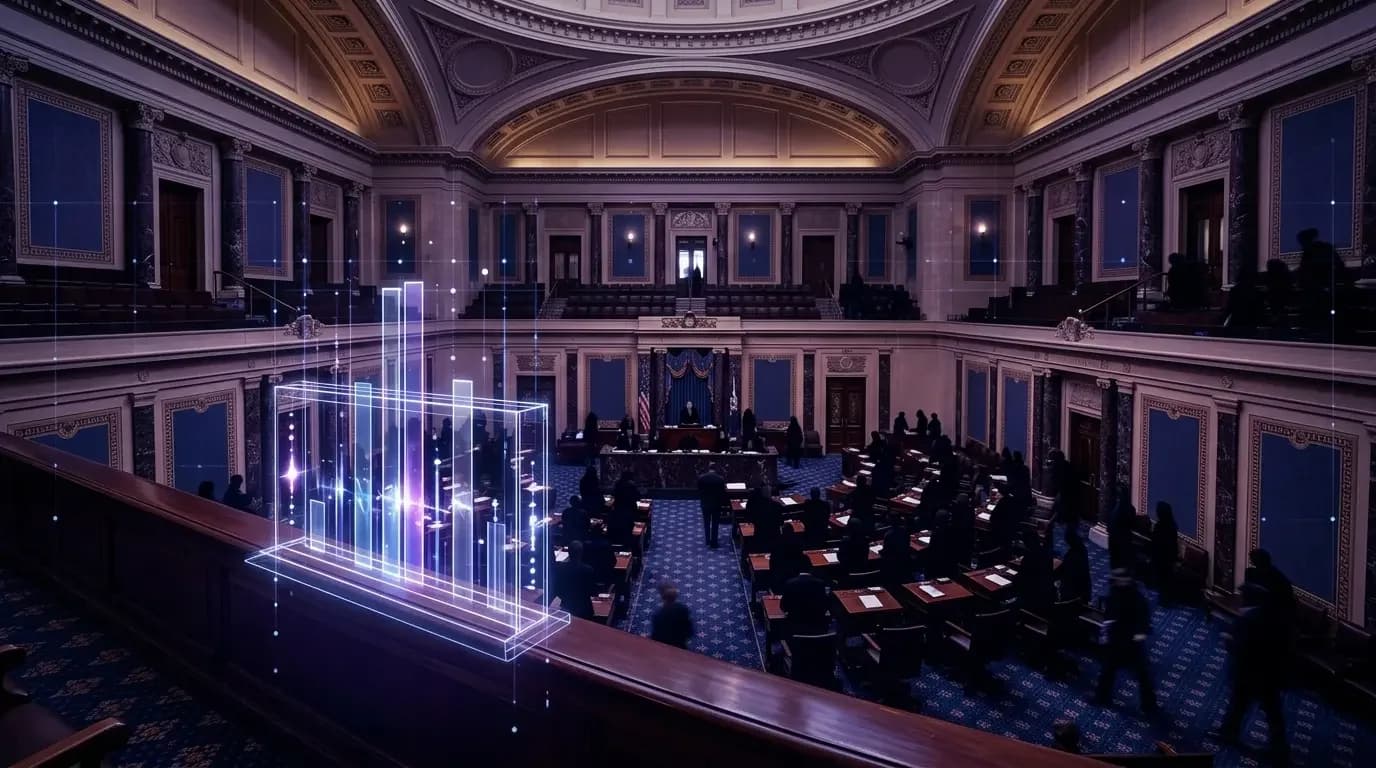
The Senate CLARITY Act faces a critical cloture vote on September 15 at 2:15 p.m. ET, with Republicans controlling 53 seats needing at least seven Democrats to reach the 60-vote threshold. However, Republican defections from Senators Rand Paul, Josh Hawley, and possibly Thom Tillis force leadership to find 10 or more Democratic crossover votes when only two crossed over in committee. House Majority Whip Tom Emmer's office notified Republican members that leadership had removed the weeks of September 21 and September 28 from the voting calendar, cutting eight previously scheduled legislative days and leaving representatives with only four voting days after Labor Day before the midterm recess. Polymarket traders now place the chance of enactment in 2026 at about 14%, down from previous estimates, reflecting the mounting challenges to completing the bill before the midterms. Senate Majority Leader John Thune filed cloture on the motion to proceed shortly before the August recess, forcing senators to take positions within 24 hours of returning to Washington, leaving almost no time for last-minute negotiations.
Ripple CEO Brad Garlinghouse has given traders another reason to keep the CLARITY Act on their radar, responding to CFTC Chairman Michael Selig's comments about the administration's crypto push. As per recent reports, Garlinghouse said that "making America the crypto capital of the world is within reach, let's finish the job," adding momentum to the regulatory push. XRP has gained roughly 6% to 7% over the past week, trading around $1.44 following a volatile week that saw the token rebound sharply from the $1.31 area and briefly approach $1.48. The regulatory optimism is arriving alongside a market still sensitive to macroeconomic conditions, with XRP remaining caught between a potentially bullish regulatory catalyst and broader market volatility. The CLARITY Act continues to face disagreements over stablecoin rewards, DeFi rules, ethics provisions, and consumer protections, leaving XRP positioned between regulatory hopes and macro uncertainty.
The National Sheriffs' Association has withdrawn its opposition to the CLARITY Act, adopting a neutral position 12 days before the Senate's scheduled September 15 procedural vote. In a September 3 letter to Senate Majority Leader John Thune and Minority Leader Chuck Schumer, NSA President Sheriff Troy Wellman and Executive Director Justin Smith stated that the organization had changed its position from opposition to neutral. "We believe the most appropriate course is to step back and allow the legislative process to proceed to establish a clear, effective, and much-needed regulatory framework," Wellman and Smith wrote. The letter removes a vocal law enforcement objection before senators decide whether to begin formal debate on the legislation. The National Sheriffs' Association had previously warned in May that Section 604 could provide a "blanket exemption" from anti-money laundering requirements for mixers, tumblers and decentralized finance platforms, arguing that criminals could use evolving software and artificial intelligence to transfer crypto without traceable records. After the NSA's May warning, the White House invited concerned law enforcement organizations to discuss the proposal's treatment of illicit finance, with the meeting focusing on objections involving DeFi, anti-money laundering enforcement, and legal protections for developers.
The CLARITY Act faces three unresolved disputes that could kill the bill: ethics rules targeting President Trump's $1.4 billion in crypto income, DeFi developer liability protections under Section 604, and stablecoin yield provisions that put $1.35 billion in annual Coinbase USDC rewards revenue on the line. Seven Democratic senators issued a joint statement calling the current draft insufficient on ethics, consumer protection, and illicit finance, making their support conditional on text changes that have not materialized during the August recess. The Trump ethics provision bars senior officials and their spouses from issuing or sponsoring digital assets, with Senator Elizabeth Warren's staff calling the language "riddled with major loopholes" that would not prevent the president from making his next $1.4 billion in crypto profits. Section 604 shields non-custodial software developers from money-transmitter registration requirements, with the National Sheriffs' Association, International Association of Chiefs of Police, and National District Attorneys' Association opposing the current form as creating a "compliance-free lane" for money launderers. Section 604 addresses when developers and providers of non-custodial crypto software may be treated as money transmitters, with supporters arguing that publishing code is different from operating a financial service, while law enforcement critics say the distinction could reduce the number of companies required to verify customers and retain records.
The stablecoin yield fight has split the banking lobby in half, with a coalition of 78 banking groups, led by the American Bankers Association and Independent Community Bankers of America, urging lawmakers to replace the current language. Coinbase generated roughly $1.35 billion in annual revenue from USDC rewards programs in 2025, and the current text permits crypto exchanges to offer yield on stablecoin balances while banning rewards that are "economically or functionally equivalent" to bank deposit interest. A coalition of 78 banking groups sent a letter urging lawmakers to replace the "functional and economic equivalent" standard with a "substantially similar" standard and remove language that could create ambiguity around rewards tied to stablecoin balances. Banking lobbyists warn that if a customer can earn 4.5% on USDC at Coinbase while a savings account at a regional bank pays 1.2%, the incentive to move deposits is obvious, potentially triggering deposit flight from community banks and credit unions that cannot compete with stablecoin yields backed by Treasury bill portfolios. The Blockchain Association later disputed the NSA's interpretation, with CEO Summer Mersinger calling the measure an important consumer-protection effort, while the industry group maintained that businesses controlling customer funds would remain subject to financial-crime laws.
If the bill fails, the crypto industry faces regulation by enforcement until at least 2029, with investment bank Bernstein projecting a 10 to 25% near-term correction in Bitcoin if the bill fails, potentially testing the $55,000 to $60,000 range. The crypto industry has spent over $189 million in the 2026 election cycle, with Fairshake spending more than $82 million, Coinbase directing $35.2 million, and Ripple Labs contributing approximately $49 million. Polymarket odds for 2026 passage have cratered from 82% in February to roughly 14% by late August, with Galaxy Digital cutting its own estimate to 10%. Senate Majority Leader John Thune filed cloture on the motion to proceed shortly before the August recess, forcing senators to take positions within 24 hours of returning to Washington, leaving almost no time for last-minute negotiations. The House approved the CLARITY Act in July 2025 by a 294-134 vote, with 78 Democrats joining Republicans, while the Senate Banking Committee advanced its portion by a bipartisan 15-9 vote in May 2026.