Strategy has formally outlined a plan to raise $44.1 billion in fresh capital to accelerate its Bitcoin acquisition program, signaling an aggressive counter-cyclical expansion despite the asset's recent 40% correction from its late 2025 highs. The initiative marks a massive escalation in corporate treasury operations, aiming to leverage the disconnect between equity capital markets and spot asset prices to absorb floating supply at depressed valuations. The core of this strategy relies on the company's ability to issue equity and convertible debt at valuations that exceed the market price of its underlying Bitcoin holdings, creating a Net Asset Value (NAV) premium that allows Strategy to raise cash from institutional investors and deploy it into Bitcoin accretively. As long as the market values the company's future accumulation capability higher than its current book value, the mathematical engine of the treasury strategy remains solvent.
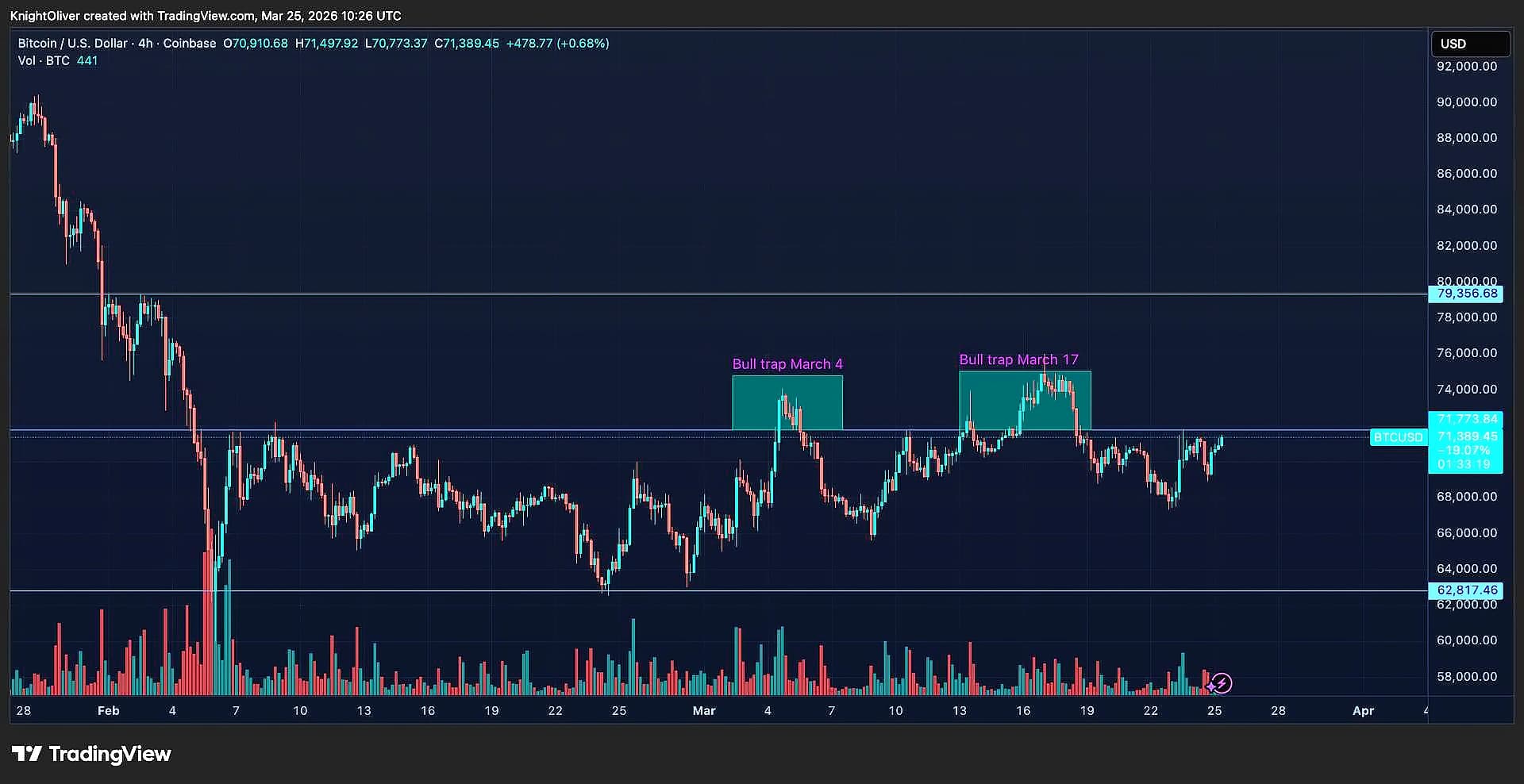
Bitcoin is locked in a critical battle at the $72,000 level, with the price currently hovering near $68,000 - down roughly 38% from its October 2025 high above $109,000. This five-month streak of losses has pushed the Crypto Fear & Greed Index to Extreme Fear, creating a technical setup where a break above $72,000 is required to invalidate a bearish pattern targeting $42,000-$45,000. The clash between ETF-driven support and fragile on-chain demand highlights Bitcoin's psychological resistance at $72,000, where short-term holders' cost basis could limit rallies. Recent data shows U.S. spot ETFs logged about $155 million in net inflows last week, continuing a two-week streak of roughly $1.47 billion in new allocations, but underlying on-chain momentum remains fragile. The $70,000-$70,800 region serves as immediate support and a key reaction area, with $67,900 acting as a mid-range pivot that could shift momentum.
Despite retail selling pressure, a monumental shift in corporate treasury management is creating a structural demand floor. Data from Capriole Investments indicates that institutional Bitcoin purchases in early 2026 have already exceeded newly mined supply by 76%, highlighting a net deficit in available coins even before Strategy deploys this fresh capital. This metric aggregates corporate treasury buying with spot ETF flows, demonstrating that when a single corporate entity executes purchases that outpace the daily production of the entire mining network, the programmable scarcity of the protocol is put to a stress test. The U.S. Bitcoin ETF market has seen assets under management grow 45% to $103 billion, with institutional ownership of the asset class rising to 24.5%. The $44.1 billion capital raise occurs against a backdrop of widening institutional adoption, with the firm effectively securing long-term funding to buy a distressed asset at current market prices hovering near $75,000.
The $44.1 billion capital raise creates a programmatic bid in the market, with every dollar raised destined for the order book. At current market prices, this capital could theoretically remove over 580,000 Bitcoin from circulation, representing a significant percentage of the liquid tradable supply and creating a scarcity shock potential that goes beyond standard ETF inflows. The firm recently executed a $1.57 billion Bitcoin purchase in a single week earlier this year, with the pace of supply removal accelerating toward a mathematical squeeze. This approach mirrors the "intelligent leverage" model deployment seen in previous cycles, but the scale has now shifted from mere billions to tens of billions. The mechanism functions as a programmatic bid in the market, effectively securing long-term funding to buy a distressed asset while the capital markets remain open to convertible offerings despite the broader crypto market downturn.
Bitcoin continues to trade within a tightening range on the 4-hour chart, with price compressing between $70,000 support and $72,000 resistance. Technical indicators reinforce this indecision, with the EMA cluster remaining tight and price oscillating near moving averages. The Donchian Channel reflects balance, with price hovering around its midpoint, while Fibonacci levels show Bitcoin holding above the 0.5 retracement level. Higher lows continue to form, indicating strengthening support, though sellers maintain control near resistance, preventing continuation. The current profit-taking wave from short-term holders has created additional selling pressure that reinforces the resistance near $75,000. However, CoinEx analysts have forecasted a base-case price target of $180,000 by the end of 2026, driven by this convergence of corporate treasury expansion and sovereign interest. The 50-day EMA reinforces the upper boundary at $70,000-$72,000, acting as a ceiling that has rejected every meaningful rally attempt in 2026, while the lower boundary sits at $60,000-$62,000 - the October 2024 lows.