Bitcoin ETF weekly trading volume just hit its lowest level for a full five-session week since October 2024, clocking in at roughly $8.05 billion, a 14% drop from $9.37 billion the prior week. According to latest data, this represents a significant deterioration in institutional demand, with the volume collapse telling one story while the flow data reveals a messier picture. Bitcoin ETFs finished the recent week with just $33.8 million in net inflows, the softest of three consecutive positive weeks, following $75.7 million the week before and $197.4 million the week prior to that. The deterioration is sharp, with ETFs pulling in roughly $499.1 million across the first three sessions before investors yanked $225.2 million on Thursday and another $240.1 million on Friday, nearly erasing the full week's gains in 48 hours.
BlackRock's iShares Bitcoin Trust (ticker: IBIT), the largest spot Bitcoin ETF by net assets, recorded $95.5 million in net outflows for the week after hemorrhaging a combined $414.7 million in just the final two sessions. As per latest reports, this represents a significant shift from the previous week's performance. Grayscale's Bitcoin Mini Trust and the ARK 21Shares Bitcoin ETF partially offset that with approximately $85.8 million and $78.1 million in inflows, respectively, not nearly enough to plug the gap. The late-week outflows brought the total weekly figure to $465.26 million, marking the smallest inflow compared to the previous two weeks of $197 million and $75.67 million. This performance contrasts sharply with earlier reports of institutional demand returning, though it's now clear that current institutional sentiment remains cautious.
Citigroup moved first among major banks, slashing its 12-month Bitcoin target to $82,000 from $112,000 and its Ethereum target to $2,240 from $3,175, explicitly citing negative ETF flows and stalled U.S. digital asset legislation. The bank's analysts wrote that the 'absence of a catalyst for increased investor interest' led them to assume no net ETF inflows over the next 12 months. That's a bold assumption given the current market conditions, though it reflects the challenging environment facing digital asset markets. Not everyone is folding, as Bernstein characterized the ETF slowdown as a 'short-term pause' and held its $150,000 BTC target for end-2025, arguing the structural bull run remains intact despite the current weakness.
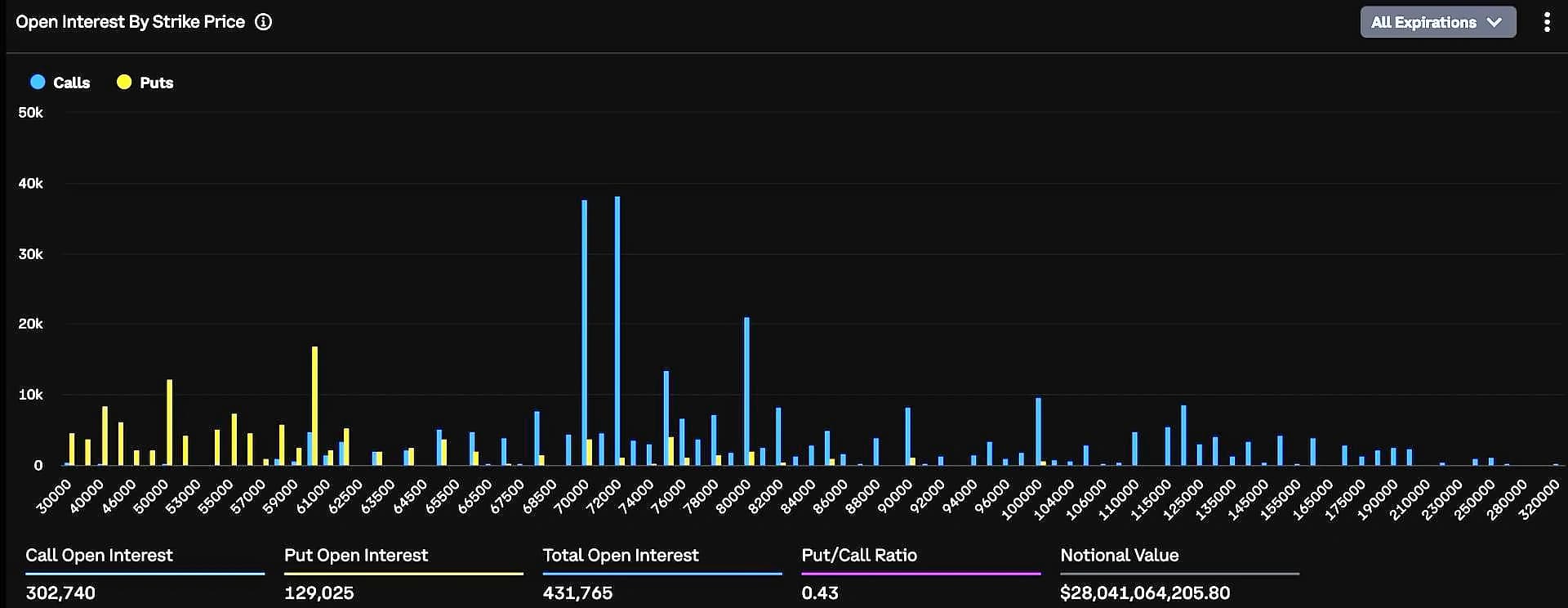
Technically, Bitcoin is holding a contested support zone in the mid-$50,000s, near Citi's bear-case target of $53,000, while the $80,000–$82,000 band now functions as medium-term resistance under Citi's revised base case. The bull scenario requires re-accelerating ETF inflows and meaningful progress on U.S. crypto legislation, while the bear case is a macro-driven recession that pushes BTC toward $53,000. The sheer size of these positions makes them a significant factor for traders to monitor, as any move toward these strike prices could see increased volatility as these positions are adjusted or closed. Looking ahead, if ETF demand strengthens alongside clearer signals from the Clarity Act or a more dovish Federal Reserve, Bitcoin could break above $67,000 and target the $68,000 to $70,000 region, while another wave of ETF outflows above $200 million per day combined with a hawkish Fed surprise could drag Bitcoin back toward $58,000.
Ethereum is in a similar bind, with ETH quoted near $1,570, bracketed by Citi's bear-case floor of $1,094 and base-case target of $2,240. Notably, Ether ETFs drew $103.9 million in net inflows last week, more than three times the Bitcoin ETFs' total, despite holding roughly one-eighth the net assets. That relative outperformance is worth watching as it suggests different institutional sentiment toward the two major cryptocurrencies. The contrasting performance between Bitcoin and Ethereum ETFs highlights the varying institutional appetite across different digital assets, with Ethereum benefiting from its role in the broader blockchain ecosystem and its growing use cases in decentralized finance and smart contracts.