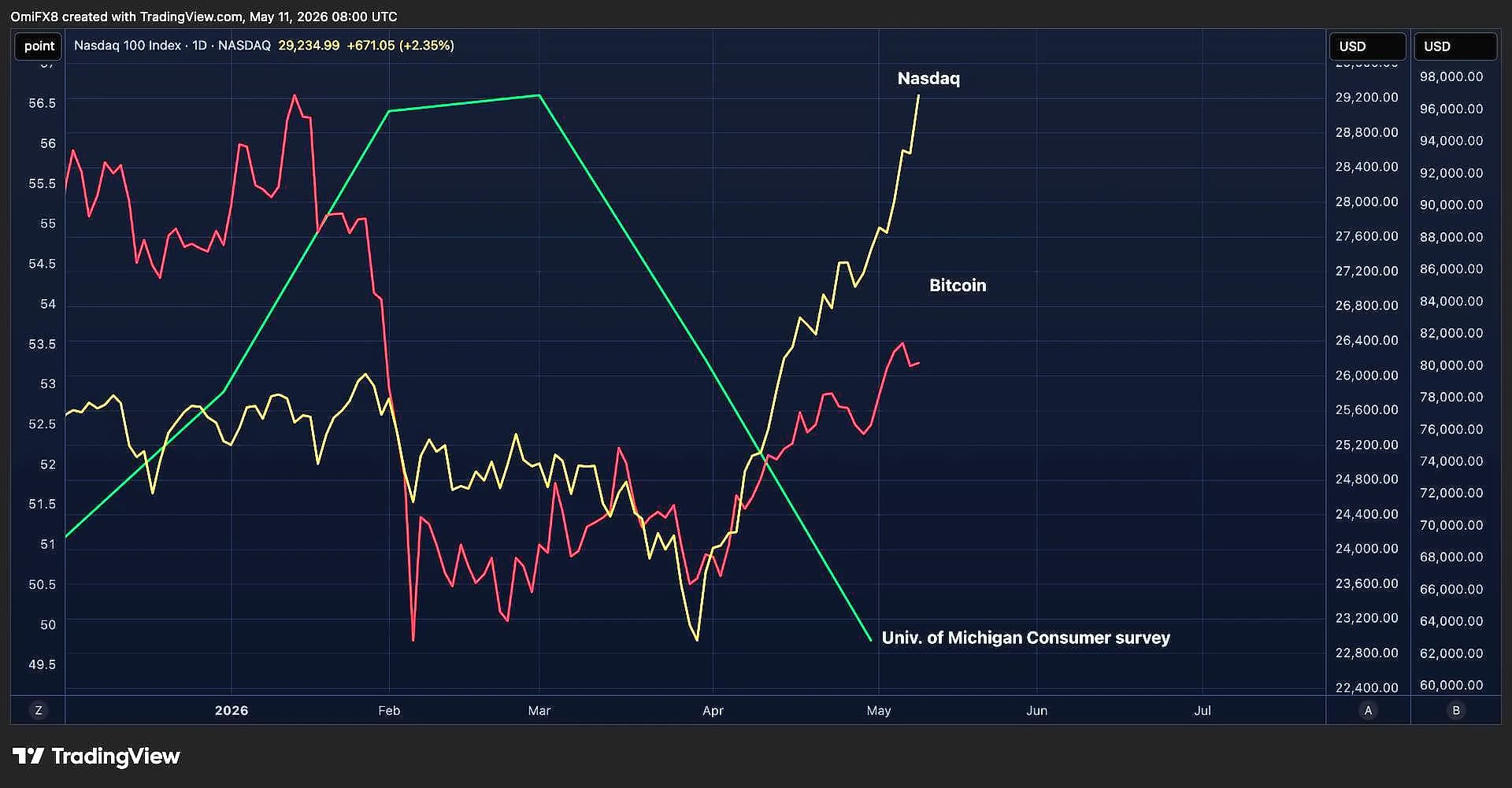
Bitcoin has climbed toward the $82,000 resistance level, representing a critical test for the cryptocurrency's momentum after weeks of unstable trading. As reported by AMBCrypto, the steady accumulation helped BTC reclaim higher levels without relying entirely on aggressive leverage, with daily trading volume holding between $4.2 billion and $4.5 billion. Futures traders expanded exposure aggressively, with futures volume pushing beyond $50 billion and aggregate Open Interest stabilizing near $60 billion after surpassing several 2025 peaks. Taker Buy approaching the positive mark reinforced upside momentum, yet balanced Funding Rates suggested speculation remained relatively controlled. The approaching resistance zone may trigger profit-taking pressure if spot demand weakens in the face of expanding derivatives activity.
Despite Bitcoin's climb toward $82,000, on-chain behavior continues telling a far more cautious story beneath the surface. According to AMBCrypto, Network participation weakened throughout the recovery phase, with Active Addresses sliding toward 707,720 despite BTC holding above key support zones. That slowdown suggests price expansion increasingly comes from concentrated trading activity rather than broad user engagement across the network. The pressure becomes clearer once unrealized losses enter the picture, with Unrealized Losses still accounting for nearly 6.9% of Bitcoin's total market capitalization even near $82,100, leaving a notable share of supply underwater. As older holders move closer toward breakeven, rallies naturally attract distribution pressure from participants seeking relief after prolonged drawdowns.
Cumulative spot Bitcoin ETF inflows continued holding above $59.8 billion, showing institutional exposure remains structurally intact despite inconsistent daily inflows. According to The Economic Times, the continued accumulation by Strategy, which recently added another 535 BTC to its holdings, alongside optimism surrounding the proposed U.S. Clarity Act, is helping support broader sentiment even as momentum remains mixed. Spot CVD, which reflects activity in the underlying bitcoin market, rose 46.4% from $42.4 million to $62.0 million, suggesting buyers are increasingly willing to pay up rather than wait for cheaper entry points. Perpetual CVD, applied to crypto futures, jumped from $110.0 million to $410.3 million, showing leveraged traders are also leaning more bullish, though this can accelerate gains but is less durable than spot demand because futures positions can reverse quickly if sentiment shifts. The concentration of ETF inflows remains heavily skewed, with BlackRock's IBIT alone bringing in about $134.6 million in a single session.
Bitcoin's rally has stalled around $80,000 to $82,000 as traders await the U.S. consumer price index (CPI) report for April at 8:30 a.m. ET. According to CoinDesk, the median estimate is 3.7%, up from 3.3% in March, which would mark the largest increase in the CPI since January 2024 and be well above the trailing 12-month average of 2.7%. Analysts are worried that such a reading, especially against the backdrop of what President Donald Trump described as an "unbelievably weak" U.S.-Iran ceasefire and still-elevated oil prices, could trigger risk aversion, potentially weighing on asset prices. The core CPI reading, which excludes volatile food and energy components, is forecast to have increased to 2.7% year-on-year from 2.6% in March. It's also possible that higher inflation is already priced in, which may be why the rally stalled in the first place.
Despite the optimistic ceasefire predictions, analysts warn that Putin's track record on peace signals is concerning, with the Minsk agreements of 2014 and 2015 both collapsing after being signed. As reported by 99Bitcoins, prediction markets have been wrong on geopolitical outcomes before, with Polymarket odds for a ceasefire briefly spiking to 45% following US election results in late 2024, then fading as negotiations stalled through early 2026. If the Russia-Ukraine peace narrative reverses, whether through a breakdown in talks, a renewed offensive, or Putin simply walking back commitments, the risk-off shock would hit crypto alongside equities. The ETH/BTC ratio dropped to 0.02835 on Tuesday, its lowest level since July 2025, and is now down more than 35% from its August peak of 0.04324. On-chain analyst CW has flagged that Binance's top traders remain net bearish, even as the long position ratio rises, suggesting caution among institutional players. The level to watch on a reversal: a daily close below $79,000 would push Bitcoin into its bull market support band and put the $75,000 April bottoming structure directly in play.