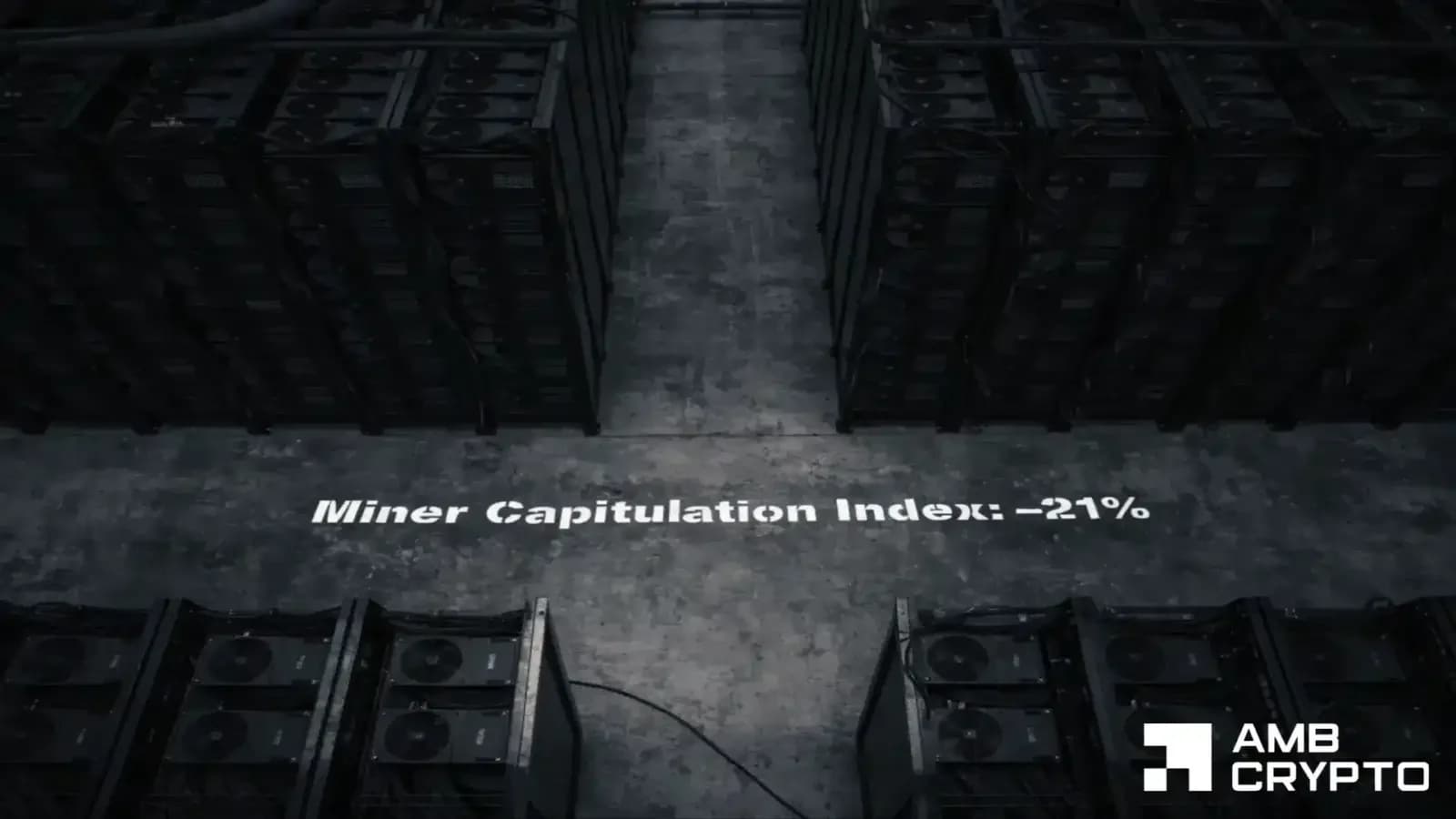
Bitcoin mining difficulty has fallen 14% from its January peak, marking the second-deepest year-over-year decline in Bitcoin's history according to Luxor's Hashrate Index. The current difficulty sits at 126.23 trillion, approximately 1.1% below the same period last year and 19.1% below the record of roughly 156 trillion set in November 2025. Bitcoin's seven-day average hashrate has dropped to 868 exahashes per second on July 29, down from more than one zettahash per second at its late-2025 peak. This represents a 12% hashrate retreat from December's peak, with the broader 30-day measure near 940 EH/s, about 12% below the December record of 1,066 EH/s. The decline has been sustained for approximately 287 consecutive days, making it one of the longest sustained mining contractions in Bitcoin's history.
Bitcoin's price decline to near $63,100 on July 31, down about 47% over 12 months and almost 50% below its October 2025 record, has significantly reduced mining profitability. The protocol continues issuing only 3.125 BTC per block, but Bitcoin Magazine Pro reports that BTC-denominated block-reward revenue recently reached its lowest daily level on record. Transaction fees are providing minimal support, with miners collecting approximately 20 BTC in fees during the seven days through July 13, equal to roughly 2.86 BTC per day and representing only 0.69% of total block rewards. Hashprice, which measures expected daily revenue from one petahash of computing power, stood near $32 per PH/s per day late in July, making older fleets struggle to remain cash-positive around $30 to $35 unless operators have electricity below roughly five cents per kilowatt-hour. The math is stark: before the halving, a miner producing one block earned 6.25 BTC worth $750,000 at Bitcoin's October 2025 peak near $120,000. Today, the same miner earns 3.125 BTC per block at a price near $63,100, yielding approximately $197,000 - a 74% decline in per block dollar revenue in less than a year.
Publicly traded miners have sold more than 32,000 BTC in the first quarter of 2026 alone, a single quarter record that exceeded their combined sales for all of 2025 and surpassed the 20,000 BTC sold during the 2022 Terra Luna collapse. Individual disclosures paint a clear picture of the pressure: Riot Platforms sold 3,778 BTC in Q1 at an average price near $76,626, generating approximately $289.5 million, while producing only 1,473 coins in the same period. Core Scientific liquidated roughly 1,900 BTC worth about $175 million in January alone. Cango sold 2,000 BTC in March for approximately $143 million, using proceeds to retire bitcoin-backed loans. In a single week during Q1, MARA, Genius Group, and Nakamoto Holdings revealed combined sales of more than 15,000 coins - these were not routine sales but drawdowns of treasury reserves. The aggregate miner reserve has been declining since 2023, falling from more than 1.86 million BTC at the end of 2023 toward roughly 1.8 million by mid-2026, suggesting this is not opportunistic selling but a structural shift in how mining companies manage their balance sheets.

Mining stocks have broken their traditional correlation with Bitcoin prices, with a basket of mining equities gaining 56% during the early part of 2026 while Bitcoin fell 17%. This divergence is driven by AI data-center revenue expectations rather than Bitcoin mining economics. Hut 8 provides the clearest example, signing a second 15-year lease for 352 megawatts at its Beacon Point campus in Texas on July 20, raising the campus's total contracted AI portfolio to $26.6 billion. The company's shares more than quadrupled over the preceding 12 months and rose 11% after the second Beacon Point agreement. Core Scientific announced another large expansion on July 28, with an AMD partnership covering about 530 MW and more than $14 billion in potential base contracted revenue, bringing total leased customer capacity to roughly 1.1 GW representing more than $24 billion in potential contracted revenue. TeraWulf's AI and HPC lease revenue reached $21 million in the first quarter, overtaking its Bitcoin-mining revenue for the first time, with mining generating less than $13 million during the period. The irony is that miner selling itself contributes to the price pressure that makes mining less profitable, as when miners sell tens of thousands of bitcoin into the market over a single quarter, they add supply at a time when demand is already weakened by broader market conditions.
The current mining contraction represents a structural shift, not just a cyclical low, according to Luxor's Hashrate Index, which found that listed miners have announced more than $70 billion in AI and HPC contracts. Some hardware is not merely being shut down temporarily, as power contracts and data-center sites are entering AI leases that can last 15 or 20 years, making their return to Bitcoin mining less likely. Hut 8's AI and HPC lease revenue reached $21 million in the first quarter, overtaking its Bitcoin-mining revenue for the first time, with mining generating less than $13 million during the period. The next difficulty adjustment, expected around August 9 to August 11, will provide another network checkpoint, with further reductions showing continued miner exodus or stable conditions indicating the contraction may be slowing. The pivot is not limited to North America: mining operators in the Nordics, the Middle East, and parts of Central Asia are exploring similar conversions, attracted by AI workloads that pay more per megawatt hour than Bitcoin mining and provide contractual revenue certainty that Bitcoin mining cannot offer. A 15-year lease agreement with a hyperscaler eliminates the price volatility, halving risk, and difficulty uncertainty that define the Bitcoin mining business.