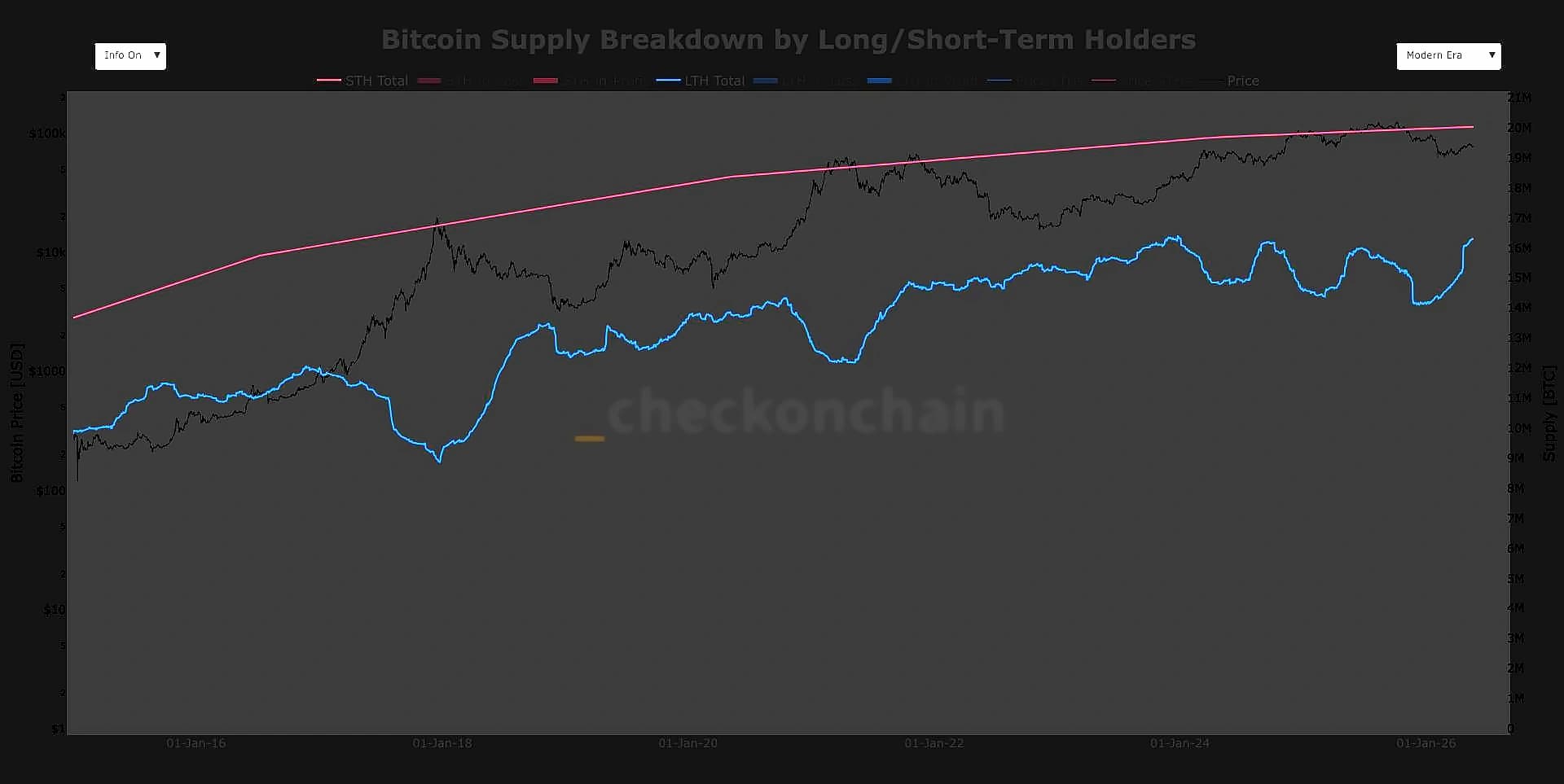
Bitcoin's long-term holder supply has surged by more than 2 million coins to 16.3 million BTC during the current bear market, according to recent analysis from CoinDesk. This represents a significant increase from 14.12 million BTC around the time of bitcoin's record high above $126,000 in October 2025. The accumulation has been particularly pronounced in recent months, with LTH supply rising by roughly 200,000 BTC in the past month alone. This behavior is typical of long-term holders, who tend to buy into price weakness and sell into price strength, with the cohort defined as investors who have held their coins for more than 155 days.
The current accumulation pattern mirrors historical behavior during previous bear markets. As reported by CoinDesk, during both the 2015 and 2019 bear markets, LTH supply increased as investors accumulated during price weakness. The only other time LTH supply was higher was in January 2024, when it reached 16.4 million BTC just before the U.S. spot bitcoin ETF launch. In the months that followed, nearly 2 million BTC was distributed by this cohort as bitcoin rallied, demonstrating the typical pattern of accumulation during weakness followed by distribution during strength. Research cited by CoinDesk highlights how supply has been shifting away from short-term traders toward long-term holders and ETF vehicles, with some estimates putting LTH dominance at around three-quarters of circulating supply.
Since the ETF launch in January 2024, LTH supply has largely fluctuated between 14 million and 16 million BTC. However, the current increase appears to have broken out of a 2.5-year downtrend, suggesting long-term holders are once again accumulating rather than distributing during bitcoin's depressed price levels. This shift in behavior is particularly significant given the extended period of accumulation that preceded the current increase, indicating a potential change in market sentiment among institutional and long-term investors. The breakout is particularly notable as it represents a return to pre-ETF supply levels, with much of the distributed supply from 2024-2025 now migrating back into long-term cohorts.
The recomposition of supply toward long-term holders tightens the freely tradable float, as more coins sit in regulated vehicles or long-term hands. This dynamic historically amplifies upside moves when fresh capital arrives, as there's less marginal supply available to meet new demand. Analysts interpret rising LTH supply as a sign that patient capital is stepping back in, while falling LTH supply signals distribution and potential late-cycle conditions. The current cycle is charting new territory, as bitcoin has already printed a new high around $126,000 in October 2025, and how this accumulation phase resolves may determine whether that high stands or becomes just another waypoint. If historical patterns hold, sustained rises in long-term holder supply at record levels often precede later-stage bull legs rather than immediate blow-off tops.