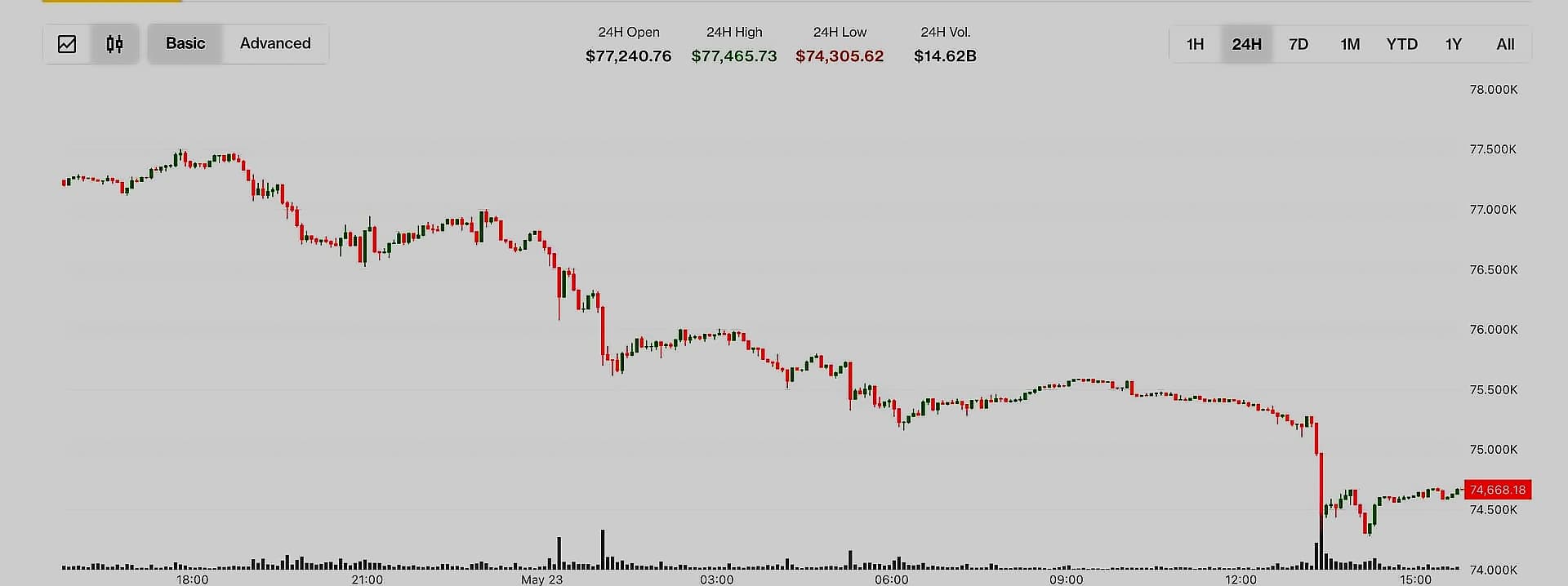
Bitcoin has plunged to a two-week low of $76,593, marking the lowest position since May 1 and representing a dramatic decline from its recent highs. According to The Block, the cryptocurrency fell 1.2% in the past 24 hours as of 11:10 p.m. ET on Sunday, having dropped to a low of around $76,720 earlier in the day. The latest decline has been particularly severe, with Bitcoin dropping by over $4,000 since Thursday evening after an impressive but brief price pump that took the asset to almost $83,000 on May 7. The bulls had stepped up in following days, driving the asset to $82,000 on Monday and Tuesday, but worry inflation numbers in the US poured more oil on the fire, with the asset dipping to $78,800 on Wednesday after another rejection at $81,200. The market capitalization has dipped to $1.560 trillion, while Bitcoin's dominance over the alts is up to 58.4% on CoinGecko, indicating that altcoins have followed Bitcoin's decline.
U.S. spot Bitcoin ETFs recorded over $1 billion in cumulative net outflows over the past week as institutional investors reduced exposure to the asset, marking a sharp reversal after several weeks of strong inflows that had previously helped support Bitcoin's recovery above the $80,000 region earlier this month. According to SoSoValue data, the latest withdrawals represent a significant shift in institutional sentiment, with Bitcoin ETFs recording a weekly net outflow of $1 billion in the week ended May 17, ending a six-week inflow streak. Spot Ethereum ETFs also remained under pressure, extending their recent streak of daily net outflows with $255 million exiting the funds last week as institutional appetite across the broader crypto market weakened further. According to SoSoValue, Bitcoin ETFs recorded their worst week since early February, with roughly 13,000 BTC exiting ETF provider addresses during the week. Ark Invest led the outflows, with more than 4,000 BTC withdrawn alone, creating sustained sell-side pressure. "ETF outflows last week likely reflect institutional investors reducing short-term exposure as expectations for Fed rate cuts continue to be pushed back, and portfolio managers rotate toward cash or defensive positioning," said Min Jung, associate researcher at Presto Research.
The latest decline was triggered by U.S. President Donald Trump's threat against Iran published on Truth Social, warning that any further delays in the peace agreement may result in military action. "They better get moving, FAST, or there won't be anything left of them," Trump wrote on Truth Social, resurfacing U.S.-Iran tensions that had previously driven market volatility. Brent crude oil rose 1.78% to $111.2, while WTI crude oil rose 2.2% to $107.7, with traders worrying that high oil prices and inflation would persist. According to The Block, investors are concerned that high oil prices could fuel inflation to the point where the Fed may raise interest rates, adding to the risk-off sentiment across markets. The Bitcoin Fear & Greed Index is back down to 27, near the "fear" zone, from a neutral range of 40 to 50 earlier in the week, reflecting the deteriorating market sentiment. Recent Producer Price Index data surged 6% year-over-year following a stronger-than-expected Consumer Price Index reading of 3.8%, reinforcing fears that the Federal Reserve may keep interest rates elevated for longer than previously expected.
The latest liquidation wave has been predominantly driven by long positions, which absorbed roughly 89% of the damage with $550 million wiped out between 6:30 a.m. and 10:30 a.m. in Singapore according to Coinglass data. Short bets lost just $73.52 million, showing a one-sided flush of leveraged bulls. Ethereum took the heaviest hit with $256.83 million in long positions wiped out, while Bitcoin recorded $180.89 million in liquidations. Together, the two largest cryptocurrencies accounted for roughly two-thirds of the day's total liquidations. The single largest liquidation order occurred on Bitget, with an ETH/USDT perpetual contract worth $28.49 million being wiped out. According to CoinGlass data, more than $661 million worth of crypto positions were liquidated over the past 24 hours, with bullish long positions accounting for nearly 95% of the wipeout.
The weakness has accelerated significantly as large red candles pushed Bitcoin back below the key $78,000-support at press time. Despite the recent selloff, Bitcoin's broader medium-term structure remains relatively constructive on the daily chart, with the asset now falling back below the key $80,000 psychological support region after facing rejection near the $82,000–$84,000 resistance zone earlier this month. Bitcoin continues holding above its 50-day simple moving average near $75,500, while the Supertrend indicator also remains bullish around the same region, suggesting that the broader medium-term uptrend structure remains intact for now. The 50-day SMA continues approaching a potential bullish crossover above the 200-day SMA near $81,400, forming what traders commonly refer to as a golden cross. However, short-term momentum has weakened following the latest selloff, with Bitcoin now struggling to reclaim the $80,000 level. If bulls manage to push BTC back above $80,000, the token could soon attempt another move toward the broader resistance cluster between $81,400 and $84,000, while failure to hold above current support could expose Bitcoin to a deeper correction toward the $75,500–$73,900 region.