Bitcoin experienced a remarkable surge of more than 650% from its November 2022 low of approximately $15,000 to its October 2025 peak of nearly $125,000. According to market analysis, a significant portion of this move occurred between September 2024 and January 2025, when the price doubled from approximately $55,000 to $110,000 alongside Donald Trump's 2024 election victory. The cryptocurrency ultimately topped around $126,000 last October before entering a prolonged bear market.
Gold followed a delayed but similar trajectory to bitcoin, driven largely by the growing 'debasement trade' narrative surrounding fiscal deficits and monetary expansion. As reported by market analysts, the metal began its breakout in early 2024 near $2,000 per ounce and eventually climbed above $5,200 per ounce in February 2026, roughly four months after bitcoin peaked. Since then, gold has corrected nearly 20% and now trades below $4,400 per ounce, demonstrating the cyclical nature of these asset classes.
Hot money trading has now shifted decisively toward memory and semiconductor companies such as SanDisk and Micron Technology, with Micron recently entering the $1 trillion market capitalization club after having a valuation of just $70 billion only one year ago. According to market analysis, these companies have effectively replaced crypto as the market's dominant momentum trade, with capital flows and market attention increasingly shifting toward other high-growth sectors. The market is experiencing intense competition with US AI stocks seeing pullbacks during sessions but funds quickly rushing in to buy on the dip, while memory stocks like Micron and SK Hynix move, the South Korean market follows suit, and then A-shares in semiconductor, memory, communication, CPO, and optical module sectors rally.
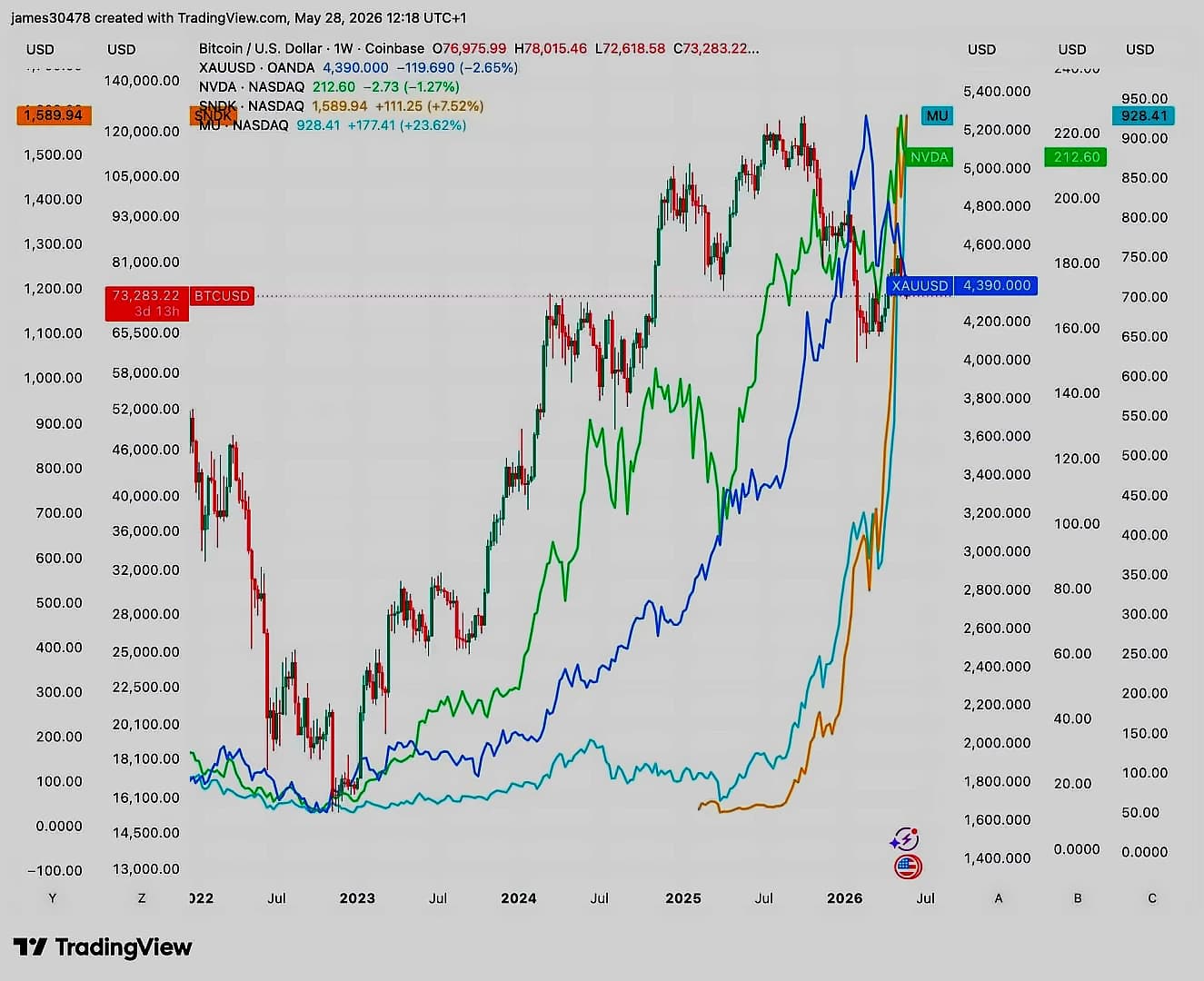
While memory and semiconductor stocks have gained prominence, AI infrastructure companies like NVIDIA continue to maintain their position in the speculative investment landscape. As reported by market analysts, NVIDIA reached a peak near $225 per share in May before easing back to $212, and it is now only slightly higher over the past six months. The company's performance reflects the ongoing interest in artificial intelligence-related investments despite broader market rotation away from crypto assets. New AI stock gurus are emerging from platforms like Reddit, X, and Substack, focusing on micro-cap stocks in the upstream of supply chains rather than traditional financial statement analysis.
The 2026 AI bull market has given rise to a new generation of stock market gurus who bypass traditional financial statement analysis in favor of supply chain and industrial logic. Representative figures like Leopold Aschenbrenner, who turned $200 million into $14 billion through concentrated investments in micro-cap stocks, and Serenity from WallStreetBets, who achieved legendary status through recommendations like AXTI which rose from $12 to $140.83, demonstrate this shift. These gurus focus on companies with market capitalizations ranging from hundreds of millions to billions of dollars, stocks that Wall Street analysts disdain but whose narratives can create significant wealth effects. The attention economy has created a new trading culture where traditional value investing methods are being challenged by supply chain-focused analysis.