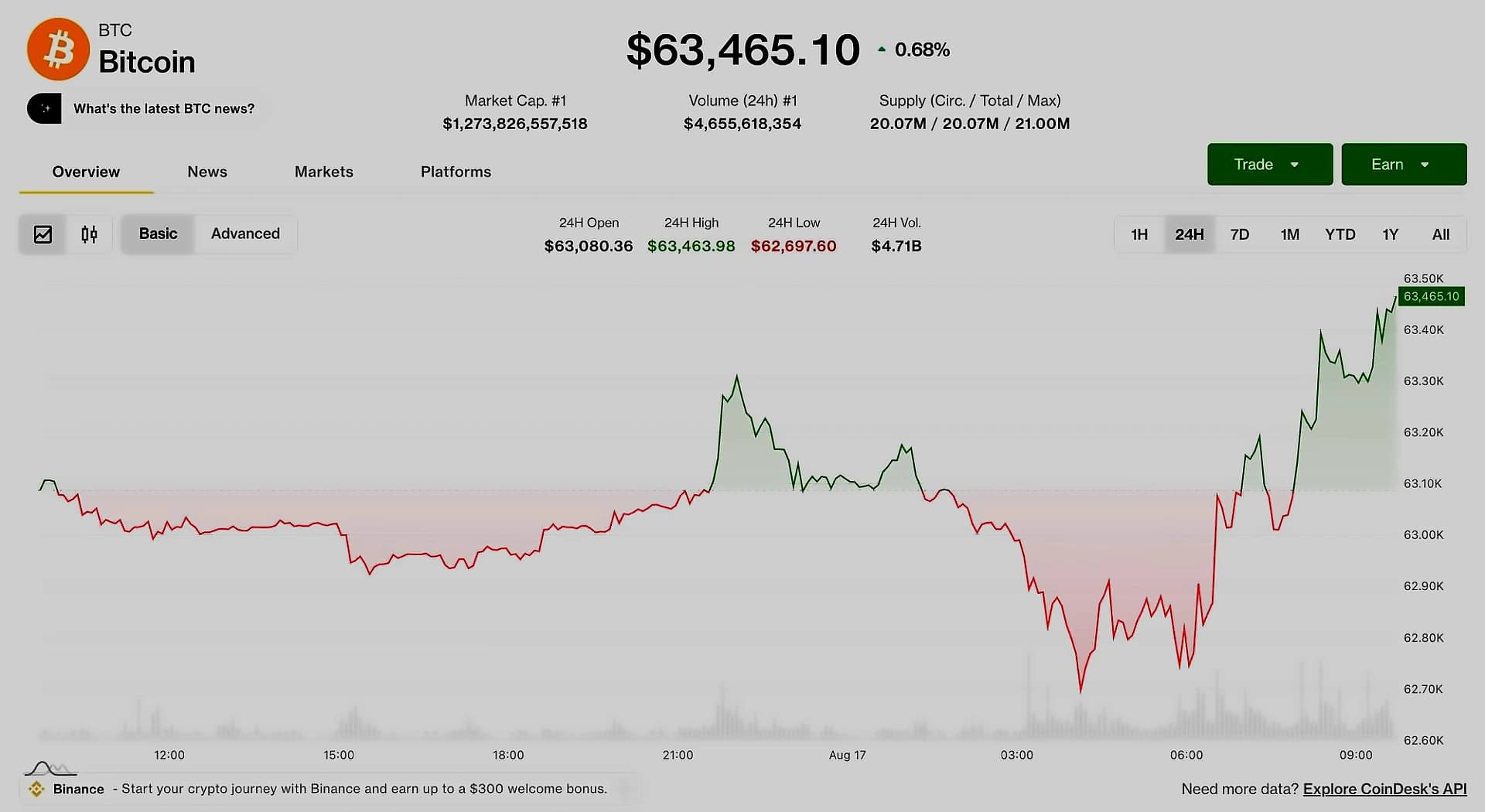
Bitcoin briefly surged over $66,800 this week, its strongest level in more than a month, before slipping back as the cryptocurrency faces a critical test at the $69,000 level. The latest rally comes after consecutive ETF inflows have pulled money back into the market after a prolonged period of outflows, with roughly $981.2 million in net inflows returning across 7 trading days from July 14, according to Santiment. However, the rebound reveals a growing divergence beneath the surface, with the Coinbase Premium Index remaining negative for more than 900 cumulative hours, the longest stretch in 2 years. This negative premium suggests relatively weaker demand or stronger selling pressure on Coinbase compared to Binance, pointing to continued caution among professional market participants.
The seven-day ETF inflow streak was ended by a $225 million outflow yesterday, despite Bitcoin holding above $65,000. According to 247 Wall St., Bitcoin climbed above $66,000 during the streak's strongest sessions, July 20 and July 21, with the catalyst being news that President Trump had agreed to ethics rules holding up the CLARITY Act. The CLARITY Act, or Digital Asset Market Clarity Act, had been stalled due to ethics-related disputes, but reports on July 20 about President Trump's agreement to the ethics rules spurred significant inflows into the market. The $226.92M and $203.14M inflow days on July 20 and 21 indicate that institutions were anticipating this regulatory change, although yesterday's large outflow has capped any bullish momentum built on the seven-day inflow streak.
BlackRock's IBIT led the surge with $193 million in inflows last week, despite not being the cheapest option. According to The Kobeissi Letter, IBIT leads with $48.86Bn in AUM while charging 0.25% annual fees, compared to Fidelity FBTC charging no management fees and holding $11.38Bn in AUM. Trading volume highlights this concentration, with IBIT accounting for nearly 79% of the $1.11Bn in total trading across all 13 spot Bitcoin ETFs on July 22. IBIT holds 3.70% of all Bitcoins, while the other twelve ETFs combined hold only 2.38%, indicating significant institutional activity in IBIT during this period. The fee differential is the root cause, with Grayscale charging 1.50% annually compared to IBIT's 0.25%, creating a 1.25 percentage-point gap that compounds significantly for long-term investors.
On-chain analysis reveals that Bitcoin's current bounce remains a relief rally rather than a confirmed recovery, with unrealized losses showing deeper pain than the February crash. According to Glassnode data, unrealized profit collapsed from roughly $1.4 trillion at the October 2025 peak to about $400 billion by late June, the lowest reading of the cycle. Net Unrealized Profit/Loss also bottomed lower in June than during the February crash, despite similar prices both times, indicating coins changed hands during the drawdown. Unrealized losses held between $200 billion and $300 billion for most of 2026, in contrast to hovering near zero throughout 2025. July brought some relief with unrealized profit recovering to roughly $500 billion as losses narrowed, but for the signal to flip bullish, profit must expand beyond its spring high near $580 billion.
Bitcoin trades below three of the four major on-chain valuation models, with only the Realized Price at $52,900 remaining as support beneath the market. According to on-chain analysis, the first real victory for bulls sits at $69,500, about 6% above the current price, which would return most recent buyers to profit and historically marked the start of recovery phases. The price last spent this long between the Realized Price and the True Market Mean during the 2022 bear market, with every attempt to reclaim the Short-Term Holder cost basis since late 2025 failing, including the March rebound. Losing the $52,900 Realized Price would signal a deep bear market instead, with one projection pointing to a potential Q4 bottom near $44,000. Reclaiming $69,500 could open the path to the $76,200 True Market Mean, while rejection risks another test of $58,000.