Eleven spot bitcoin ETFs currently trade on U.S. exchanges as of August 2026, with annual expense ratios ranging from 0.14% to 1.50%. According to the analysis, Bitwise BITB offers the lowest cost at 0.20%, followed by VanEck HODL and ARK 21Shares ARKB at 0.20% and 0.21% respectively. BlackRock IBIT charges 0.25% after its promotional waiver expired in January 2025, while Fidelity FBTC and Franklin EZBC also match this rate. Grayscale GBTC represents the outlier at 1.50%, six times higher than the cheapest competitors, though its Bitcoin Mini Trust offers a lower 0.15% rate. Morgan Stanley Bitcoin Trust currently has the lowest fee at 0.14%, followed by Grayscale Bitcoin Mini Trust at 0.15%. The latest addition to the market is Harvest Bitcoin Leaders Enhanced Income ETF (HBTE), which launched in April 2025 with an active covered call strategy and modest 25% leverage to generate higher income potential.
The compounding effect of annual fees over multi-year holding periods reveals significant cost differences. As reported in the analysis, a $100,000 bitcoin ETF investment after five years would retain approximately $98,756 with BlackRock IBIT (costing $1,244 in fees), while Grayscale GBTC would retain only $92,686 (costing $7,314 in fees). Over ten years, the gap widens substantially with IBIT retaining $97,528 versus GBTC's $85,907*, representing a difference of $11,621 for identical bitcoin exposure. The analysis notes that if bitcoin appreciates at 15% annually, the fee drag on GBTC would approach $54,000 over the same period. On a 1,000-share position (about 0.5662 BTC today), five years of fee drag reduces exposure by roughly 0.0070 BTC, which translates to approximately $704 at $100,000 per BTC.
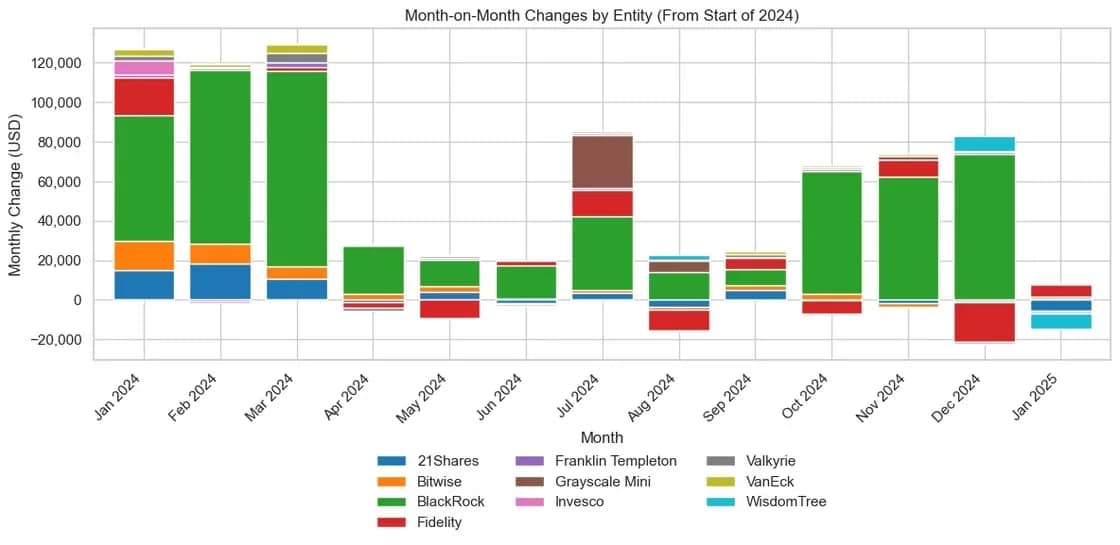
Tracking error, the difference between ETF returns and bitcoin's actual returns, creates additional hidden costs that compound alongside expense ratios. According to the analysis, tracking error across the 11 U.S. spot bitcoin ETFs ranges from 0.03% to 0.42% annualized, with the best performers like IBIT and FBTC achieving 0.03% tracking error. A 0.42% tracking error on top of a 0.20% expense ratio means the effective annual cost reaches 0.62%, more than double the advertised fee. Over ten years, a 0.20% tracking error adds approximately $1,982 to the cost of a $100,000 position, bringing the total cost of a cheaper ETF to nearly $4,000.
GBTC's fee structure reflects its unique historical evolution as a closed-end trust that converted to ETF status in January 2024. According to Bitcoin.com News, GBTC's original fee was 2% when it operated as a closed-end trust, which Grayscale reduced to 1.50% at ETF conversion but kept well above rivals. The fund's structural limitations have created significant operational challenges, with CoinFeeds reporting that GBTC's cumulative outflows since conversion have surpassed $14 billion (though Bitcoin.com News puts the figure at roughly $27.47 billion). However, Spark Money estimates that GBTC still generates approximately $223 million in annual fee revenue, more than every other spot bitcoin ETF combined despite the fund's outflows. The fund's redemption mechanism has been a key constraint, with Swan Bitcoin noting that GBTC's share price could drift away from net asset value due to the lack of redemption during early periods, though Mezzi reports this gap narrowed to around 0.02% as of February 2026.
Unlike traditional ETFs that charge fees directly to brokerage accounts, iShares Bitcoin Trust (IBIT) operates differently by selling small amounts of Bitcoin daily to cover costs. As of late January 2026, IBIT held approximately 773,671 BTC across 1.42 billion shares, yielding a ratio of about 0.0005662 BTC per share. After one year, each share represents about 0.25% less BTC than at purchase, with this effect compounding over time. This means IBIT's 0.25% annual expense ratio isn't billed to your brokerage account but paid by selling your Bitcoin daily, which reduces the BTC-per-share ratio. The fee's dollar impact scales with Bitcoin's price, so if you're right about BTC going higher, you're paying more in absolute terms for the privilege of holding it in an ETF wrapper. On a 1,000-share position, five years of fee drag reduces exposure by roughly 0.0070 BTC, which translates to approximately $704 at $100,000 per BTC.

Bitcoin ETFs offer tax advantages that direct bitcoin holdings cannot match, particularly for retirement accounts. As reported in the analysis, ETF shares held in taxable brokerage accounts are subject to capital gains tax at 0%, 15%, or 20% depending on income and holding period, with an additional 3.8% net investment income tax for high earners. ETFs can defer capital gains through creation and redemption mechanisms and allow bitcoin exposure in tax-advantaged accounts like IRAs and 401(k)s, where direct bitcoin holdings cannot be placed without a self-directed IRA structure. For high-income investors in California using taxable accounts, the combined federal and state capital gains rate on long-term bitcoin holdings can exceed 37%.