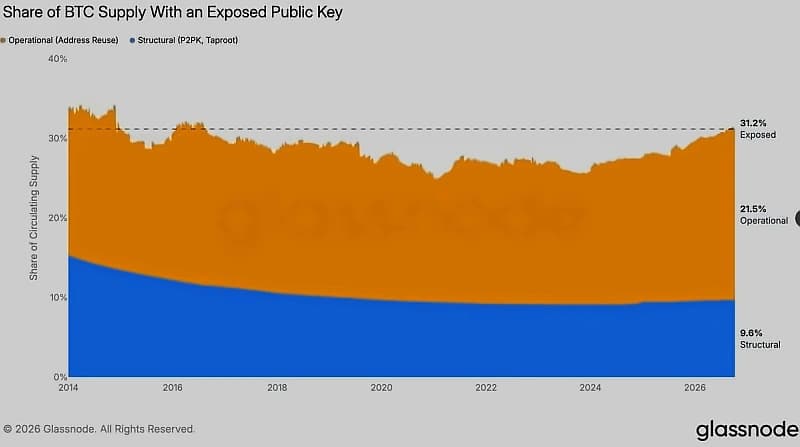
More than 6 million bitcoin, representing 31.2% of circulating supply, now sit behind public keys already visible on-chain, according to latest Glassnode data. As reported by Glassnode, this figure is roughly 5 to 6 percentage points above the 2023 low, indicating a significant increase in exposure levels. The exposed supply has increased by 222,000 BTC since May, with total bitcoin supply growing by just 64,000 BTC during the same period. Exchanges accounted for 123,000 BTC of this increase and now hold 1.79 million BTC behind visible public keys. According to the latest Europol report, approximately 6.04 million BTC — about 30.2% of total supply — had exposed public keys as of May 2026.
The growing exposure comes amid warnings from Ethereum researcher Justin Drake, who has urged the industry to prepare for what he terms 'bunker mode'. As reported by Drake, AI could potentially uncover a shortcut to breaking wallet cryptography 'in months, not years' in a worst-case scenario, before quantum computers arrive. In an Oct. 7 post on X, Drake called for a controlled migration to addresses with hidden public keys, warning that a future mathematical breakthrough could make it practical to recover private keys from exposed public keys. He described a possible attack that would take roughly one week using readily available hardware such as a large GPU cluster. The trigger for his alarm was OpenAI's Oct. 6 release of 722 mathematical manuscripts generated by an unreleased internal model, which Drake called 'mathematical superintelligence'. He also pointed to an earlier OpenAI demonstration where 10,000 autonomous AI agents worked in parallel to solve the Navier-Stokes equation in 88 hours.
Fireblocks' research chief Michael Gutkin has identified exposed public keys as the main factor in Bitcoin's future quantum risk, citing public estimates that roughly 6.7 million to 7 million BTC sit behind keys already visible on-chain. According to Gutkin, exposure depends on the blockchain, address type, and transaction history rather than whether the owner is an exchange, institution, or individual. Older Bitcoin outputs and reused addresses leave funds behind public keys that are already exposed, with many Satoshi-era outputs using pay-to-public-key format leaving keys visible even when coins have never moved. Pay-to-public-key-hash and native SegWit addresses hide keys until first spend, but once spent, keys become permanently visible. Taproot introduces additional concerns as its outputs are exposed to long-duration quantum attacks due to visible output public keys when created. The concern remains a future threat, with Ledger CTO Charles Guillemet noting no cryptographically relevant quantum computer capable of breaking Bitcoin's current signatures exists.
Ethereum co-founder Vitalik Buterin responded to Drake's warning with qualified support, while advising against immediate panic. As reported by Buterin, he wrote that there is 'a good chance' lattice-based systems could face 'serious hits' within the next two years due to AI-driven mathematical advances, challenging the common assumption that even if elliptic curves fall, hashes and lattices will remain secure. The Ethereum Foundation has already established a dedicated post-quantum security team and drafted a roadmap toward hash-based cryptography and formal verification. Fireblocks recommends institutions manage public-key exposure continuously rather than plan a single mass migration, with new deposits going to fresh addresses and change returning to fresh addresses. The company is developing tools for selecting transaction inputs based on exposure and displaying affected balances, while BitGo has introduced four Bitcoin wallet controls covering exposure scoring, address remediation, transaction-input selection, and updated address defaults. Drake emphasized that 'a rushed migration would do more harm than good', noting that botched transfers can introduce errors, compatibility problems, and direct losses.