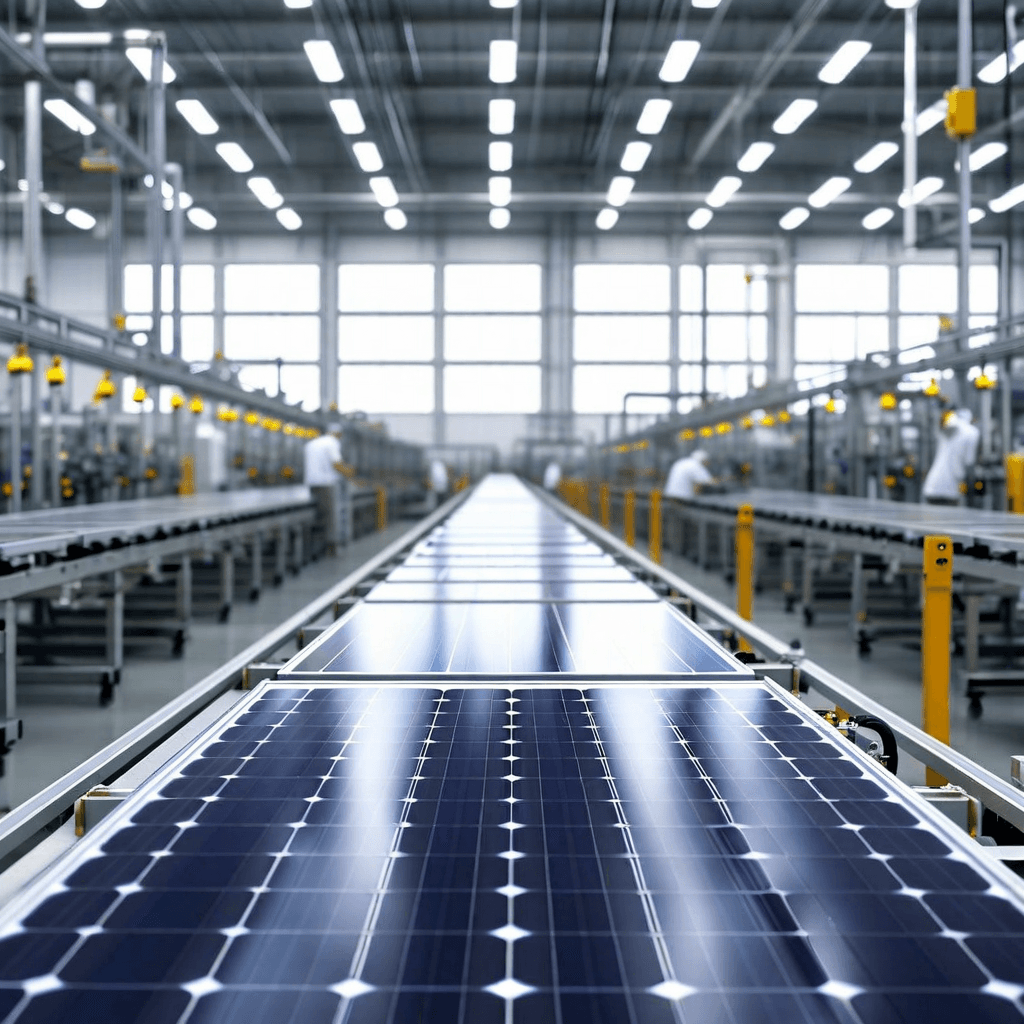
Vikram Solar delivered a standout performance in FY26, transforming from a strong player into an industry leader through exceptional operational execution. Module sales jumped 76% to 3,342 MW, driving revenue growth of 40.3% to ₹4,802.3 crore.
This operational excellence has set the stage for an ambitious capital program that will fundamentally reshape the company's business model over the next four years. InvestorPresentations
Record Production Drives Q4 Revenue Performance
The company achieved its highest-ever quarterly production of 971 MW in Q4 FY26, representing an 84.6% increase from 526 MW in Q4 FY25. This production scale directly enabled the highest-ever quarterly revenue of ₹1,452.8 crore, showing 31.4% sequential growth from Q3. The quarterly performance trajectory showed consistent acceleration throughout FY26, with Q4 alone contributing 30.3% of total annual sales and 27.2% of net profit. This momentum underscores the importance of operational execution and the company's ability to scale production efficiently to meet growing demand. InvestorPresentations
Order Book Provides Strong Revenue Visibility
Vikram Solar maintains a robust 8.2 GW order book with 87% domestic focus and 69% from independent power producers. This order book composition provides 4-5 quarters of revenue visibility, with management targeting 1.2x to 1.3x rolling coverage for the next four quarters. The record 1.9 GW of fresh orders secured in Q4 FY26 represents the highest quarterly booking in company history, demonstrating strong pipeline conversion through competitive pricing and quick team execution. This momentum is particularly significant as it positions the company well for FY27 growth, with management expressing confidence in maintaining healthy order inflows to match expanded capacity. InvestorPresentations
Customer Concentration Reduction Enhances Pricing Power
A critical improvement emerged in risk management during FY26: top-five customer concentration dropped from 80% in FY25 to 47% in FY26. This broader revenue base significantly enhances pricing power and reduces dependency on any single customer. The company has built strong relationships with clients, as evidenced by 7 out of the top 10 customers being repeat clients. Management maintains stable realizations at INR 14-14.5 per watt peak for Non-DCR modules and INR 23-24 per watt peak for DCR modules, targeting sustained 18-20% EBITDA margins. The reduction in concentration risk, combined with the repeat customer base, provides a solid foundation for stable revenue growth and margin maintenance. InvestorPresentations
Massive Capacity Expansion Program Underway
The total capex program of approximately ₹10,000 crore includes ₹6,400 crore for cell and module manufacturing and ₹4,300 crore for battery energy storage systems. Commissioning milestones are on track with First Module Out in June 2026 and First Cell Out in December 2026. This expansion represents one of the most aggressive capacity build-outs in the Indian solar manufacturing sector and will transform Vikram Solar from a module assembler into a fully integrated manufacturer. InvestorPresentations +1
The vertical integration strategy targets approximately 10 percentage points of margin improvement through multiple mechanisms. Customs duty avoidance alone is significant—eliminating 40% basic duty plus 27.5% anti-dumping duty on imported cells through in-house production. Additionally, DCR market participation offers access to 30%+ EBITDA margins compared to ~20% in the non-DCR segment. Operational efficiencies will also contribute, as single-campus integration enables zero transport costs with cell output feeding directly into module lines. Shared utilities, advanced automation, and higher manufacturing yields will further reduce overhead and labor costs, creating a structural improvement in the business model. InvestorPresentations
BESS Entry Diversifies Revenue Streams and Mitigates Cyclicality
Vikram Solar is strategically diversifying into battery energy storage with planned 15 GWh capacity by FY30, beginning with a 5 GWh cell-to-pack phase commissioning in FY27. The ₹4,300 crore BESS investment positions the company to capture India's rapidly growing storage market, projected to reach ₹20,370 crore by 2035 at 29.1% CAGR. This entry into BESS serves multiple strategic purposes: it diversifies revenue streams beyond solar modules, provides exposure to structural rather than cyclical growth, and leverages the company's manufacturing expertise.
Execution Risks and Financial Implications of Capital-Intensive Phase
The simultaneous expansion across modules, cells, wafers, and BESS will pressure free cash flow generation over the next 3-4 years. Management targets debt-to-equity below 1.0x at peak capex deployment, with current D:E already improved from 0.19 in FY25 to 0.03 in FY26, providing significant headroom for leverage. The 8.2 GW order book provides execution visibility, but delays in commissioning the June 2026 module expansion or December 2026 cell capacity could impact FY27 revenue targets. The company must navigate multiple complex projects simultaneously, each with its own execution risks, technology challenges, and regulatory requirements. The J-curve risk is substantial, with significant capital outflows preceding revenue benefits from the expanded capacity. InvestorPresentations +1
Maintaining Profit Growth Through Expansion Phase
Sustaining the 3x profit growth achieved in FY26 through the capital-intensive expansion phase presents significant challenges. The company will face pressure on operating margins as it ramps up new facilities, absorbs startup costs, and navigates the learning curve associated with new manufacturing processes. However, several factors provide a solid foundation: the strong balance sheet with minimal debt, 88% pass-through cost model protecting margins from input cost volatility, and improving operational efficiencies from automation and scale. With cumulative solar installations projected to grow from 150 GW in FY26 to 323 GW by FY30, Vikram Solar's integrated strategy positions it to capture significant market share while building long-term competitive advantage through technology depth and vertical integration. InvestorPresentations +1