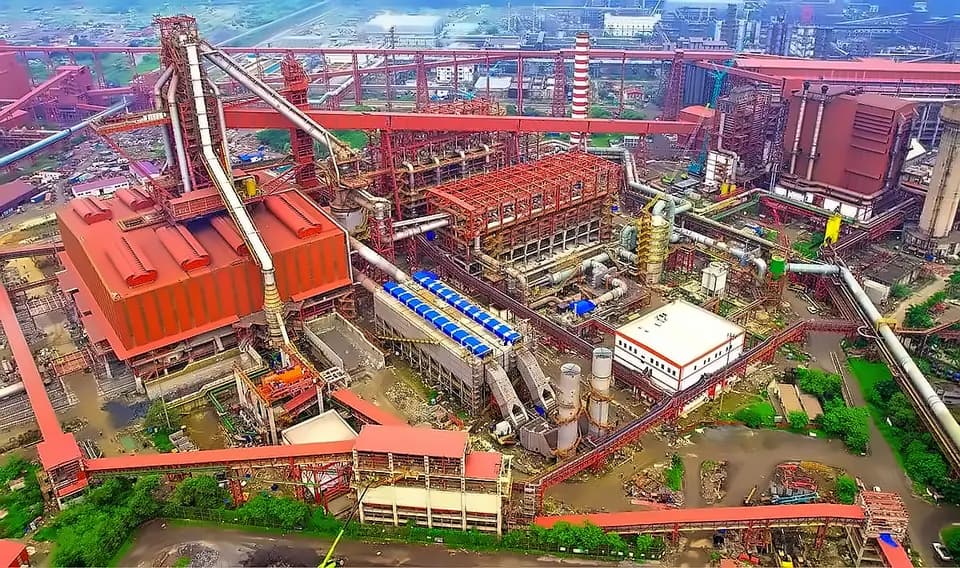
Here's the thing about big corporate mergers: the legal paperwork often moves slower than the business strategy. Tata Steel expects to complete the amalgamation of Neelachal Ispat Nigam Limited (NINL) in the current financial year, but the final stamp of approval from the National Company Law Tribunal (NCLT) is still pending. The Cuttack bench issued its first-motion order on August 25, 2026, and the final hearing is scheduled for November 2026.
Does this legal timeline actually block the Rs 40,000 crore expansion? Not really. The Board approved the 4.8 million tonnes per annum (MTPA) expansion separately, with a zero date of August 1, 2026. The project is expected to come on stream around 2029-30, giving Tata Steel a 48-month construction window. The merger is more about simplifying the corporate structure than unlocking the expansion itself. Management has already committed to the spend, and the company's net debt to EBITDA ratio of 2.3x sits comfortably within its stated 2.5-3.0x through-cycle range, which already factors in funding for all announced expansions. Transcript +3
The TSLP Route: A Clever Structural Play
Why did Tata Steel route the NINL acquisition through Tata Steel Long Products (TSLP) in the first place? The sources don't explicitly state the reasons, but the corporate history tells an interesting story. In FY2023, TSLP—then a listed subsidiary specializing in sponge iron and specialty steel—acquired control of NINL for Rs 12,100 crore. By FY2024, TSLP itself merged into Tata Steel, making NINL an indirect subsidiary. Now, NINL is being merged directly into Tata Steel as a wholly owned subsidiary. Other
This two-step approach likely served a purpose. TSLP was the group's dedicated long-products company with about 1 MTPA capacity in special bar quality steel, making it a natural home for NINL's long-products assets. The subsequent amalgamation into Tata Steel fits the broader consolidation drive, alongside buying out joint venture partners. The balance sheet impact? Minimal. Tata Steel will issue no new shares and pay no cash. NINL's share capital and Tata Steel's investment in NINL simply get cancelled. Since NINL is already consolidated, the standalone balance sheet absorbs the assets, but the consolidated numbers barely move. Transcript +1
The Rs 40,000 Crore Question: Leverage and Returns
Let's talk numbers. The media reports peg the expansion at Rs 40,000 crore for roughly 5 MTPA.
That works out to roughly Rs 7,060 crore per MTPA—about 33% higher than the last Kalinganagar phase.
How does this hit leverage? Tata Steel's net debt stands at Rs 84,173 crore with net debt to EBITDA at 2.3x. If the entire project were debt-funded on today's numbers, the ratio would rise to roughly 3.1-3.3x. But that's an extreme case. Management says brownfield expansion can be paced to manage the balance sheet, and India cash flows can fund the spend. The company generated Rs 35,065 crore in operating cash flow in FY26, so absorbing roughly Rs 8,500 crore annually (the average spend over 48 months) seems feasible. Investor Presentation +1
Return on capital employed (ROCE) tells another story. Current annualized ROCE is about 27% in India and 15% consolidated. The expansion adds roughly 20% to the capital base but earns nothing until around 2030. That's near-term pressure. NINL's existing business earned Q1 FY27 EBITDA of about Rs 498 crore at a 29% margin—comparable to Tata Steel India's 27% margin. But extrapolating a 1 MTPA plant's margins to a 6.2 MTPA operation is risky business. Transcript +3
The Synergy Story: Why Long Products and Why Now?
Tata Steel is doubling down on long products for a reason. The expansion deepens its presence in branded, high-margin retail products like Tata Tiscon, which grew volumes 33% year-on-year in Q1 FY27. The distribution network now covers 97% of India's districts, and retail sales exceed 200,000 tonnes per month. Management says retail GMV sells at the same EBITDA margin as the rest of the business—no discounts, just better branding. Investor Presentation +2
The synergies go beyond branding. NINL's MKB mines are expanding by 15 MTPA of iron ore in phases, and after the merger, ore from both Tata Steel's and NINL's mines can be used across the combined entity's life of mines. That's raw material security. The coastal location lowers logistics costs compared to inland plants. The merger also promises lower compliance costs, pooled order management, and centralized procurement. Transcript +3
But here's the catch: long products are more cyclical.
Flat products held up better, helped by auto demand, while long products depend heavily on construction. The expansion therefore adds more cyclicality to the margin profile, even if the branded retail share cushions the blow. Transcript +1
The Kalinganagar Proximity: Capital Efficiency or Myth?
NINL sits just 5-10 km from Tata Steel's Kalinganagar plant. You'd think that proximity would drive massive cost savings. The reality is more nuanced. The Chief Financial Officer explicitly said NINL should be treated as a greenfield project, so the shared-infrastructure benefit may be smaller than expected. Kalinganagar phase I built enabling facilities for 8 MTPA, which lowered phase II costs. But NINL's capex is still 33% higher than that last phase. Transcript +1
The qualitative benefits are real: easier access to group management, talent, and procurement. But the sources don't quantify these advantages. The per-tonne capex of roughly Rs 70,600 (my calculation at Rs 33,873 crore for 4.8 MTPA) suggests this isn't a bargain-basement expansion. Exchange rates affecting imported equipment costs add another layer of uncertainty. Transcript
Competitive Positioning: The Race to 50 MTPA
Tata Steel isn't building in a vacuum.
Tata Steel's roadmap targets 45-50 MTPA in India from existing sites, including 25-26 MTPA at Kalinganagar, 11 MTPA at Jamshedpur, and 10 MTPA at Meramandali. The two plans are similar in scale. Transcript
Market structure matters too. The top three players account for about 45% of the Indian steel market. Tata Steel's stated goal is a market share within chosen segments that is double its overall share. At a 20% overall share, that means targeting 40% in value-accretive segments like auto, where it already holds about 50% share. The NINL expansion strengthens its hand in long products, but Chinese exports selling at USD 50-100 per tonne below domestic prices remain a persistent threat. Transcript +1
Execution Risks: The Devil in the Details
Scaling from 1 MTPA to 6.2 MTPA is no small feat.
That's a schedule risk the company itself names. On the positive side, the 5 MTPA blast furnace is a replica of the Kalinganagar unit, which should reduce engineering risk. The steel melt shop will differ because it makes long products. Transcript +1
Approvals look advanced. NINL has Environmental Clearance and Consent to Establish for 6.2 MTPA, and the Consent to Operate was raised to 1.16 MTPA for FY27. The mining plan for 2026-31 has been renewed. But a show cause notice from the Odisha mines department seeking about Rs 588 crore in additional dispatch charges for FY22-25 hangs over the project. NINL disputes the claim and says there's no financial or operational impact, but legal battles have a way of dragging on. Annual Report +2
Workforce integration? The sources are silent. No headcount data, no union arrangements, no HR integration plan. That's a gap. The merger rationale cites centralised safety and governance, but integrating processes and people is where many mergers stumble. Other +1
The Bottom Line
Tata Steel's NINL expansion is a bold bet on India's infrastructure story and the long products market. The Rs 33,873 crore (or Rs 40,000 crore, depending on which source you believe) investment will test the company's execution capabilities and balance sheet discipline over the next four years. The NCLT approval is a milestone, not a gate. The real story is whether Tata Steel can deliver on the promised synergies, manage the cyclicality of long products, and hit the 2029-30 timeline without the cost overruns that have plagued the industry in the past.
If it works, Tata Steel cements its position among India's steel leaders with a stronger presence in high-margin branded products. If it stumbles, the leverage pressure and execution challenges could weigh on returns for years. The steel business, after all, is as much about managing cycles as it is about making metal.