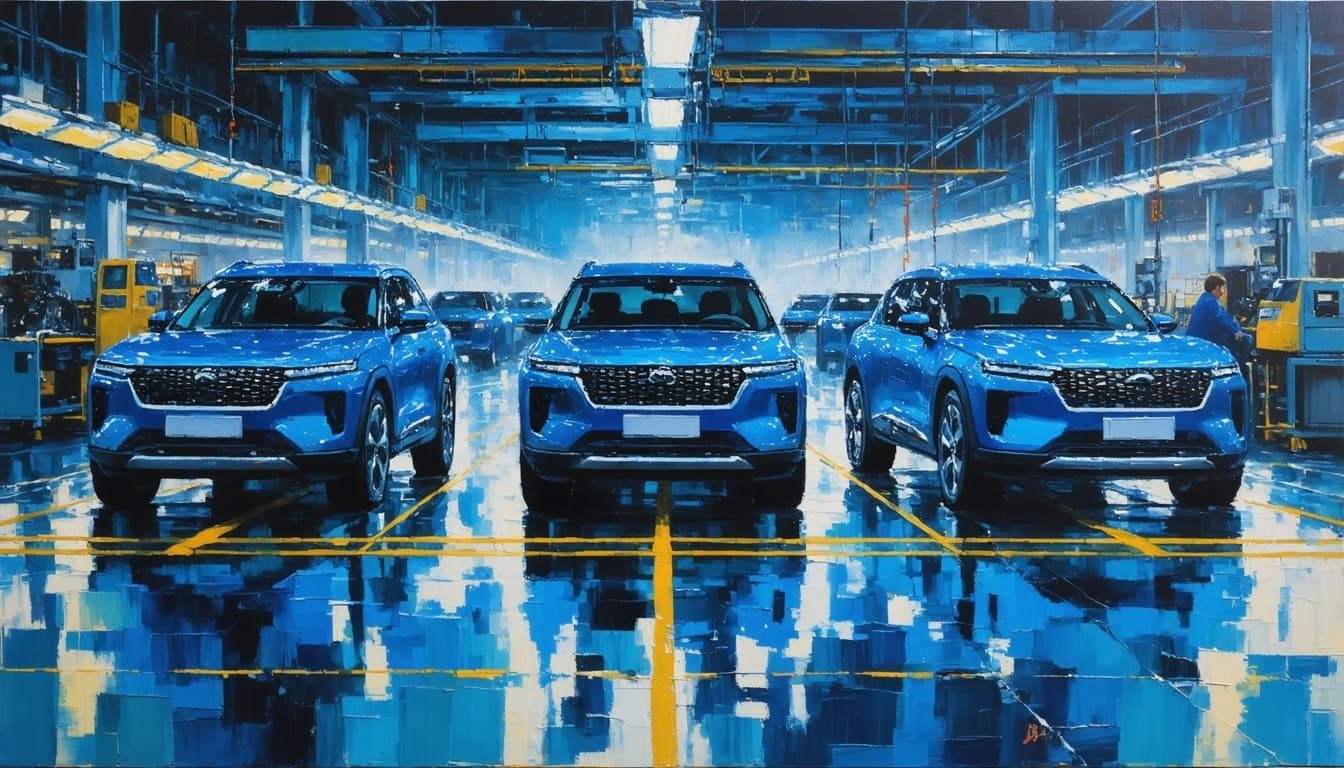
Tata Motors didn't just grow in Q1 FY27—it sprinted. The company retailed 174,299 passenger vehicles between April and June, up 39.5% from 124,984 units a year earlier. Market share expanded from 12.5% to 14.2%, putting clear daylight between Tata and its nearest rivals. Mahindra & Mahindra managed 165,402 units (13.5% share), while Hyundai Motor India slipped to 140,552 units (11.5%). Maruti Suzuki remained the untouchable leader with 498,632 registrations and a 40.7% share.
What makes this performance remarkable isn't just the growth—it's the consistency.
This wasn't a flash in the pan.
The Powertrain Advantage
Tata's secret weapon isn't a single model—it's a multi-powertrain strategy that covers more bases than any competitor. While rivals bet big on specific technologies, Tata spread its bets: petrol, diesel, CNG, and electric vehicles across its portfolio.
The electric vehicle bet has paid off spectacularly. Tata commands over 40% of India's EV market, with volumes more than doubling in Q1 FY27 (112% year-on-year growth). June 2026 saw record monthly EV sales of 14,800 units. The Punch.ev and Nexon.ev have become mainstream choices, not niche experiments. Meanwhile, factory-fitted CNG options on the Tiago, Tigor, and Punch have allowed Tata to match Maruti Suzuki's strength in the affordability segment, where running costs matter more than upfront price.
This powertrain diversity creates a broader retail base. Whether a customer wants the lowest running cost (CNG), the lowest total cost of ownership (EV), or traditional diesel torque for highway driving, Tata has an answer. Competitors are playing catch-up—Hyundai's first sub-4-meter electric SUV arrives only around Diwali 2026, while Mahindra's EV efforts remain niche.
Volume Anchors and Premium Aspirations
Tata's growth rests on two pillars: the Punch and Nexon. In May 2026 alone, these models contributed 39,308 units—67% of Tata's total sales. The Punch sold 20,208 units (up 54% year-on-year), while the Nexon added 19,100 units (up 46%). These aren't just successful models; they're the number one and number three best-selling vehicles in their segments, providing the volume foundation that funds everything else Tata does.
But volume alone doesn't build a sustainable business. That's where the Sierra comes in. Launched as Tata's premium lifestyle SUV, the Sierra represents the company's bid for margin improvement and brand elevation. It's already Tata's third-best-selling model at 6,606 units in May 2026, despite production constraints. More importantly, it's India's first internal combustion engine passenger car engineered for full over-the-air software updates, positioning Tata at the forefront of the software-defined vehicle trend.
The problem? Demand is outstripping supply. Sierra customers face extended waiting periods, and the company is racing to accelerate production. This bottleneck isn't just frustrating buyers—it's costing Tata market share. Every month the Sierra can't meet demand represents lost sales and potential defections to competitors.
The Margin Trade-off
Here's the strategic tension: Tata's volume-driven strategy delivers market share but sacrifices margin per unit compared to rivals. The Punch and Nexon compete in the mass market (roughly INR 6-15 lakh), where discount pressure is intense and feature wars never end. Mahindra & Mahindra, by contrast, has built its business around premium SUVs like the XUV700 and Scorpio-N (INR 13-28 lakh), where higher prices and lower discount intensity translate to superior margins.
The company is trading volume growth for margin protection. It's a rational strategy, but it creates a competitive vulnerability. In a growing market, volume leadership creates its own advantages: economies of scale, dealer network utilization, and brand visibility that money can't buy.
Tata faces the opposite challenge. It has the volume but needs the margins. The Sierra is the answer—but only if production can catch up with demand.
Get this right, and Tata could push toward 15-16% market share. Get it wrong, and Mahindra could close the gap.
The Competitive Storm on the Horizon
Tata's early FY27 lead is real, but the competitive landscape is about to get more crowded. Hyundai Motor India is preparing a comprehensive product offensive over the next 12-18 months. A sub-4-meter electric SUV launching before Diwali 2026 will directly challenge Tata's EV dominance. A new mid-size SUV (rumored to be Bayon-based) arrives in early 2027, targeting the Nexon's heartland. And a next-generation Creta refresh could reverse the current model's 10% year-on-year decline.
Mahindra isn't standing still either. The XUV 3XO is adding volume in the compact SUV segment, while the BE 6e and XEV 9e represent Mahindra's push into electric vehicles. The company's premium positioning remains a formidable advantage—customers willing to pay INR 20-25 lakh for an SUV are less price-sensitive and more loyal to brand equity.
Then there's the portfolio concentration risk. Tata's 67% dependence on Punch and Nexon creates vulnerability. If consumer preferences shift or competitors launch superior products in these segments, Tata has limited fallback options. The Sierra helps, but it's one model against a portfolio that needs more depth.
What Comes Next
The next six months will determine whether Tata's Q1 FY27 performance was a milestone or a peak. The immediate priority is clear: accelerate Sierra production to capture demand before frustrated customers walk away to Mahindra's XUV 3XO or Hyundai's upcoming launches.
But production fixes are short-term solutions. The medium-term challenge is portfolio diversification. Tata needs additional volume models to reduce its Punch-Nexon dependence. It needs premium offerings to improve average selling prices. And it needs to defend its EV leadership against Hyundai's entry and Maruti Suzuki's inevitable push.
The five-year transformation that brought Tata to this point has been impressive. From a company briefly occupying second place to one establishing an early lead in FY27, the turnaround has been built on strategic bets that paid off: SUV-first positioning, multi-powertrain leadership, and execution excellence in manufacturing and distribution.
Sustaining the No. 2 position will require more of the same—plus some new tricks. The passenger vehicle market is growing, but it's also getting more competitive. Maruti Suzuki's 40.7% market share shows that dominance is possible with the right strategy. Tata has the volume. It has the technology. The question is whether it can balance market share leadership with the margin improvement needed to fund the next phase of growth.
The Sierra bottleneck is both a problem and a preview. It shows that Tata's products can generate premium demand. Now the company needs the production capacity and portfolio depth to capture it without sacrificing the volume foundation that got it here.