Energy Transition: Ports, Power, and Solar Manufacturing
Adani Ports and Special Economic Zone (APSEZ) has achieved a significant milestone at Dhamra Port in Odisha, shifting entirely to renewable electricity. The port now consumes over 108 GWh annually, making it India's first large private multi-cargo port to run fully on clean power. This transition, effective August 2026, is part of APSEZ's broader Net-Zero strategy targeting carbon neutrality by 2025 and net-zero emissions by 2040. The move directly addresses Scope 2 emissions while delivering tangible cost benefits. One APSEZ port already achieved approximately 5% reduction in electricity costs per unit through renewable procurement. The company has also implemented an internal carbon pricing mechanism at USD 20 per metric tonne of CO2 equivalent, generating USD 9.5 million (about ₹79 crore) in FY 2024-25 for reinvestment in renewable projects AnnualReports +1.
Dhamra's renewable power is sourced through a strategic three-tier mix under Odisha's regulatory framework. About 25-30% comes from APSEZ's captive hybrid power plant at Khavda in Gujarat, another 10-15% through third-party access arrangements, and the remaining 55-65% via a Green Consumer arrangement with Odisha's distribution utility. This balanced approach optimizes capital efficiency while ensuring 24/7 power availability. Captive generation offers the lowest long-term operating costs but requires significant upfront investment. Third-party access provides moderate capex with predictable long-term pricing, while the green consumer arrangement minimizes upfront costs but exposes the port to potential regulatory changes and premium tariffs .
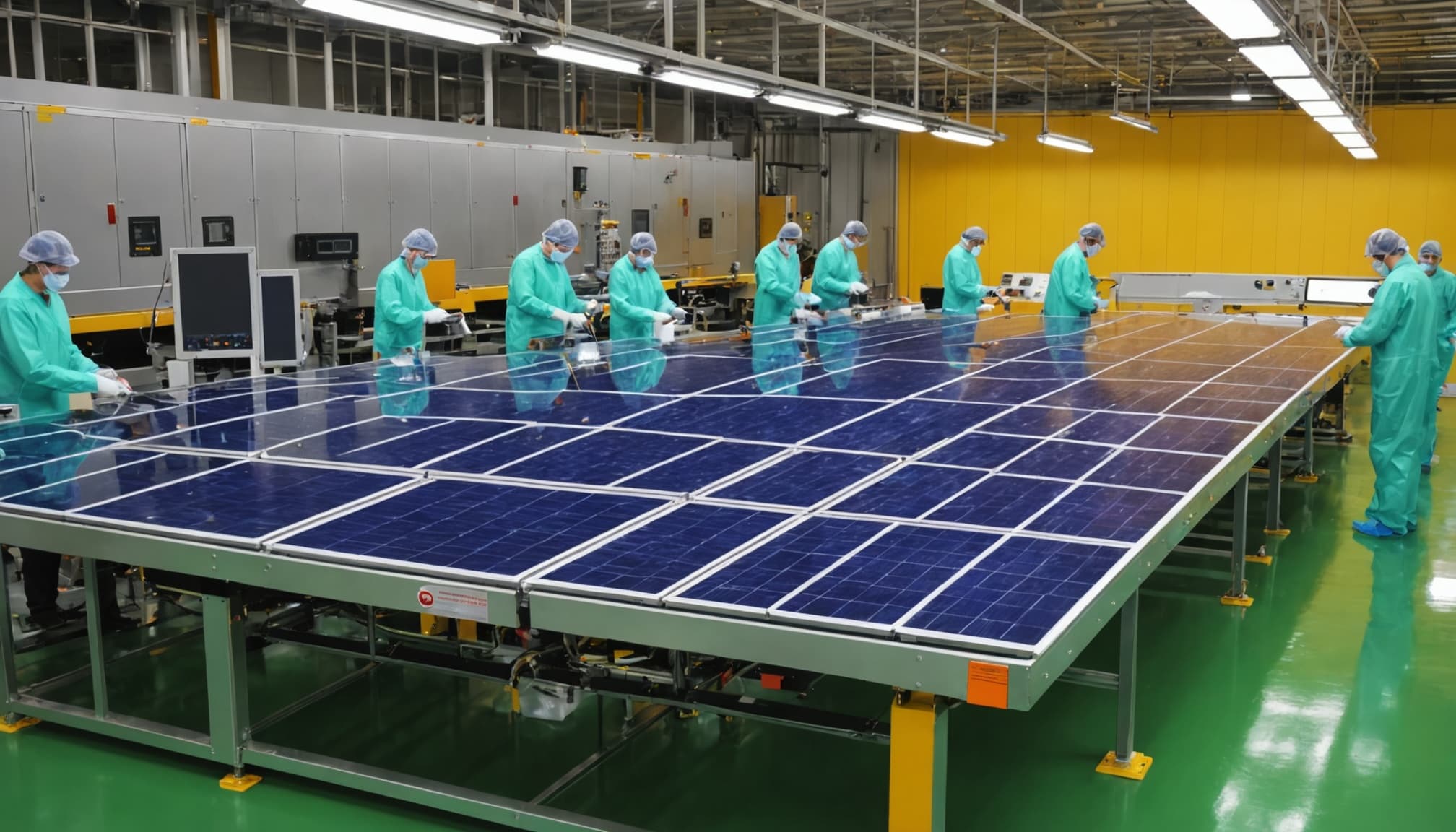
In solar manufacturing, Fujiyama Power Systems is advancing its technology positioning with a 1.2 GW TopCon solar cell manufacturing facility at Ratlam, Madhya Pradesh. The company currently operates a 1 GW Mono PERC facility at Dadri, Uttar Pradesh. TopCon technology offers higher efficiency (~24-25%) compared to conventional PERC (~22-23%), along with lower degradation rates and superior bifacial performance. The ₹350 crore investment translates to approximately ₹292 per watt of capacity. Backward integration into cell manufacturing typically adds 5-8% to EBITDA margins compared to module-only assembly. Commercial operations are expected to commence in Q1 FY2028. This expansion strengthens Fujiyama's position in the B2C rooftop solar market, particularly under the Pradhan Mantri Surya Ghar Muft Bijli Yojana, where inclusion in MNRE's ALMM-II list provides preferential access to government projects requiring domestic content .
NTPC Limited is accelerating its low-carbon transition through a 50:50 joint venture with EDF Power Solutions India, signed on September 25, 2026. The partnership will develop, own, and operate pumped storage projects, hydropower, and other renewable energy ventures within India and neighboring countries. This collaboration aligns with India's ambitious target of 100 GW pumped storage capacity by 2036. NTPC currently has 18 GW of pumped storage projects in its pipeline and aims to achieve 60 GW of renewable energy capacity by 2032. The JV leverages EDF's international expertise in low-carbon power plants and flexibility solutions, complementing NTPC's domestic market presence. For NTPC, which derives significant revenue from thermal generation, this partnership represents a strategic shift toward a balanced clean energy portfolio, with pumped storage providing the grid flexibility essential for high renewable penetration Others +1.
Capital Allocation: IPOs, Warrants, and Infrastructure Commissioning
Coal India Limited is advancing its subsidiary listing strategy with two major offerings in FY27. Mahanadi Coalfields Ltd (MCL) has filed draft IPO papers with SEBI, proposing an offer for sale of 66.18 crore shares (10% stake) by Coal India. MCL reported a profit after tax of ₹10,698 crore in FY 2025-26 and coal production of 218.31 million tonnes, making it India's largest coal producer. South Eastern Coalfields Ltd (SECL) has appointed investment banks for a potential $800 million IPO (~₹6,700 crore) and could file draft papers by December 2026. SECL reported a profit after tax of ₹4,755 crore and coal production of 176.29 million tonnes in FY 2025-26. These offerings could generate combined proceeds of ₹13,000-15,000 crore for Coal India, which currently maintains a conservative debt-to-equity ratio of 0.11. The IPO proceeds will substantially reduce leverage, potentially creating a net cash position, while establishing independent market valuations for high-producing subsidiaries InvestorPresentations +2.
Aequs Limited has approved a ₹650 crore preferential issue of convertible warrants to its promoter group. The transaction involves 2.80 crore warrants at ₹231.55 each, with a 50% upfront payment of ₹325 crore—double the SEBI minimum requirement of 25%. The balance is payable upon conversion by December 31, 2027. This infusion will increase promoter stake from 59.09% to 60.73% and significantly improve the company's capital structure. Aequs' debt-to-equity ratio, which improved from 0.88x (Q1 FY26) to 0.34x (Q1 FY27) post-IPO debt repayment, could decline further to approximately 0.33x upon full warrant conversion. The equity funding avoids interest costs of approximately ₹40-50 crore annually and protects return on capital employed during expansion. The proceeds will fund capacity expansion across aerospace and consumer businesses, supporting an aerospace order book that has crossed $1 billion Others +2.
NMDC Limited has commissioned its ₹5,427 crore integrated project in Bastar, Chhattisgarh, comprising a 2 MTPA pellet plant at Nagarnar, a 4 MTPA iron ore processing plant at Bacheli, and a 135 km slurry pipeline connecting the two. The project enables processing of low-grade fines and slimes from Bailadila operations into value-added products. NMDC is targeting 67% Fe grade DR pellets, which command a premium of approximately $20-30 per tonne over standard pellets. Assuming 2 MTPA pellet production at 80% utilization, this could generate additional annual EBITDA of ₹270-400 crore. The slurry pipeline delivers substantial logistics cost savings. Operating costs for slurry pipelines are approximately ₹0.60-0.80 per tonne-km compared to ₹3.50-5.00 for road transport and ₹1.60 for railway freight. For the 135 km pipeline transporting 15 MTPA, this translates to annual savings of ₹5,880-8,505 crore compared to road transport and ₹1,620-2,025 crore compared to rail. The pipeline investment of ~₹3,450 crore could pay for itself in 5-7 months through road transport cost avoidance alone Others +3.
AGI Infra Limited completed a ₹275 crore Qualified Institutional Placement in March 2026, issuing 28.30 lakh equity shares at ₹265 each. The QIP strengthens the company's capital base, reducing its debt-to-equity ratio from 0.43 to approximately 0.27. AGI Infra maintains a substantial land bank of approximately 165 acres across New Chandigarh, Ludhiana, and Jalandhar, plus 6,25,000 sq. ft. of FAR at Mohali. The company's project portfolio includes completed projects of ~95.19 lakh sq. ft., ongoing projects of ~168.26 lakh sq. ft., and upcoming projects of ~78.73 lakh sq. ft. The equity raise provides financial flexibility for land acquisition and project execution while maintaining an optimal capital structure. In the same period, the company acquired 60% in Worldnext Realty LLP for ~₹30 crore and received a license for the 'AGI Green Crest' group housing project (452 flats) in Jalandhar Others +5.
Regulatory and Governance Developments
The Ministry of Power has extended Section 11 directions under the Electricity Act, 2003 for Tata Power Company Limited's Mundra Thermal Plant until December 31, 2026. Section 11 is an emergency provision empowering the government to direct power plants to operate at full capacity during power shortages, with generators receiving full compensation for actual cost of generation. The Mundra plant (4,000 MW across five 800 MW units) resumed operations in April 2026 after a nine-month shutdown and has achieved 94% availability under Section 11. The tariff mechanism provides full pass-through of actual coal costs, ensuring no operating losses. Tata Power is working toward concluding a long-term supplementary PPA with five procurer states, which would provide stability through 2038. The Gujarat cabinet has already approved the Supplementary PPA. With international coal prices remaining softer, Mundra's power has become attractive in the merit order dispatch system, supporting long-term viability Transcripts +2.
Fortis Healthcare Limited received clarification from the Supreme Court on September 25, 2026, regarding the forensic audit ordered by the Delhi High Court. The apex court clarified that various paragraphs in the High Court judgment were "tentative and only for the purpose of making out a case for forensic audit" and that the audit would be conducted independently without being influenced by those observations. The High Court has not imposed any liability, penalty, or fine on the company. Fortis was neither a party to the underlying arbitration nor a judgment debtor. The dispute originates from a 2016 Singapore arbitral award directing the Singh brothers (erstwhile promoters) to pay Daiichi Sankyo approximately ₹2,562 crore, with outstanding claims now estimated at ₹5,300 crore. Based on management's assessment, any further financial impact is not expected to be material, as the company had already recognized provisions in FY2021 for contingencies related to pre-2018 transactions Others +3.
Zydus Lifesciences Limited achieved a significant regulatory milestone with a successful USFDA inspection at its New Jersey office from September 22-25, 2026. The inspection of the company's pharmacovigilance and post-marketing surveillance system concluded with NIL observations, demonstrating robust compliance frameworks. The United States accounts for approximately 40-44% of Zydus' pharmaceutical business mix, making regulatory compliance critical for sustained growth. The successful inspection supports the company's strategic initiatives in orphan and rare disease franchises, 505(b)(2) products, and specialty complex products (which represent approximately 35% of R&D spending). Zydus operates 41 manufacturing facilities globally, including 16 USFDA-inspected facilities. Recent approvals include generic Ascorbic Acid Injection and Indocyanine Green for Injection, both with 180-day Competitive Generic Therapy exclusivity Others +3.
Petronet LNG Limited has sought shareholder approval to continue paying commission to directors, capped at 1% of annual profits, for FY2026-27 to FY2030-31. The proposal follows a well-established five-year approval cycle, with previous approvals granted in 2007, 2011, 2016, and 2021. In FY26, whole-time directors received ₹26.5 lakh each as commission, while independent directors received ₹10 lakh each. These payments represent only 27.1% of the combined eligible limit of ₹134.5 lakh and 0.0057% to 0.0085% of Profit Before Tax historically. Petronet operates with a unique governance structure—registered as a private limited company despite having state-owned shareholders—which enables higher remuneration levels and a retirement age of 65 compared to 60 for typical PSUs. MD & CEO Akshay Kumar Singh, who will superannuate in May 2027, received total remuneration of ₹3.64 crore in FY26. The company's strong financial position (FY26 net profit of ₹3,843 crore, debt-to-equity of 0.12) provides justification for the continued commission arrangement while maintaining conservative utilization of approved limits AnnualReports +2.