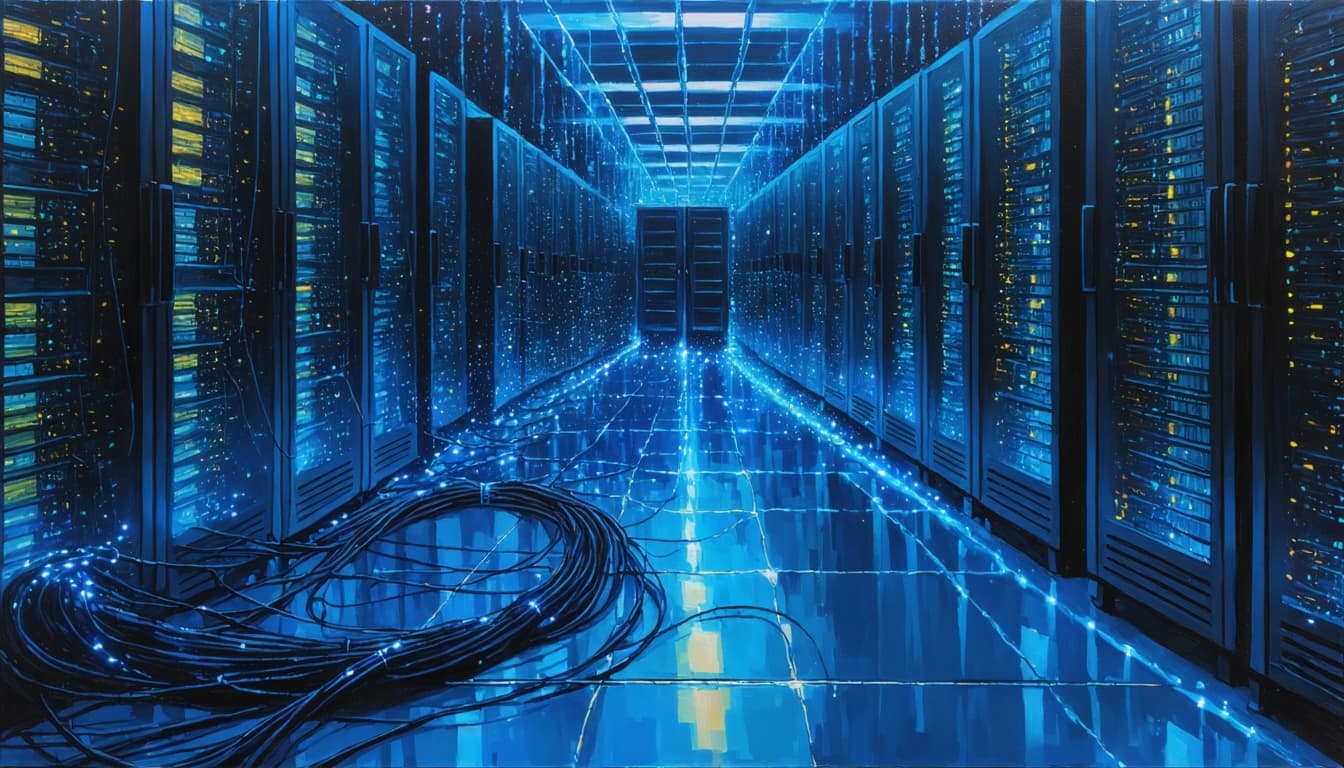
The artificial intelligence boom is reshaping data centre architecture, and Sterlite Technologies has emerged as a primary beneficiary. Global hyperscalers are collectively committing $660-690 billion to capex in 2026, nearly doubling 2025 levels. This spending surge is fundamentally altering optical fiber demand. AI workloads create dense fiber interconnections, with GPU racks requiring 36 times more fiber than traditional CPU setups. Nearly 70% of data centre demand is expected to be AI-led by 2030, driving exponential increases in fiber per rack. GPU architectures are rapidly shifting from 400-gig to 800-gig and up to 1.6-Terabit speeds, where copper reaches bandwidth thresholds and fiber becomes essential. Transcripts +1
The $1 Billion Hyperscaler Contract
In May 2026, Sterlite Technologies announced a transformative multi-year Product Award Letter valued at over $1 billion (₹10,000 crore) from a US-based hyperscaler for AI data centre build-outs. This deal alone exceeds the company's FY26 revenue of ₹4,745 crore and provides execution visibility through FY29. The contract includes a risk-sharing framework that protects margins against demand fluctuations. CLSA increased earnings forecasts by 25-64% over FY27-29 following this announcement, modeling a 49% EBITDA CAGR for the period. The order book grew 67% year-on-year to ₹7,309 crore even before this award, and the hyperscaler deal adds another 137% to that base. Transcripts
India's Data Centre Growth: Supporting Narrative, Not Primary Driver
India's data centre IT load has expanded from 350 MW in 2019 to 1.5-1.6 GW in 2025, representing a 29% CAGR compared to roughly 20% globally. This growth elevated India's share of global data centre capacity from 1.5% to 2-3%. However, the 500% stock rally is more directly attributable to the US hyperscaler order rather than domestic capacity expansion. India's growth story provides additional credibility and diversification but is not the primary catalyst. Management expects India's data centre capacity to grow 5x from 1.4 GW in 2025 to 8 GW by 2030, driven by commitments from hyperscalers, Indian conglomerates, and domestic majors. Transcripts
Neuralis Portfolio: Technical Differentiation
Sterlite's Neuralis AI Data Centre portfolio represents a comprehensive reimagining of connectivity for the AI era. The Celesta IBR cable series supports up to 6,912 fibers in a single cable—4-8 times higher density than traditional solutions. This enables full GPU compute building deployment in one duct pull, with 62% of duct space still free. The portfolio features breakthrough technologies including Hollow Core Fiber (HCF) that delivers 46% faster transmission with ultra-low latency, and Multi-Core Fiber (MCF) providing 4-7x higher capacity within the same physical footprint. Factory-terminated solutions reduce deployment complexity by 60-70% and accelerate time-to-service, critical for rapidly scaling AI infrastructure. InvestorPresentations
Vertical Integration: The Competitive Moat
Sterlite maintains full-stack integration from glass preform to pre-terminated assemblies. This "glass-to-gigabit" capability provides unique advantages: supply chain security through glass preform ownership, end-to-end quality control, cost efficiency through integrated manufacturing, and innovation capability from material science to smart optical systems. During recent AI infrastructure build cycles, non-integrated vendors faced significant supply constraints while Sterlite maintained delivery schedules. The company has achieved its highest ever connectivity attach rate of 23% by delivering purpose-engineered solutions, demonstrating customer preference for integrated offerings from a single vendor. InvestorPresentations +1
Operational Factors Enabling 49% EBITDA CAGR
CLSA's projection of 49% EBITDA CAGR for FY26-29 is supported by several operational improvements. Sterlite has demonstrated consistent margin expansion over the last six quarters, with Q4 FY26 achieving 15.1% operational EBITDA margin. Management targets 20% EBITDA margin by Q4 FY27. Capacity utilization is increasing from 45-50% to over 70%, driving operating leverage. The Enterprise & Data Center segment is expected to scale from 19% of FY26 revenues to 30% in the current fiscal, with data center products carrying superior margins due to advanced, patented offerings. Geographic mix optimization is also contributing, with North America's share increasing from 25% in FY25 to 39% in FY26. Transcripts +4
Valuation: Stretched Multiples and Growth Expectations
Sterlite trades at exceptionally elevated valuation multiples—Forward P/E of 543x, P/B of 12.53x, and P/S of 6.24x. The current P/E of 544x represents a 602% premium to the 5-year average of 77.6x. Even compared to ITI Limited (125x P/E), Sterlite trades at a 334% premium despite operating in similar segments. The Price-to-Earnings Growth (PEG) ratio stands at 2.8, traditionally indicating investors are paying a significant premium relative to expected growth rates. These multiples price in perfection—flawless execution of the hyperscaler contract, sustained AI capex growth, and additional order wins.
Risks from AI/Telecom Capex Slowdowns
The valuation is exceptionally fragile due to several risks. Hyperscaler capex sustainability concerns include power constraints (Microsoft's $80 billion Azure backlog unfulfilled due to power availability), return on investment gaps (infrastructure built today may take 18-36 months to generate proportional returns), and efficiency gains that could reduce compute requirements per workload. Traditional telecom capex faces headwinds from 5G rollout maturation, BharatNet delays, and fiber overcapacity. With 81% of FY26 revenue from Telecom & Citizen Networks, any slowdown in traditional telecom spending would significantly impact Sterlite's revenue base. Execution risks include supply chain bottlenecks, technology obsolescence, customer concentration, and margin compression. InvestorPresentations
Sterlite vs. Vedanta: Focused Strategy vs. Diversified Conglomerate
Sterlite's strategic focus on AI data centre connectivity creates a distinct growth trajectory independent of parent Vedanta's diversified natural resources portfolio. Vedanta operates across zinc, lead, silver, copper, iron ore, steel, aluminium, power, nickel, oil & gas, and glass substrates—with FY26 revenue of ₹177,194 crore. Sterlite's focused AI infrastructure play offers higher growth potential (46% projected FY27 revenue growth), technology leadership with 700+ patents, premium valuation multiples due to the AI growth narrative, and higher margin potential through patented AI-specific products. While Vedanta provides financial backing and operational expertise, Sterlite's growth is driven by AI adoption, hyperscaler relationships, and technology leadership—factors independent of commodity cycles.
The Path Forward
Sterlite Technologies has established genuine differentiation in the AI data centre market through technical innovation, vertical integration, and hyperscaler relationships. The $1 billion contract provides unprecedented revenue visibility through FY29. However, the current valuation of ₹28,490 crore market capitalization at 543x forward P/E requires flawless execution. Any delay in AI/telecom capex or execution shortfall could trigger 50-70% downside as the market rapidly re-rates the stock from a growth story to a traditional optical fiber manufacturer. The next 12-18 months will be critical as the company scales the Enterprise & Data Centre segment from 19-20% to 25-30% of revenues and begins executing the hyperscaler contract. Success depends on maintaining technology leadership, expanding the customer base beyond the initial hyperscaler win, and achieving the 20% EBITDA margin target while navigating supply chain complexities and potential AI capex moderation.