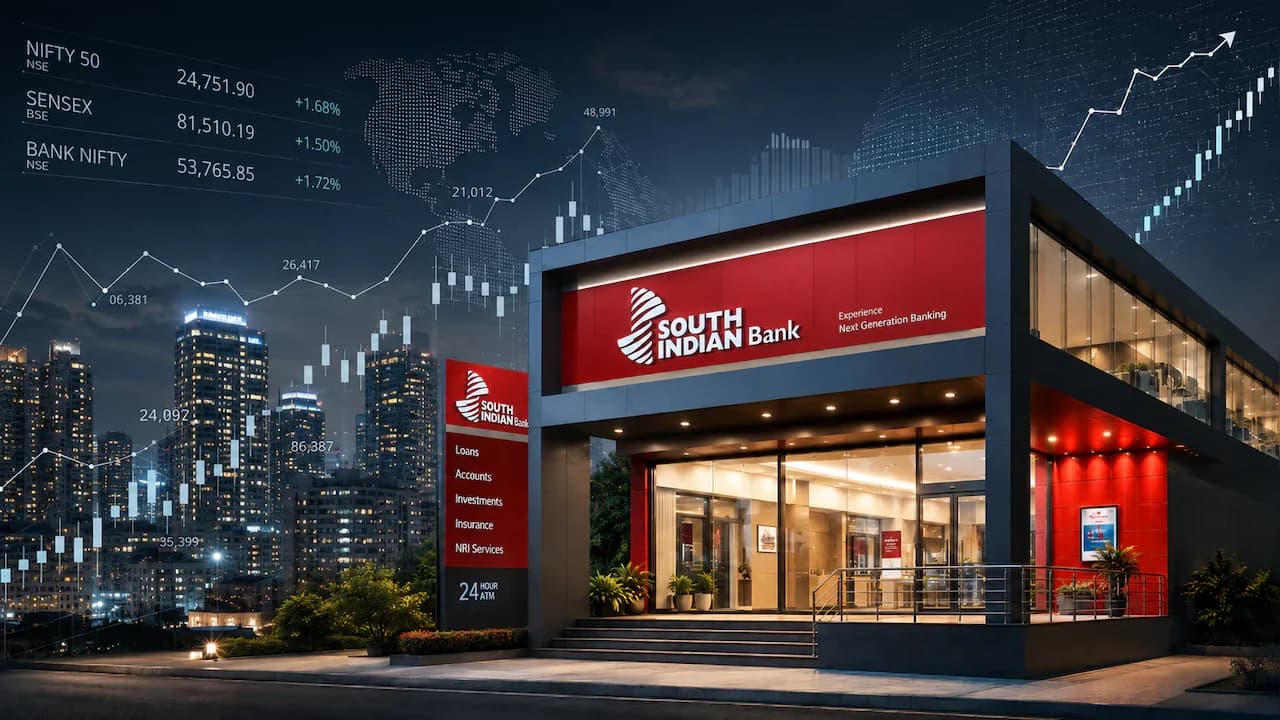
South Indian Bank finds itself at a crossroads. The Thrissur-based lender has made remarkable progress on asset quality—GNPA has plummeted to 1.38% from 3.15% a year ago, while NNPA sits at just 0.26%, below pre-COVID levels. Yet profitability headwinds persist. Non-interest income collapsed 39% year-over-year in Q1 FY27, with treasury and forex income plunging 83%. The cost-to-income ratio deteriorated to 57.9%, and the bank missed positive operating leverage in the quarter. These challenges necessitated bringing in Mahesh Muralidhar Pai, a veteran banker with nearly three decades at Canara Bank, where he most recently served as Chief General Manager spearheading digital banking and innovation. Transcripts +4
Timing and Strategic Alignment
Pai assumes office on October 1, 2026, precisely when incumbent MD & CEO P.R. Seshadri's term concludes. This transition coincides with a critical phase in South Indian Bank's turnaround strategy. The bank is actively shifting from corporate-led lending to retail and MSME segments—a transformation already underway but requiring acceleration. With capital adequacy at a robust 19.62% (well above the RBI's 11.50% minimum), the bank has the balance sheet strength to support growth. However, deploying this excess capital efficiently into higher-yielding assets while maintaining asset quality discipline remains the core challenge. Pai's appointment signals the board's intent to execute this pivot with greater urgency. Others +2
Expertise Meets Constraints
Pai's track record directly addresses South Indian Bank's specific constraints. He successfully established Canara Bank's gold loan vertical—experience that aligns perfectly with South Indian Bank's strategy to grow gold loans to 22% of total advances. The gold loan portfolio already surged 43% year-over-year to ₹24,930 crores in Q1 FY27. His background in treasury and foreign exchange is equally relevant given the bank's 83% decline in treasury income. Furthermore, his experience heading one of Canara Bank's largest zones brings operational rigor needed to restart branch expansion after a three-year freeze. Perhaps most importantly, Pai is recognized for strategic clarity and execution excellence—qualities critical for a bank in the midst of complex portfolio rebalancing. Others +5
Asset Quality and Profitability Metrics
The immediate impact on asset quality will likely be positive. South Indian Bank's new loan book originated since October 2020 carries a GNPA of just 0.38%, validating its underwriting standards. Management targets slippages of ₹500-750 crores for FY27, with recoveries expected at ₹800-1,000 crores. On profitability, the pressure is more acute. Net interest margins stand at 3.23%, and management guides to sustain this within a 3.20%-3.35% corridor. Pai's expertise in shifting the asset mix toward higher-yielding retail and MSME segments (which carry risk weights of 100-150% versus lower corporate weights) should support NIM expansion. The cost-to-income ratio, currently at 57.9%, needs to return to the 52-54% range through digital efficiency gains and branch productivity improvements. Transcripts +3
Capital Efficiency and Return Ratios
The bank's Return on Assets currently sits at 1.05%, with management targeting migration to 120-125 basis points over time. Pai's capital allocation strategy will be crucial here. The plan involves growing the balance sheet at market rate plus 2% while changing the asset mix toward higher-yielding segments. This strategic shift aims to improve spreads and returns despite higher capital charges. As RoA improves, Return on Equity—currently at 12.84%—should automatically benefit given the bank's leverage profile. The key will be executing this transition without compromising the strong capital buffer that currently stands at 8.12% above regulatory minimums. InvestorPresentations +3
Regulatory Compliance and Supervisory Engagement
South Indian Bank faces no immediate supervisory concerns. Its CRAR of 19.62% is far above PCA trigger thresholds, and GNPA at 1.38% is well within comfortable limits. Pai's public sector banking background and his recognition by the Financial Services Institutions Bureau as a future leader in 2022 should strengthen constructive engagement with the RBI. His governance experience, including directorships at Canara Bank Tanzania Ltd and Karnataka State Financial Corporation, brings sophisticated understanding of regulatory frameworks. On priority sector lending, the bank consistently exceeds targets—achieving 41.97% against the 40% requirement. Pai's agriculture and MSME expertise will help maintain this compliance while optimizing the risk-weighted asset mix through strategic PSL certificate trading. InvestorPresentations +6
Portfolio Transformation and Digital Acceleration
The loan book composition is already shifting—corporate exposure has decreased from 42% to 40%, while RAM (Retail, Agri, MSME) segments increased from 58% to 60%. The long-term target is 33% corporate and 67% RAM. Gold loans, mortgage loans, and MSME business loans are driving growth, with gold loans targeting 22% of total advances. On the deposit side, CASA improved to 32.98% (up 92 basis points), and bulk deposits were reduced by 50% year-over-year. Pai's digital banking leadership will accelerate the "Trust and Technology" positioning. The bank already conducts 98%+ transactions digitally and has established an AI Centre of Excellence with its in-house "Zeni" framework. Digital lending platforms like GST Power, LAP Power, and SIB RED are operational. Pai's task is to scale these initiatives to achieve the target of 40-50% of new customer acquisitions through digital channels. InvestorPresentations +6
Competitive Positioning and Investor Sentiment
South Indian Bank trades at a significant valuation discount to peers—P/B ratio of 1.07x versus 1.2-1.7x for regional private banks like Federal Bank, Karur Vysya, and City Union Bank. Analyst consensus targets ₹51-52 over the next 12 months, implying roughly 8-9% upside from current levels. However, the re-rating potential is substantial if execution improves. The stock has already delivered strong returns—up 64.66% over the past year and 39.30% over six months. Investor sentiment around Pai's appointment was initially cautious (the stock dropped 7.26% on the RBI approval announcement in July), but this appears to be a classic "buy the rumor, sell the news" reaction rather than fundamental concern. The stock has since recovered and trades near its 52-week high of ₹50.68.
The Value Proposition Under Pai
Pai's leadership aims to differentiate South Indian Bank through a unique combination of PSB-scale stability and private-sector agility. His gold loan expertise, MSME specialization focus, and digital transformation acceleration create a distinct value proposition. The bank's NRI franchise (28-30% of deposits) provides a stable funding base, while its regional strength in Kerala (37% of MSME book) offers expansion opportunities in South India and beyond. The critical test will be whether Pai can deliver the RoA improvement to 1.20-1.25%, maintain GNPA below 1.2%, and achieve the P/B re-rating to 1.3-1.5x that analysts believe is possible. If successful, South Indian Bank could emerge as a leading mid-cap private sector bank with a specialized niche in gold loans and MSME banking, backed by digital-first operations and strong risk discipline. InvestorPresentations +1