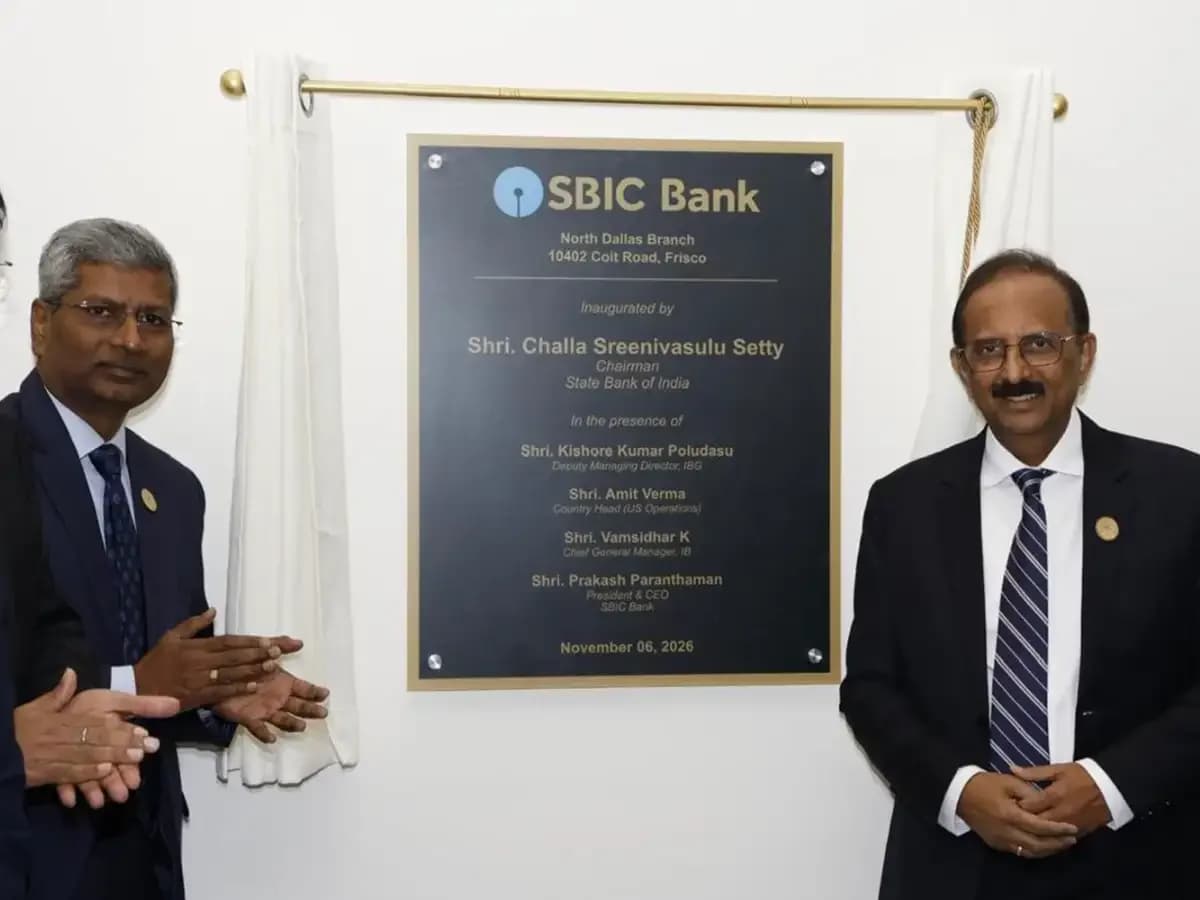
State Bank of India didn't pick Frisco, Texas, at random. The bank chose Dallas because it's a major commercial center, setting up the outpost to handle retail deposits, commercial lending, global remittances, and specialized services for Non-Resident Indians (NRIs). The branch sits in the rapidly growing North Dallas region, designed to serve individuals, professionals, entrepreneurs, and corporate entities across North Texas.
The diaspora angle is straightforward. The Consul General of India in Houston highlighted the branch's role in bolstering India-US economic ties while enhancing financial connectivity for the fast-growing Indian diaspora in North Texas. Chairman Challa Sreenivasulu Setty put it plainly: the expansion beyond California reflects a commitment to serve vibrant local communities and the Indian diaspora, while deepening financial and economic ties between the two countries.
This isn't entirely new territory. Management had flagged Dallas earlier, enabled by multi-state branching rules, as the one area where US retail expansion might actually make sense. The Frisco branch is the execution of that plan—a targeted addition rather than a broad branch rollout. Transcript
The Strategic Shift: Seven to Eight Branches
On paper, going from seven to eight branches doesn't sound like much. But this is SBIC Bank's first office outside California, and that's the headline. Setty called the Texas branch "a significant milestone in SBI's international growth journey".
The broader context matters here. SBI's stated international strategy has been cautious. Management has repeatedly said the bank won't expand overseas aggressively, describing the US as a wholesale market where expansion should be selective. They've emphasized building retail reach through YONO Global, the digital app, rather than new physical branches. Dallas is the exception they signaled—a calculated step into a new state, not a departure from their digital-first approach. Transcript
Dallas offers commercial advantages that California doesn't. It's a major business hub with different economic drivers, including energy, real estate, and technology. For SBIC Bank, this means access to new corporate clients and commercial lending opportunities. The branch's product mix—retail deposits, commercial lending, and remittances—matches the stated aim of serving both the diaspora and local businesses.
Foreign Advances and Deposits: The Growth Engine
The Texas branch lands amid strong overseas growth. For the quarter ended September 30, 2026, foreign advances rose 22.86% year-on-year to Rs 8,31,332 crore, while overseas deposits increased 22.61% to Rs 2,83,319 crore. These figures come from news reports and weren't directly verified in SBI's investor materials, but they align with management's commentary on healthy overseas growth. Transcript
What drove that 22.86% advance growth? In rupee terms, it looks massive. But in dollar terms, growth was 13.84%. The gap is mostly currency translation—a weaker rupee inflates the rupee value of dollar loans. The underlying growth is closer to the dollar figure. Investor Presentation +1
The drivers are clear. External Commercial Borrowings (ECBs) and local credit are major contributors. Customer credit growth came mainly from US operations, London, GIFT City, the Middle East, and East Asia branches. FCNR(B) deposits played a big role too. SBI raised about $10.9 billion against a $10 billion target, with about $8.83 billion lent through foreign offices. Investor Presentation +2
On deposits, the story is about funding costs. The cost of deposits at foreign offices fell from 3.85% to 3.52% year-on-year, while yields on advances dropped from 5.06% to 4.56%. The overseas spread narrowed by about 17 basis points. Management said FCNR(B) flows were mainly used to replace wholesale deposits, which lowered funding costs. They also said margins on the FCNR(B)-funded book are comparable or better, with no negative impact on the Net Interest Margin (NIM). Investor Presentation +4
Whole-bank NIM improved to 2.94%, up 8 basis points sequentially, with domestic NIM at 3.11%. The NIM improvement is mainly domestic. Overseas deposits helped keep funding costs in check but didn't drive the expansion.
The Dual Presence Model: Subsidiary Plus Direct Branches
SBI's US structure is a bit unusual. It has eight SBIC Bank subsidiary branches (now including Frisco) plus three direct branches in New York, Chicago, and Los Angeles, alongside a representative office in Washington, DC. The direct branches are wholesale operations. The New York branch is SBI's largest overseas operation. The subsidiary, State Bank of India (California), is a 100%-owned US banking subsidiary. Transcript +2
This dual presence likely splits the business by license type. The wholesale branches handle corporate and trade business, while the locally chartered subsidiary can take US retail deposits and lend locally. Running two regulated structures usually means separate compliance, capital, and reporting overheads. SBI hasn't quantified these costs, and no US-specific compliance cost figures were found in the disclosures. Annual Report
On the digital side, YONO Global offers synergies. The app is live for overseas customers in 14 locations, including Chicago and New York, with more than 4.20 lakh overseas customers onboarded. The "One View" feature lets overseas customers see their domestic SBI accounts in the app. SBI UK, SBI Canada, and SBI California have launched products for Indian students and professionals relocating abroad, allowing onboarding before arrival. While there's no specific plan linking YONO Global to the Frisco branch, the app could support onboarding and account visibility for NRIs, with the branch handling cash, lending, and in-person service. Annual Report +1
SBI's correspondent banking network supports this cross-border activity. The bank has relationships with 222 correspondent banks in 56 countries, managed by its Financial Institutions Group. It works with 50+ remittance partners and holds a reported 25.28% market share in remittances. The Global Payments & Services department handles SWIFT-based rupee remittances, foreign currency cheque collection, and Vostro transactions. The branch's stated remittance and NRI services would plausibly use these existing channels. Annual Report +2
Capital, Risk, and Regulatory Considerations
Here's where the disclosures get thin. SBI hasn't disclosed any capital allocation for the Texas branch. No investment amount, capital infusion, or branch-level return target was found. A single branch in an existing subsidiary is typically funded from the subsidiary's own capital, so it's unlikely to move SBI's group Return on Equity (ROE). For the half year, ROE was 18.68% with Return on Assets (ROA) at 1.14%. Overseas-specific ROE figures aren't disclosed. Annual Report +1
The only overseas profit proxy is FY26 foreign operations, at Rs 14,823 crore of net profit (about 17.8% of the group's) from about 12.4% of assets. This covers all foreign operations, not SBIC Bank, so it says little about Texas. Annual Report
On diversification, one of eight branches doesn't change much. Deposits and loans remain overwhelmingly California-based, so the risk reduction is marginal for now. Texas's economic cycle, including its energy, real estate, and technology sectors, would differ from California's, but SBI hasn't published branch-level lending targets or sector limits.
Credit risk considerations are general, not company-specific. A new branch has no local credit history, which is a seasoning risk. Small and mid-sized business loans in a new market tend to be more cyclical. NRI and diaspora clients bring community ties but also concentration in a single segment. Cross-border borrowers and collateral across two jurisdictions complicate recoveries. There's also a compliance burden from know-your-customer and anti-money-laundering rules on cross-border flows.
On the regulatory front, SBIC Bank is a California state-chartered bank regulated by the Federal Deposit Insurance Corporation (FDIC) and the California Department of Financial Institutions. Management had flagged multi-state branching rules as the enabler for Dallas. I found no filing listing the specific approvals obtained, their timing, or any conditions. A state-chartered bank opening a branch in another state would typically engage its home regulators and the host state, but I haven't confirmed what SBIC Bank actually needed. Transcript
SBI's international footprint is substantial—245 overseas points of presence across 29 countries. Group capital adequacy stands at 16.09% as of Q2 FY27, up 147 basis points year-on-year. Subsidiary-level capital ratios as of March 31, 2026, show State Bank of India (California) with a CET1 ratio of 12.65% and a total ratio of 13.73%. Each subsidiary must meet local capital minimums and is consolidated into group capital. Host-country capital rules and limits on moving capital can leave surplus capital trapped in subsidiaries. Annual Report +1
The Bottom Line
The Frisco branch is a small step in footprint terms but a significant strategic signal. It aligns with SBI's stated objective to serve the Indian diaspora and commercial clients in a strategically important market. It lands amid strong overseas growth, driven by US operations, ECBs, and FCNR(B) deposits. It leverages SBI's correspondent banking network and could eventually tap into YONO Global's digital capabilities. Investor Presentation +2
But the financial impact will take time. A single branch won't move the needle on SBI's group ROE or NIM. The real test will be whether Dallas can grow into a meaningful share of SBIC Bank's book, delivering the diversification and returns that justify the capital and compliance costs. For now, it's a calculated bet on Texas—and on the enduring financial ties between India and the United States.