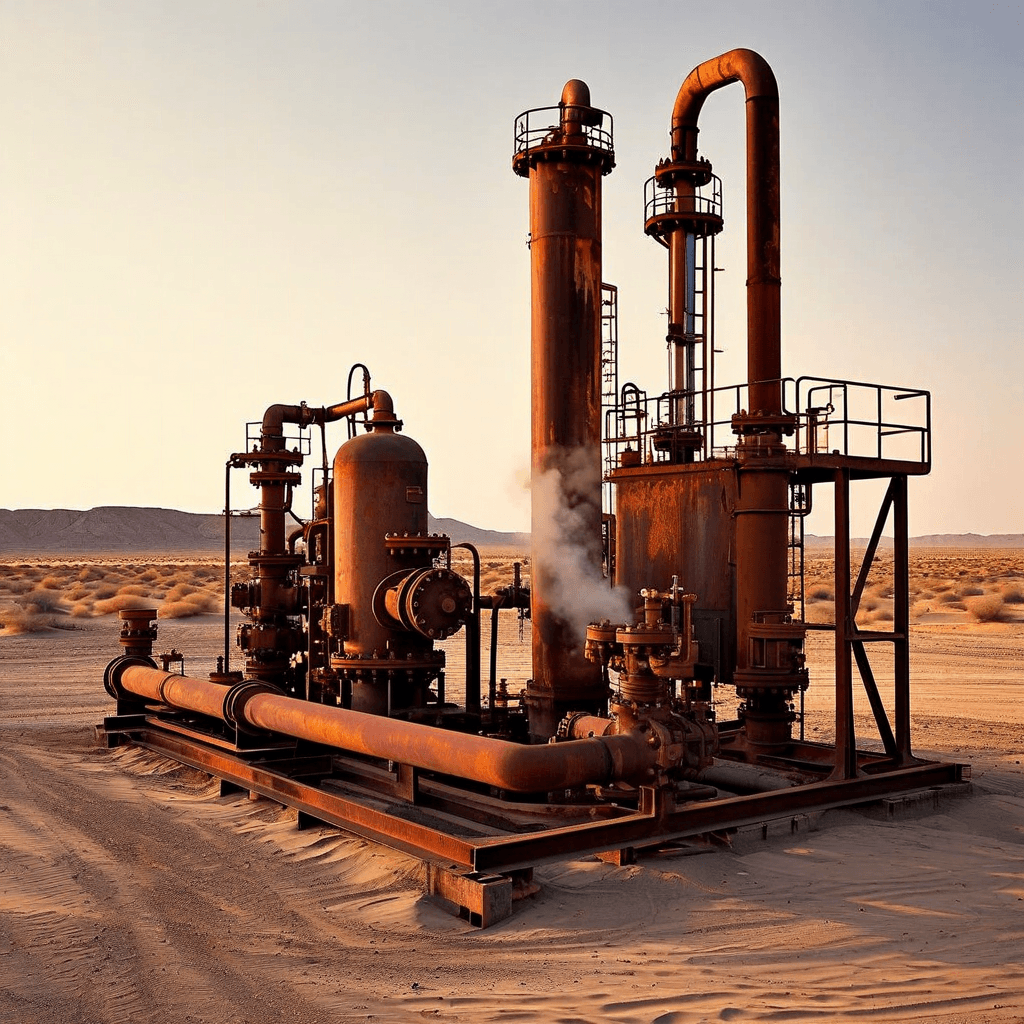
Oil India's Heavy Oil Breakthrough in the Thar Desert
Here's something remarkable happening in one of India's most unforgiving landscapes. Oil India Limited has cracked the code on extracting heavy crude from the Rajasthan Thar Desert, achieving a 70% production surge at its Baghewala field to hit 1,202 barrels per day in FY 2025-26. This isn't just about pumping more oil—it's about making the impossible possible through sheer technological ingenuity .
The Challenge: Oil That Refuses to Flow
The Baghewala field, discovered back in 1991, sat largely dormant for decades for good reason. The crude there is incredibly stubborn—imagine honey that's been left in the freezer. With viscosity of 10,000-13,000 centipoise at reservoir temperature and API gravity of just 14-17°, this oil simply wouldn't flow through conventional wells. Primary recovery methods would extract maybe 10% of what's there, leaving the rest trapped forever .
That's where Oil India's technological transformation kicks in. The company deployed Cyclic Steam Stimulation (CSS)—a thermal Enhanced Oil Recovery technique that's essentially a three-step process: inject steam to heat the oil, let it soak, then pump it out. They expanded CSS operations from 11 wells to 19, a 72% jump, and the results speak for themselves. Wells treated with CSS saw output jump 39.5%, contributing 23.4% of the field's total production AnnualReports.
Technology Stack: First-in-India Innovations
What makes this story compelling is the technology cocktail Oil India assembled. They're using fishbone drilling for the first time in India's heavy oil reservoirs—a technique that creates multiple lateral branches from a single well, like the bones of a fish. It costs 130% more than conventional drilling but delivers 3.9 times the production rate. That's the kind of math that makes sense when you're dealing with challenging resources .
Then there's electric downhole heating, which delivers 4-6 times higher oil rates compared to cold-producing wells. The company also deployed Hydraulic Sucker Rod Pumps, Vacuum Insulated Tubings to minimize heat loss, and high-temperature thermal wellheads. One well was drilled in just 23 days, showing how operational efficiency has improved dramatically Transcripts +1.
The Economics: Heavy Lifting for Heavy Oil
Let's talk money, because extracting heavy crude isn't cheap. Oil India's capital expenditure has grown 117% from ₹5,968 crores in FY22 to ₹12,969 crores in FY25, with Capital Work in Progress now at ₹29,527 crores—28.27% of total assets. This heavy investment has pushed free cash flow negative in recent years, but it's enabling production growth that wouldn't happen otherwise .
The Rajasthan operations contribute approximately ₹154-183 crore annually to revenue, representing about 0.5-0.6% of the company's total. That might sound modest, but the Return on Capital Employed for Baghewala's CSS investments comes in at 8-12%—competitive for heavy oil projects, though below the company's 11.84% historical average. The real value here isn't just today's production; it's proving that India's substantial heavy oil reserves can be economically developed .
Logistics: The Long Road to Market
Getting this oil to market is another story entirely. The crude travels by tanker from Baghewala to ONGC's North Santhal facility in Mehsana, Gujarat—over 500 kilometers away—before moving via pipeline to Indian Oil Corporation Ltd's Koyali refinery. This multi-modal journey, governed by COTA (Crude Oil Transport Agreement) with ONGC and COSA (Crude Oil Sales Agreement) with IOCL, costs roughly 12-26% of revenue. That's a hefty margin hit, but it's the price of monetizing resources that would otherwise stay underground .
Strategic Significance: Beyond the Barrels
Here's why this matters beyond Oil India's balance sheet. India imports 89.4% of its crude oil, up from 84.6% in FY16. Every barrel produced domestically is one less barrel imported, saving foreign exchange and reducing vulnerability to geopolitical disruptions. While Rajasthan's 43,773 metric tonnes annually is a fraction of India's 240 million tonne consumption, the strategic value lies in the technological breakthrough .
The CSS technology pioneered at Baghewala since 2018 is now a replicable model. Oil India has identified eight leads in the Bikaner-Nagaur basin, and there's potential collaboration with ONGC on their Mehsana heavy oil fields. Conservative estimates suggest this technology could add 50,000-300,000 barrels per day of domestic production across India's portfolio over the next decade—enough to shave 1-2 percentage points off import dependence .
What Lies Ahead
Oil India is planning to expand CSS operations from 19 to 30 wells in the near term, with a longer-term vision of 50+ wells. The company is also exploring advanced EOR techniques like polymer flooding and CO2-based recovery. With disciplined capital allocation and continued technology optimization, the Rajasthan operations could deliver 12-15% ROCE and contribute ₹300-400 crore annually within 3-5 years .
The Thar Desert production story isn't just about hitting production targets. It's about how technological innovation can transform uneconomical resources into strategic assets. For a country that imports nearly 90% of its crude, that's a breakthrough worth celebrating.