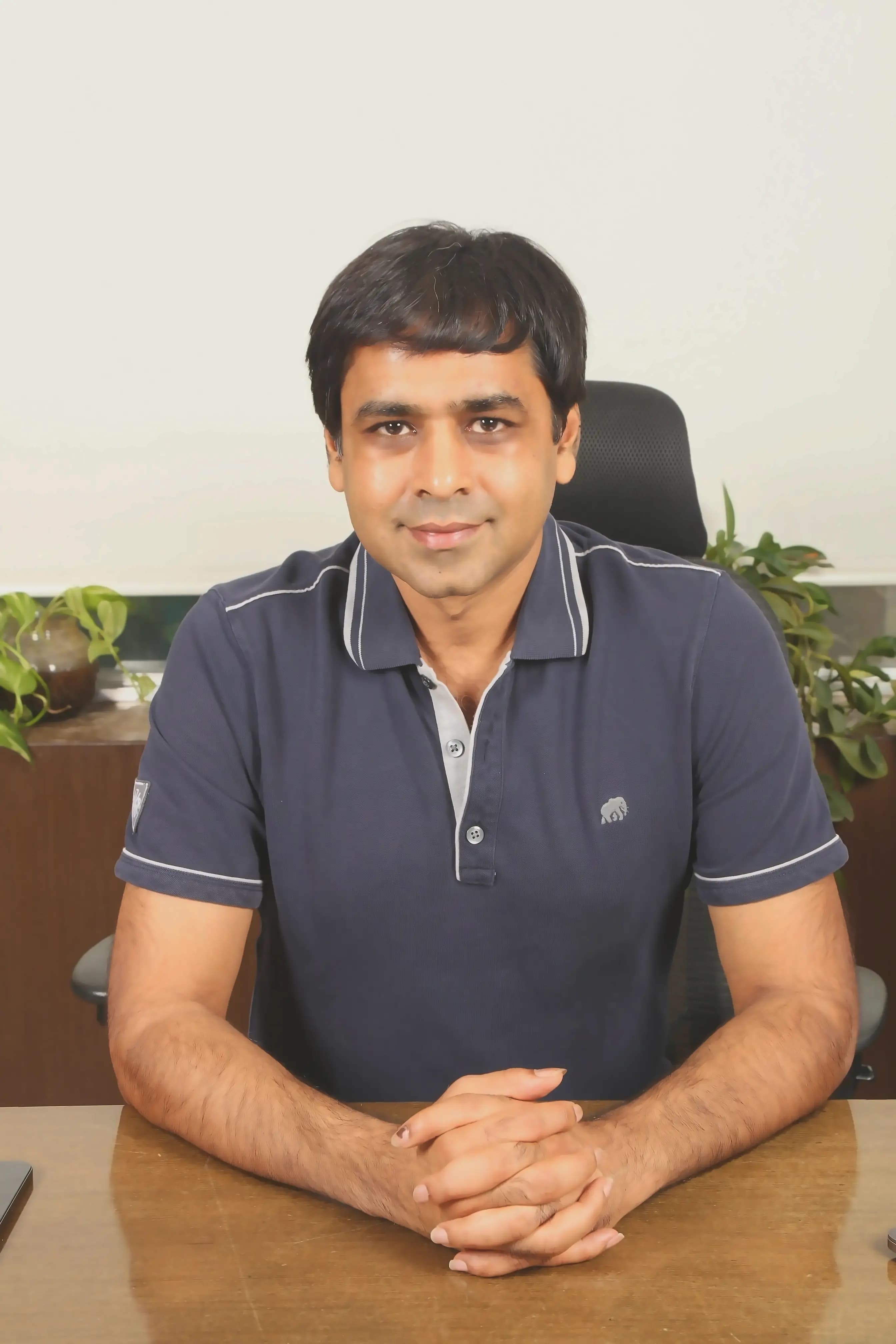
Nitish Mittersain, who founded Nazara Technologies in 1999 and built it into India's first publicly listed gaming company, is stepping down as Managing Director. The board approved his transition to founder and non-executive director on October 12, effective immediately, subject to shareholder approval. This move comes just months after he relinquished the CEO position in August 2026, following Q1 FY27 results that showed a consolidated net loss of ₹82.47 crore[stock data].
The stated rationale is straightforward: create space for professional leadership to drive the company's "next phase" while Mittersain provides strategic guidance to the board. But the timing against weak financials—Q1 FY27 EBITDA was negative at ₹37.74 crore—suggests a push for operational discipline as the company integrates its largest-ever acquisition [stock data]. Mittersain himself wrote on LinkedIn that "every founder has to create space for the institution to grow beyond them," signaling a deliberate shift from founder-led decision-making to professional management.
New Executive Leadership Takes Charge
Replacing the founder's executive presence is Mithun Padam Sacheti, co-founder of jewellery retailer CaratLane, who has been redesignated from non-executive director to whole-time director and executive director for a five-year term. Sacheti, who became a Nazara co-promoter last year, will oversee "strategic initiatives and other operational responsibilities assigned by the board".
Sacheti's background in scaling a consumer brand across online and offline channels brings relevant experience in monetisation and portfolio management, though not gaming-specific expertise. His appointment as a promoter-aligned executive director helps maintain governance continuity while the founder family steps back. However, the exact division of responsibilities between Sacheti and new CEO Raymond Stauffer remains unclear, which could create overlap or gaps in operational oversight.
CFO Transition Amid Heavy Deal Activity
The financial helm is also changing. CFO Rakesh Shah resigned effective October 15 to pursue opportunities outside the company, with Arun Agrawal taking over from October 16. Agrawal brings over two decades of experience, having served as global CFO at Ness Digital Engineering and held leadership roles at Mastek, General Electric, Wipro, and Tata Motors.
This transition occurs during Nazara's most capital-intensive period. The company is funding the second tranche of its Bluetile and BestPlay acquisitions, executing a ₹731 crore preferential allotment, and converting loans worth approximately ₹424 crore into equity. Shah will provide 90 days of transition support, ensuring no gap in the CFO role, but the handover coincides with Q2 FY27 closing and the first full period of acquisition consolidation—a challenging test for any incoming CFO.
₹731 Crore Preferential Allotment: Capital at a Cost
The board approved issuing 2,38,81,711 equity shares at ₹306 per share, raising approximately ₹731 crore. The issue is subscribed entirely by founders and senior leadership of Bluetile Games and BestPlay Systems, with new CEO Raymond Stauffer receiving 1,90,67,969 shares worth ₹583.48 crore.
The proceeds are earmarked for strengthening the balance sheet, funding strategic acquisitions, supporting existing gaming businesses, and investing in owned intellectual property and AI-enabled game development. The preferential route offers speed and certainty compared to alternatives like rights issues or debt, but it dilutes existing shareholders by approximately 6.2%. Other
Notably, the issue price of ₹306 is about 24% below the current market price of ₹400.45 but above the book value of ₹99.53 per share, mechanically adding to book value per share [stock data]. However, whether it creates shareholder value depends entirely on the returns generated from the acquisitions—a question mark given recent financial performance.
CEO Skin in the Game
Stauffer's substantial personal investment—₹583.48 crore for a 4.67% post-issue stake—represents strong alignment with long-term performance objectives. Unlike traditional executive compensation packages laden with stock options, Stauffer receives no additional stock-based incentives for his CEO role. His wealth moves directly with the share price in both directions. Other
However, this capital comes from selling his business to Nazara. While he is recycling a significant portion back into the company, his net exposure is smaller than the headline investment suggests. The all-cash acquisition structure removed performance-linked earn-outs, meaning equity ownership now serves as the primary performance lever—less targeted than the previous earn-out structure but more comprehensive across the entire group.
Funding the Bluetile and BestPlay Acquisition
The board approved investing $77 million (approximately ₹743 crore) into Nazara Technologies UK to fund the second tranche of the Bluetile and BestPlay acquisition. This infusion enables the UK subsidiary to complete payments under the amended deal structure, which increased the stake from approximately 50% to 100% for a fixed all-cash consideration of $303 million.
Under the original terms, Nazara would have acquired about 50% for $100.3 million upfront, with earn-outs estimated at $98.2 million and a put/call option on the remaining stake by 2028. The amended structure provides certainty of ownership and price, full economics from closing, and single-owner governance—but requires substantially more cash upfront. Other +2
The payment schedule is aggressive: $89 million at first close, with the remaining $214 million due in tranches by April 1, 2027, including approximately $75 million within 90 days. This concentration of cash payments in a short window creates significant execution risk, particularly given the company's recent loss-making performance. Transcript
Loan Conversions: Balance Sheet Clean-Up
The board also approved converting up to ₹129.35 crore of loans to Smaaash Entertainment and £23 million (approximately ₹294 crore) of loans to Nazara UK into equity. These conversions primarily affect subsidiary-level and standalone balance sheets rather than consolidated numbers.
On consolidation, intercompany loans and the corresponding equity are eliminated, meaning debt-to-equity ratios remain largely unchanged. However, at the subsidiary level, these conversions reduce leverage and repayment pressure—particularly relevant for Smaaash, which has been loss-making and contributed to the associate losses that dragged Q1 FY27 performance. Other
The company has not explicitly stated its rationale for these conversions, but plausible drivers include improving subsidiary solvency, simplifying cross-border funding structures, and preserving cash during the acquisition integration period. The trade-off is the loss of standalone interest income for the parent company.
Foreign Exchange and Integration Risks
Nazara's significant capital deployment into UK and Spanish entities exposes the company to material foreign exchange risk. The acquisition consideration is denominated in USD, while the Spanish entities likely operate in EUR with USD app-store revenue—creating a multi-currency exposure that the company has not disclosed any hedging policy for. Annual Report
FY26 already showed the impact of currency fluctuations, with exchange differences on translating foreign operations reaching ₹8,716 lakh compared to ₹551 lakh in the previous year. As Bluetile and BestPlay consolidate from Q2 FY27—bringing in quarterly revenue of ₹518 crore, larger than Nazara's existing consolidated quarterly revenue of ₹429 crore—this translation effect will magnify. Annual Report +2
Operationally, integrating cross-border subsidiaries under a new leadership structure presents substantial challenges. The three-tier structure (Indian parent, UK vehicle, Spanish operating entities) adds complexity in transfer pricing, tax compliance, and regulatory reporting across multiple jurisdictions. With the founder stepping back, a new CEO, a transitioning CFO, and an executive director from a different industry, the integration burden falls on a leadership team still finding its rhythm.
The Road Ahead
Nazara is betting big that professional management, coupled with the Bluetile and BestPlay acquisition, will transform it from an Indian gaming company into a global gaming platform. The capital raises and leadership changes provide the resources and structure for this ambition. But the execution risks are significant: concentrated acquisition payments, currency exposure, margin pressure in the acquired businesses, and a leadership team in transition.
For shareholders, the key metrics to watch will be Q2 FY27 results—the first full quarter with Bluetile and BestPlay consolidated—integration progress, and whether the new management team can deliver on the synergies that justified this ambitious transformation. The founder has created space for the institution to grow. Now the institution must deliver.