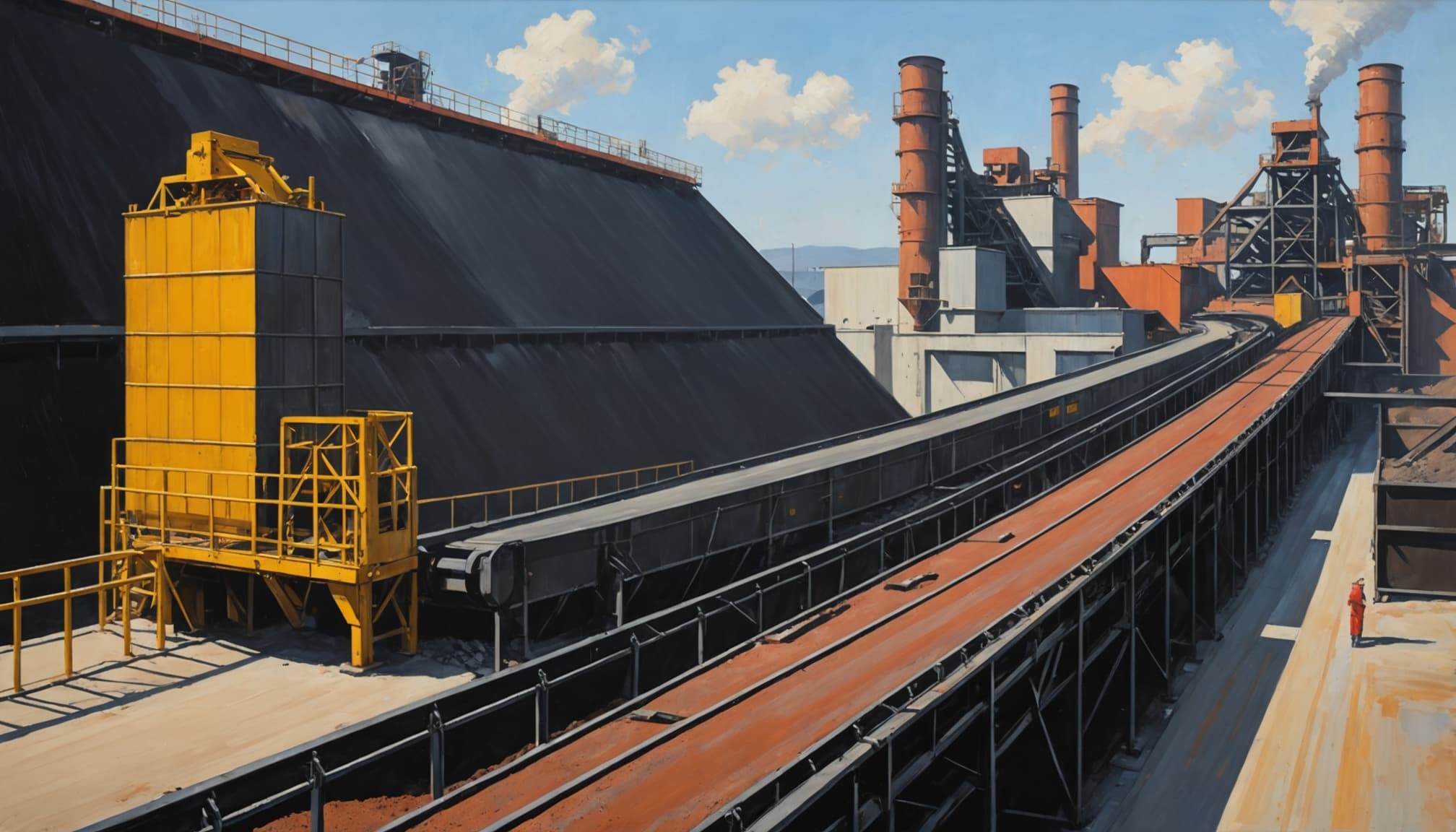
Coal India is preparing to sell up to 10% of its stake in Mahanadi Coalfields Limited (MCL) through an initial public offering that could raise approximately ₹9,500 crore (~$1 billion). This isn't just another IPO—it's part of a broader government push to unlock value from high-performing PSU subsidiaries by giving them independent market visibility rather than burying their worth inside consolidated financials.
The proposed listing follows successful public debuts of two other Coal India subsidiaries earlier in 2026: Bharat Coking Coal Limited (BCCL) and Central Mine Planning & Design Institute (CMPDI). Markets reacted positively to the DRHP filing news itself—Coal India's shares jumped roughly 5% intraday when the draft prospectus became public.
Deal Structure: What's Actually Being Sold
The entire issue is structured as an Offer for Sale (OFS). Coal India will sell up to 66.18 crore equity shares (face value ₹2 each), and every rupee raised goes directly to the parent company. MCL itself will not receive a single rupee of IPO proceeds.
This 10% stake sale is likely just the first step. Coal India's board has already approved a partial divestment of up to 25% of its equity holding in MCL, and India's inter-ministerial Alternative Mechanism formally cleared the disinvestment and listing proposal in May 2026. The government's disinvestment targets and the precedent set by BCCL and CMPDI suggest this process could move relatively quickly once cleared.
SEBI issued its final observations on the draft offer document on November 4, 2026, clearing the way for the company to proceed with preparations for the public issue. The IPO could open in the second half of November or early December 2026, though the company has yet to confirm the launch schedule.
Mahanadi Coalfields: The Asset Behind the IPO
MCL isn't just another arm of India's state-run coal giant—it's genuinely the largest coal-producing subsidiary of Coal India, contributing roughly 28% of the parent's total output in FY26 alone. Given that Coal India itself accounts for more than 80% of India's domestic coal production, that makes MCL one of the single most important coal-mining assets in the entire country's energy supply chain.
The company produced 218.31 million tonnes of coal in FY26, accounting for approximately 22.4% of India's non-coking coal production, according to a CRISIL report cited in its draft prospectus. As of June 30, 2026, MCL operated 17 mines, including 14 opencast and three underground mines, primarily in Odisha's Talcher and Ib Valley coalfields.
Financially, MCL reported revenue from operations of ₹8,033.7 crore in the June quarter of FY27, compared with ₹7,548.3 crore a year earlier, registering growth of 6.4%. However, net profit declined around 2% to ₹2,398.7 crore from ₹2,448.3 crore in the corresponding quarter last year. For the full year FY26, MCL posted a profit after tax of ₹10,698 crore. Other
Valuation and Pricing: What Investors Need to Watch
At the reported valuation of $10 billion, the 10% stake sale could fetch $1 billion, making it one of the largest remaining IPOs of 2026. However, the company has yet to announce its official price band, IPO dates, or lot size.
The DRHP shows some impressive metrics: return on net worth (RoNW) of 53.87%, return on capital employed (ROCE) of 73.26%, and a PAT margin of 31.56%. These numbers are significantly higher than Coal India's own RoNW of 27.78%, which could justify a premium valuation.
However, there are concerns. Revenue and profit have both fallen over the last two financial years. The Q1 FY27 profit dip, combined with declining e-auction premiums (which fell from 48% to 38% in FY26) and a sharp stock drawdown at Coal India, suggests cautious sentiment toward spot coal pricing. Investor Presentation
Peer comparison puts MCL's FY26 diluted EPS at ₹16.13, against Coal India's ₹50.46 and NMDC's ₹8.47. At an implied price of roughly ₹143 per share (based on the ₹9,500 crore issue size), MCL would trade at about 8.9x FY26 earnings—slightly above Coal India's current P/E of 7.45 but below NMDC's 10.24x.
The QIB Factor: Why Institutional Allocation Matters
The proposed allocation structure reserves not more than 50% of the net offer for qualified institutional buyers (QIBs), while not less than 15% will be allocated to non-institutional investors (NIIs). Retail individual investors will be eligible for at least 35% of the net offer.
This QIB-heavy allocation is significant. In book-built IPOs, institutional bids at the top of the book usually set the cut-off price. A large QIB share means pricing will track institutional comparisons—Coal India, NMDC, and global coal miners such as Bukit Asam and Yancoal named as peers in the DRHP.
The precedent from BCCL's January 2026 IPO is instructive. That issue saw QIB subscription of 310.81x, NII subscription of 240.49x, and retail subscription of 49.37x, with overall subscription of 143.85x. BCCL listed at a 96% premium to its issue price of ₹23 but has since fallen about 21.5% from its listing close, though it still trades above its issue price.
Retail and NII Dynamics: The Demand Puzzle
The 35% minimum retail allocation is substantial for a PSU issue of this size. At the ₹2 lakh retail application cap, covering a roughly ₹3,325 crore retail book would need about 16-17 lakh full-sized applications. That's a high bar, especially given that retail investors showed restraint in 2026 due to valuation and volatility concerns.
In the September NSE IPO, which raised ₹22,562 crore, retail subscribed only 1.39x their reserved portion, while QIBs subscribed 12.68x and NIIs 6.55x. This pattern suggests MCL's retail book may see modest oversubscription at best, unless the price band comes in attractively.
For NIIs, the 15% minimum allocation (roughly ₹1,425 crore) is relatively small. This segment is typically more aggressive on listing gains and often uses leverage to amplify bids. BCCL's NII subscription of 240.49x shows the potential for strong demand if sentiment is favorable.
Impact on Coal India: Balance Sheet and Strategy
The proceeds from this OFS will flow entirely to Coal India, not MCL. This raises questions about how the parent company will deploy approximately ₹9,500 crore in cash.
Coal India is already close to debt-free. Consolidated debt-to-equity was 0.09 in 2025, and a later presentation puts it at 0.12. The company holds an AAA domestic rating with a stable outlook. The proceeds are therefore not about deleveraging—they add to liquidity. Annual Report +2
Coal India proposed capex of ₹16,000 crore for FY2025-26, alongside allocations to critical minerals, coal gasification, thermal power, and renewables. Dividends were ₹26.50 per share in FY26, a payout ratio of about 46% in 2025. The company's own cash generation already covers these commitments. Annual Report +2
The ₹9,500 crore is best read as extra flexibility for diversification spending or special payouts. However, there's a trade-off: keeping 90% ownership means Coal India retains control and consolidates MCL's profits, but it also means about 10% of MCL's profit (roughly ₹1,000 crore annually based on FY26 numbers) will flow to minority shareholders going forward.
Market Context: Timing and Sentiment
The IPO comes at an interesting time for markets. Nifty 50 is up 10.66% over the past month, sitting at 25,144.30. Nifty Energy has gained about 4% over the same period, though it remains below its 52-week high of 41,828.55. Coal India's own stock is essentially flat over the past month, down just 0.32% at ₹403.50.
The broader IPO market has been active but selective. The NSE IPO in September showed strong institutional demand but relatively modest retail interest. Several other large issues, including Jio and NSE, are in the pipeline, potentially competing for the same pool of institutional capital.
What Comes Next
The key milestones to watch are the price band announcement, the formal bidding schedule, and the anchor investor allocation. Once the price band lands, grey market sentiment will provide additional clues about retail appetite.
For investors, the fundamental question is whether MCL's scale, cash generation, and coal reserves justify the reported valuation despite weakening profits and the long-term questions around energy transition, pricing, and regulation. The IPO will allow investors to assess Mahanadi Coalfields independently, with its valuation likely to be benchmarked against Coal India and other listed mining companies.
For Coal India shareholders, this divestment represents a step toward unlocking subsidiary value while maintaining strategic control. The success of this IPO could pave the way for further subsidiary listings and stake sales, potentially reshaping the structure of India's coal sector over the coming years.