On August 14, 2026, LEAP India Limited made its stock market debut with a story that seemed tailor-made for success.
Instead, it delivered a masterclass in how market discipline works in 2026. The shares listed at ₹165.90, a modest 4.3% premium to the issue price of ₹159, only to fall 5.3% within the same trading session, valuing the company at ₹6,918 crore ($725.2 million). This wasn't a disaster by any stretch, but it was far from the blockbuster debut that KKR's reputation and the company's fundamentals might have suggested.
The Pricing Puzzle: Aggressive Multiples Meet Market Skepticism
LEAP India's IPO pricing strategy was bold, to put it mildly. The company came to market at approximately 112 times trailing earnings, 20-20.5 times EV/EBITDA, and nearly 7 times price-to-book.
The IPO comprised a fresh issue of ₹480 crore and a massive offer for sale (OFS) of ₹2,000 crore, with KKR's Vertical Holdings II selling nearly ₹1,999 crore worth of shares—representing about 93% of KKR entities' estimated aggregate investment. This structure signaled that the IPO was primarily an exit opportunity for existing shareholders rather than a capital-raising exercise for business expansion, which typically dampens retail investor enthusiasm.
The Grey Market Premium (GMP) told an interesting story of its own. In the days leading up to listing, GMP fluctuated between ₹13-16, suggesting an expected listing gain of 8-10%. However, the actual listing delivered only a 4.34% gain, and the stock subsequently declined 5.3% from those listing levels. This gap between GMP expectations and reality reflects the inherent volatility and unreliability of grey market signals, particularly in a market that's becoming increasingly valuation-conscious. The GMP moderation from ₹16 to ₹13 in the final days before listing also indicated growing caution among market participants.
KKR's Double-Edged Sword: Credibility vs. Exit Perception
KKR's involvement in LEAP India has been a double-edged sword. On one hand, it provided tremendous institutional credibility. The anchor book attracted marquee global investors including Singapore's Monetary Authority, Morgan Stanley, Norway's Government Pension Fund Global, Goldman Sachs, Amundi, and Citigroup, with ₹743.62 crore raised from 32 anchor investors at the upper price band. This caliber of institutional backing typically supports premium valuations and provides confidence in governance standards. KKR acquired a majority stake in 2023 and has since provided strategic support for growth and direction, lending operational expertise to the business.
On the other hand, KKR's substantial exit through the OFS—nearly the entire ₹2,000 crore offer for sale—raised questions about promoter commitment at the current valuation. When the primary seller is your biggest backer cashing out 93% of their investment, investors naturally wonder whether they're buying at the top. The promoter and promoter group's combined holding declined from 90% pre-IPO to about 55.4% post-IPO, a significant dilution that may have contributed to the muted listing reception. KKR's reputation, while impressive, couldn't override fundamental concerns about whether the valuation left room for future growth.
The Subscription Story: Institutions In, Retail Out
The subscription patterns revealed a stark divide in investor sentiment.
This pattern is telling—institutions with deep research capabilities and longer investment horizons saw value, while retail investors, often driven by listing gain expectations and GMP signals, stayed away due to valuation concerns.
The timing of subscriptions also mattered. Day 1 saw total subscription of only 0.26x, with retail at a paltry 0.12x. By Day 3, total subscription surged to 8.31x, but this last-minute momentum was primarily driven by institutions and NIIs rather than retail FOMO. This pattern often leads to weaker listing performance because institutional investors typically have longer holding periods and don't provide the same short-term trading momentum that retail investors seeking quick listing gains would generate. The weak retail participation meant there was less speculative buying pressure on listing day, contributing to the stock's inability to sustain its initial premium.
Market Conditions: The Perfect Storm of Caution
LEAP India's debut occurred in a markedly different IPO market environment compared to the heady days of 2024.
The market has transitioned from an "exuberance-led capital raising wave to a more mature value-driven capital flow". Investors have become increasingly selective, focusing on fundamentals and valuation discipline rather than chasing subscription buzz.
The broader market wasn't helping either. LEAP India listed in a subdued market environment with the benchmark Nifty 50 index down 0.2% on the day. Secondary market weakness in early 2026 had already contributed to IPO listing performance coming in below grey market expectations on multiple occasions. When the overall market is under pressure, recently listed stocks typically open weaker because discretionary selling on listing day is harder to absorb.
Sector-specific headwinds also played a role. The logistics sector was facing margin pressures from rising fuel costs and intensifying competition. LEAP India's own EBITDA margins had declined from 56.45% in FY25 to 50.69% in FY26, reflecting these broader sector challenges. The company's asset-intensive business model requires continuous capital expenditure, with net debt/equity deteriorating from 0.72 in FY24 to 1.01 in FY26. These factors, combined with receivable days of approximately 131 days indicating working capital challenges, gave investors legitimate reasons to be cautious about paying premium multiples.
The Post-Listing Reality Check
The stock's movement from a 4.3% listing premium to a 5.3% decline within the same trading session reflects a rapid reassessment of valuation versus fundamentals. The market is essentially saying that while LEAP India has a strong business model and impressive growth, the current valuation requires perfect execution and leaves little room for error.
The modest return on equity of 6.48% in FY26, below the peer average of 7.4%, raises questions about capital efficiency. When you're paying 112 times earnings for a company generating single-digit ROE, you're making a very specific bet about future growth and margin expansion that may or may not materialize. The market, in its wisdom, decided to wait for evidence rather than pay up front.
What This Means for the Future
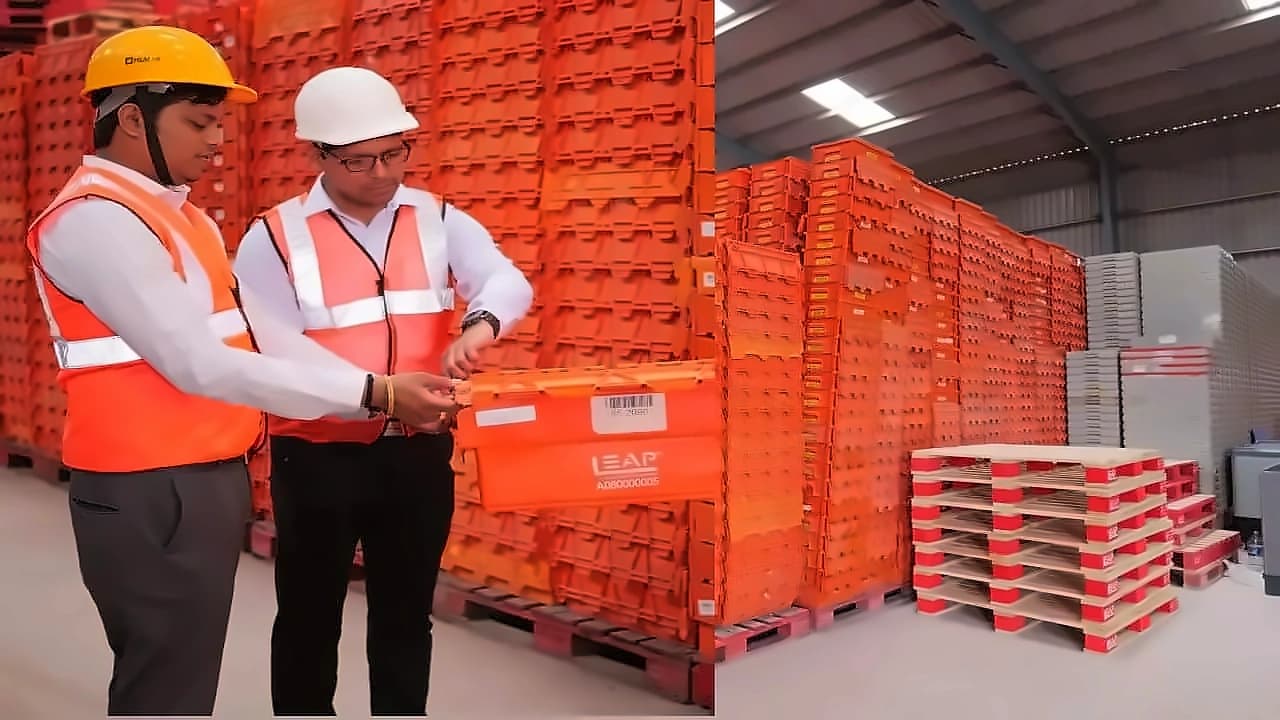
LEAP India's listing performance shouldn't be viewed as a failure but rather as a reality check in a maturing market. The company has genuine competitive advantages—90% market share in organized pallet pooling, over 14.7 million pooled assets, a pan-India network of more than 10,100 customer touchpoints, and partnerships with over 1,000 blue-chip customers. The ₹360 crore from the fresh issue allocated to debt repayment should reduce annual interest costs by ₹28-34 crore, potentially boosting profitability. RHP
However, the stock's near-term performance will likely depend on several factors: margin stabilization or improvement, successful integration of recent acquisitions like CHEP India, asset utilization enhancements, and evidence that the high growth rates can be sustained without continued heavy capital expenditure. The KKR association provides governance comfort and operational expertise, but as the listing day demonstrated, it cannot substitute for sustainable financial performance.
For investors, LEAP India's debut offers a valuable lesson about the evolving Indian IPO market. The days of automatic listing gains are behind us. Even companies with strong sponsors, impressive growth, and market leadership can face valuation headwinds if the pricing is too aggressive. The market is increasingly rewarding discipline and punishing excess, which is ultimately healthy for long-term market development. LEAP India may well prove to be a sound long-term investment at the right price, but its listing performance shows that the market is no longer willing to take that on faith—it wants to see the numbers first.