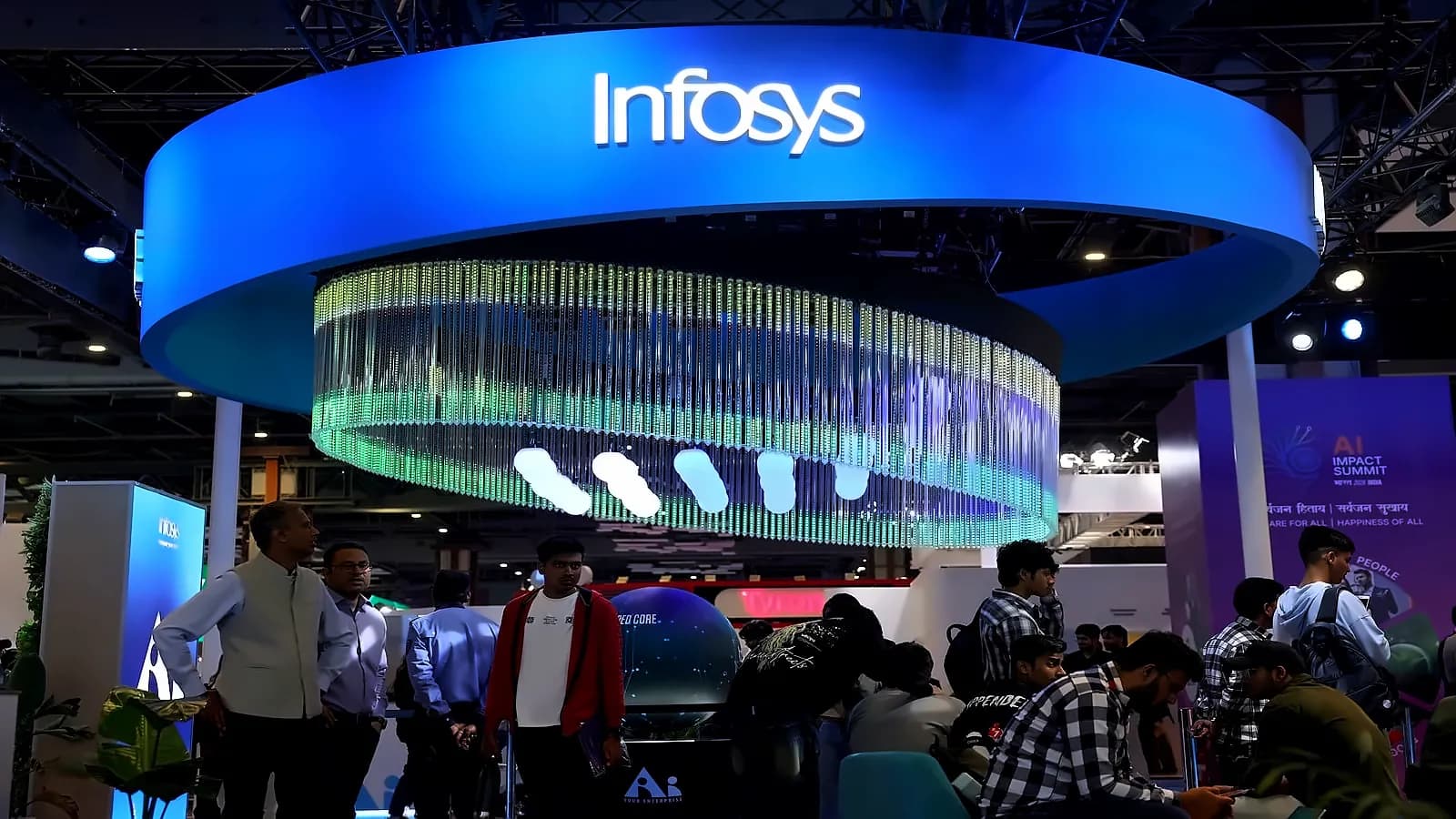
The numbers are staggering. Tata Consultancy Services has plummeted 55% from its August 2024 peak of ₹4,592 to around ₹2,051. Infosys is down 47% from its December 2024 high of ₹2,006 to roughly ₹1,006. HCL Technologies has fallen 43% from its January 2025 peak. Collectively, nearly ₹19.28 lakh crore in market value has evaporated across ten major IT stocks.
Yet here's the puzzle: these companies trade at a 36% discount to their 10-year average P/E ratios. TCS sports a P/E of 15.06, Infosys at 14.72, and HCL Tech at 18.67. Their dividend yields range from 4.48% to 5.35%, while free cash flow yields sit between 6.44% and 7.71%. On paper, these look like value opportunities. So why does the market keep hammering them?
The answer lies in a fundamental reassessment of the entire IT services business model, driven by artificial intelligence.
The AI Disruption Threat
Motilal Oswal estimates that 12-15% of sector revenue faces direct AI-driven displacement. This isn't about gradual automation—it's about structural revenue deflation. Consider this example: a cloud migration project that previously required 500 people working for 18 months on time-and-materials billing now compresses to roughly 50 people with AI. Revenue per workload collapses even if total workloads grow.
The impact is already visible. TCS has cut over 11,000 roles in FY26. HCL Technologies management estimates 2-3% deflation impact on their portfolio from AI disruption. Infosys acknowledges "some deflation from our existing services". Transcripts +1
This creates what analysts call "revenue deflation risk." When AI improves productivity by 50%, clients demand corresponding cost reductions. Fewer employees improve margins, but revenue shrinks due to lower billing. It's a margin catch-22 that's causing the market to reprice the entire sector.
The Earnings Visibility Crisis
The core problem isn't current performance—it's future uncertainty. Management guidance for FY27 tells the story: Infosys projects 1.5-3.5% revenue growth, HCL Technologies expects 1-4%, while TCS offers no specific guidance despite expressing positivity. Transcripts +1
These low single-digit growth rates are a far cry from the double-digit expansion that justified premium valuations for decades. The era of linear revenue growth through headcount expansion appears over. Without clear visibility on sustainable growth trajectories, attractive dividend yields and free cash flow yields become insufficient to drive stock performance.
The market is asking uncomfortable questions: Can AI services revenue grow fast enough to offset traditional service declines? Will new outcome-based pricing models replace time-and-materials billing at scale? When will growth return to historical levels? Until these questions get answers, valuation multiples remain compressed.
Parag Parikh's Contrarian Bet
While 42 of 49 mutual fund houses have reduced IT exposure in 2026, Parag Parikh Flexi Cap Fund has increased its allocation by nearly 20%. The fund added 54 lakh shares of Infosys, 18.26 lakh shares of TCS, and 31.15 lakh shares of HCL Technologies in June alone.
Why this bold contrarian move? The fund's conviction rests on cash flows rather than AI narratives. CIO Rajeev Thakkar applies Jevons' Paradox: "Even assuming the narrative to be correct, and the work of 10 developers can now be done by five engineers, does that mean profits disappear entirely? I don't think so. Productivity improvements will likely make services cheaper, which could lead to higher demand".
The fund believes the market has confused a sentiment problem for a business problem. Their analysis suggests earnings so far back their view more than price action does.
The Cash Flow Fortress
The financial fundamentals support this contrarian thesis. All three companies demonstrate exceptional cash generation capabilities.
Their cash conversion ratios exceed 100% of net income.
Balance sheets are equally robust. TCS and Infosys are debt-free, while HCL Technologies carries minimal debt. Current ratios range from 1.72 to 1.84, indicating strong liquidity. These companies aren't facing financial distress—they're facing business model uncertainty.
The fund's valuation discipline is evident. The Nifty IT index trades at 15.7 times estimated 2026 earnings, down sharply from 21.2 times a year earlier. The fund's own portfolio P/E sits at 16.39 against a flexi-cap category average of 26.36. They're buying when prices are attractive, not chasing momentum.
Currency and Cost Advantages
The rupee's depreciation to record lows above 96 against the US dollar provides a significant earnings cushion. All three companies derive substantial revenue from North America and bill largely in dollars. A weaker rupee boosts rupee-denominated revenue, operating margins, and profitability when overseas earnings are repatriated.
Wage inflation has also moderated. Revenue per employee improved 3-4% across major IT firms in FY26, with TCS achieving 3.4% growth despite reducing its workforce by 2%. Utilization rates climbed to around 85% while bench strength declined significantly. This productivity-led growth model reduces wage inflation pressure and supports margins.
The AI Transition Opportunity
Despite the disruption, AI is creating new opportunities. TCS reports annualized AI services revenue of $2.3 billion with "revenue productivity definitely much better than the TCS average or traditional business". Infosys has AI programs running across a majority of its top clients. HCL Technologies has emerged as a key beneficiary of AI-led deal wins, securing several large, long-term contracts as a strategic AI transformation partner. Transcripts +1
AI-based deals lack the large legacy commitments of traditional managed services contracts, creating flexibility. AI programs typically have 12-to-16-week delivery cycles for high-impact business problems. This allows IT companies to demonstrate value quickly and win additional business. The managed services market is growing from $330.4 billion (2025) to $1,118.2 billion (2034) at 14.80% CAGR, driven by transition toward agentic AI and autonomous IT service management. Transcripts
The Path Forward
The next 24-36 months will be critical. Companies that successfully scale AI-native delivery models will capture market share from slower competitors. Success factors include platform maturity, client penetration, deal quality, and vertical specialization.
Catalysts needed to restore earnings visibility include evidence of AI revenue scaling (reaching 15-20% of total revenue), large deal ramp-ups, margin stability, macro environment improvement, and clear competitive positioning gains.
The current valuation dislocation represents both the risk of disruption and the opportunity for transformational success. Parag Parikh Flexi Cap Fund is betting that the market has overestimated AI disruption risks and underestimated the adaptability of high-quality IT services companies. With strong balance sheets, exceptional cash generation, and attractive valuations, they're accumulating positions while others flee.
Time will tell if this contrarian bet proves prescient. But one thing is clear: the IT services sector is undergoing a structural reset, not a temporary correction. The companies that navigate this transition successfully will emerge stronger, while those that struggle will face continued pressure on both market share and valuations.