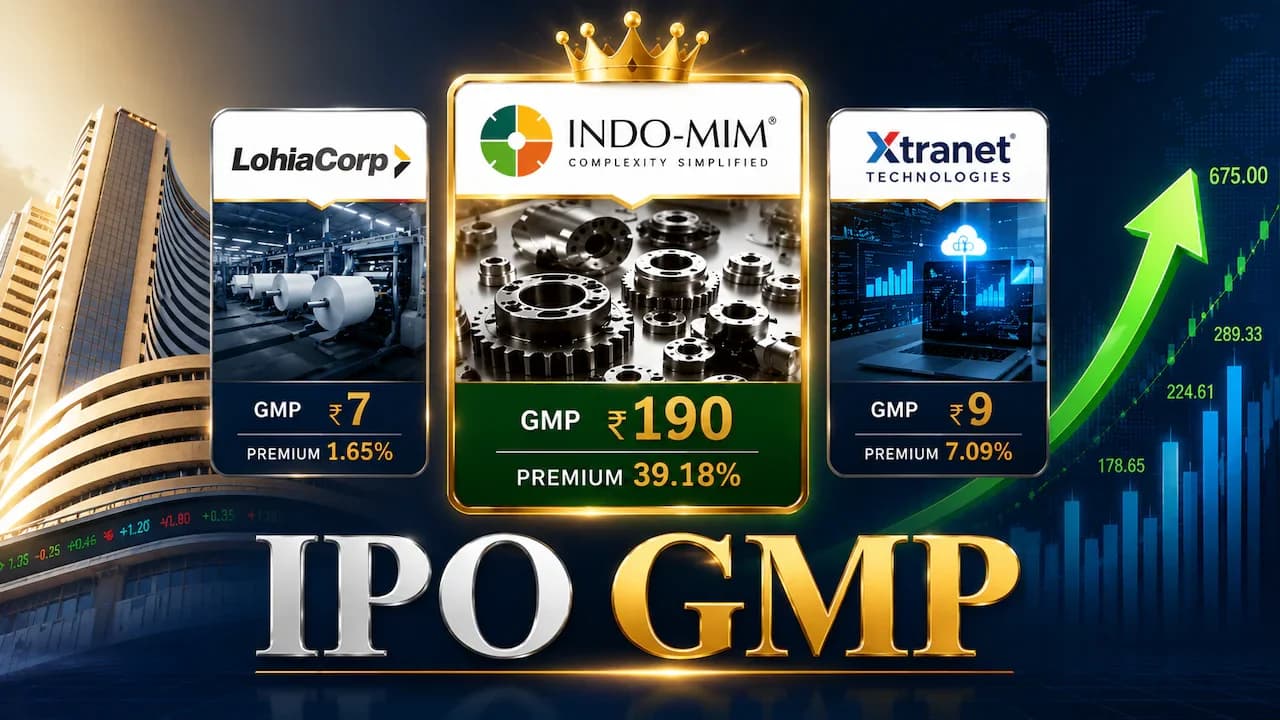
Three companies listed on Indian stock exchanges on July 30, 2026. The outcomes couldn't have been more different. Indo-MIM opened at ₹700 against an issue price of ₹485—a 44.33% premium. Lohia Corp listed at ₹461 (8.47% above its ₹425 issue price). Xtranet Technologies debuted at ₹136 (7.09% over its ₹127 issue price). The question isn't just who won, but why the gap was so massive.
The Subscription Story: Demand That Made the Difference
The numbers tell a clear tale before trading even began.
Non-Institutional Investors (NIIs) put in bids for 50.63 times the shares available to them. Even retail investors showed strong interest at 6.67 times subscription.
Contrast this with Lohia Corp, which was undersubscribed at just 0.68 times overall. Xtranet Technologies fared better but still only managed 3.05 times subscription. When institutions bid 200 times more shares than available, they're sending a signal—they see something special. That confidence translated directly into listing-day performance.
Business Quality: Technology Leadership vs. Mature Operations
Indo-MIM isn't just another manufacturer. It's the world's largest producer of precision engineering components using Metal Injection Molding (MIM) technology, holding a 6.8% global market share. The company operates 15 manufacturing facilities across India, the US, UK, and Mexico, serving over 1,100 customers globally. Its portfolio spans more than 9,000 products across automotive, defence, medical, consumer, and aerospace sectors.
Lohia Corp, by comparison, makes woven raffia machinery for technical textiles. It's been around since 1981, operates in a mature market, and its growth is tied to capital expenditure cycles in the textile industry. Xtranet Technologies provides IT-enabled services—a competitive sector where differentiation is tough and pricing pressure is constant. The market clearly rewarded technological leadership and global scale over regional industrial equipment or commodity IT services.
Financial Performance: Growth That Commands Premium
Numbers matter, and Indo-MIM's stood out. For FY26, the company reported revenue of ₹4,193 crore and profit after tax of ₹533.5 crore—both growing 26% year-on-year. More importantly, its Return on Capital Employed (ROCE) sits at 26.60%, with Return on Net Worth (RoNW) at 21.26%. The EBITDA margin, despite moderating in FY26, remained healthy at 25.54%.
These metrics place Indo-MIM in a different league. Specialized engineering companies with EBITDA margins above 25% and ROCE above 20% typically trade in the 35x-50x earnings range. Indo-MIM's financial quality justified premium pricing, while Lohia Corp's mature business model and Xtranet's smaller scale offered less compelling growth stories.
Pricing Strategy: Finding the Sweet Spot
Indo-MIM's IPO was priced at ₹461-485 per share, translating to 44.6x-44.9x FY26 earnings at the upper band. This wasn't cheap, but it wasn't unreasonable either for a company with its growth profile and return metrics. The pricing left room for upside while signaling quality.
Lohia Corp, priced at 23.21x FY26 earnings, came at a discount to its industry range of 35x-65x. Yet the discount didn't drive demand. Why? Because the IPO was 100% Offer for Sale—no fresh capital for the company, just existing shareholders cashing out. Investors saw limited growth catalysts and stayed away. Xtranet Technologies, with its 100% fresh issue of ₹166.80 crore, faced the opposite problem—a small player in a competitive sector struggling to stand out.
Indo-MIM's allocation strategy played to its strengths. Fifty percent of shares went to QIBs, who responded with overwhelming demand. The 204.34x QIB subscription wasn't just a number—it was institutional conviction in the business model and growth prospects. Anchor investors contributed ₹1,140.99 crore before the public issue opened, providing stability and credibility.
Lohia Corp's undersubscription across all categories reflected weak institutional interest. Xtranet's moderate 3.05x subscription indicated functional but not enthusiastic demand. When institutions lead with conviction, retail follows. When they sit out, listing gains are hard to come by.
The Intraday Story: Surge, Peak, and Consolidation
Indo-MIM's listing day told its own story. The stock opened at ₹700, surged to an intraday high of ₹757.75, and then consolidated around ₹730-740 by afternoon. The initial surge reflected pent-up demand from the 72.34x subscription. The peak came from momentum buying and short covering. The consolidation? That was profit booking and valuation discipline kicking in.
Investors who applied for listing gains took profits after the 44% opening. Others reassessed whether 64.87x post-listing P/E left room for further upside. The stock found equilibrium around ₹730—a level that still represented a 50% gain over the IPO price but reflected more rational valuation. This wasn't disappointment; it was market efficiency at work.
What This Means for Future IPOs
The July 30 listings offer clear lessons for companies and investors alike. First, business quality trumps issue size. Indo-MIM's ₹3,811 crore issue succeeded because of its fundamentals, not despite its size. Second, growth visibility commands premium. Companies with clear catalysts—aerospace expansion for Indo-MIM, capacity utilization headroom—get rewarded. Third, institutional confidence is the leading indicator. When QIBs bid 200 times, retail follows.
For investors, the message is equally clear. Not all IPOs are created equal. Subscription quality matters more than subscription quantity. A 3x subscription with weak institutional backing (Xtranet) performs very differently from a 72x subscription led by institutions (Indo-MIM). And valuation discipline eventually prevails—even the strongest listings face consolidation when expectations run too far ahead of fundamentals.
Indo-MIM's blockbuster debut wasn't an anomaly. It was the market rewarding superior business quality, exceptional financial metrics, and genuine growth visibility. Lohia Corp and Xtranet Technologies didn't fail—they simply reflected investor preferences for quality over size, growth over maturity, and technological leadership over commodity services. In a discriminating market, the difference between a 44% gain and an 8% gain comes down to what lies beneath the stock ticker.