India's wire and cable industry is experiencing a structural growth phase, driven by the country's ambitious electrification and power infrastructure expansion. The market is projected to grow from USD 14.8 billion in 2025 to USD 30.08 billion by 2035, representing a compound annual growth rate (CAGR) of 7.35%. This expansion is underpinned by rapid urbanization, significant government spending on smart cities, railways, and highways, and aggressive renewable energy targets.
The Electrification Boom and Winding Wire Demand
Winding wires—essential components in transformers, motors, and generators—are emerging as key beneficiaries of this infrastructure surge. India plans to nearly double its installed power generation capacity from approximately 442 GW in FY24 to 900 GW by FY32, supported by more than Rs 9 trillion of planned investments in transmission infrastructure. This expansion directly drives demand for distribution, power, and specialty transformers, creating a cascading demand effect for winding wire manufacturers.
The renewable energy transition adds another layer of demand. India's non-fossil power capacity target of 612.7 GW by 2032 (from 194 GW in 2024) implies a 15.5% CAGR. The deployment of battery energy storage systems, smart grids, and green hydrogen projects generates additional demand for specialized winding wires used in transformers, generators, inverters, and other electrical equipment.
Government Initiatives Fueling Revenue Growth
Several government schemes are directly shaping demand across the industry. The Revamped Distribution Sector Scheme (RDSS), with an allocation of over INR 3,037 billion, is modernizing India's transmission and distribution infrastructure by adding new substations, feeders, and underground cabling. Parallelly, Green Energy Corridor projects are expanding transmission capacity to integrate India's fast-growing solar and wind assets, creating sustained demand for high-voltage and specialty cables.
The Production Linked Incentive (PLI) programme has catalyzed INR 1.47 lakh crore in private capital expenditure, contributing an estimated 1.2% boost to India's GDP. For the wire and cable sector, which supplies essential infrastructure to many of these sunrise industries, this policy framework creates a dependable, long-term demand pipeline.
Company-Specific Growth Trajectories
The domestic cables and wires industry grew at a CAGR of 12.5% between FY22 and FY26, reaching approximately Rs 1 lakh crore. Organized players significantly outpaced the broader industry, registering growth of around 17% during the period.
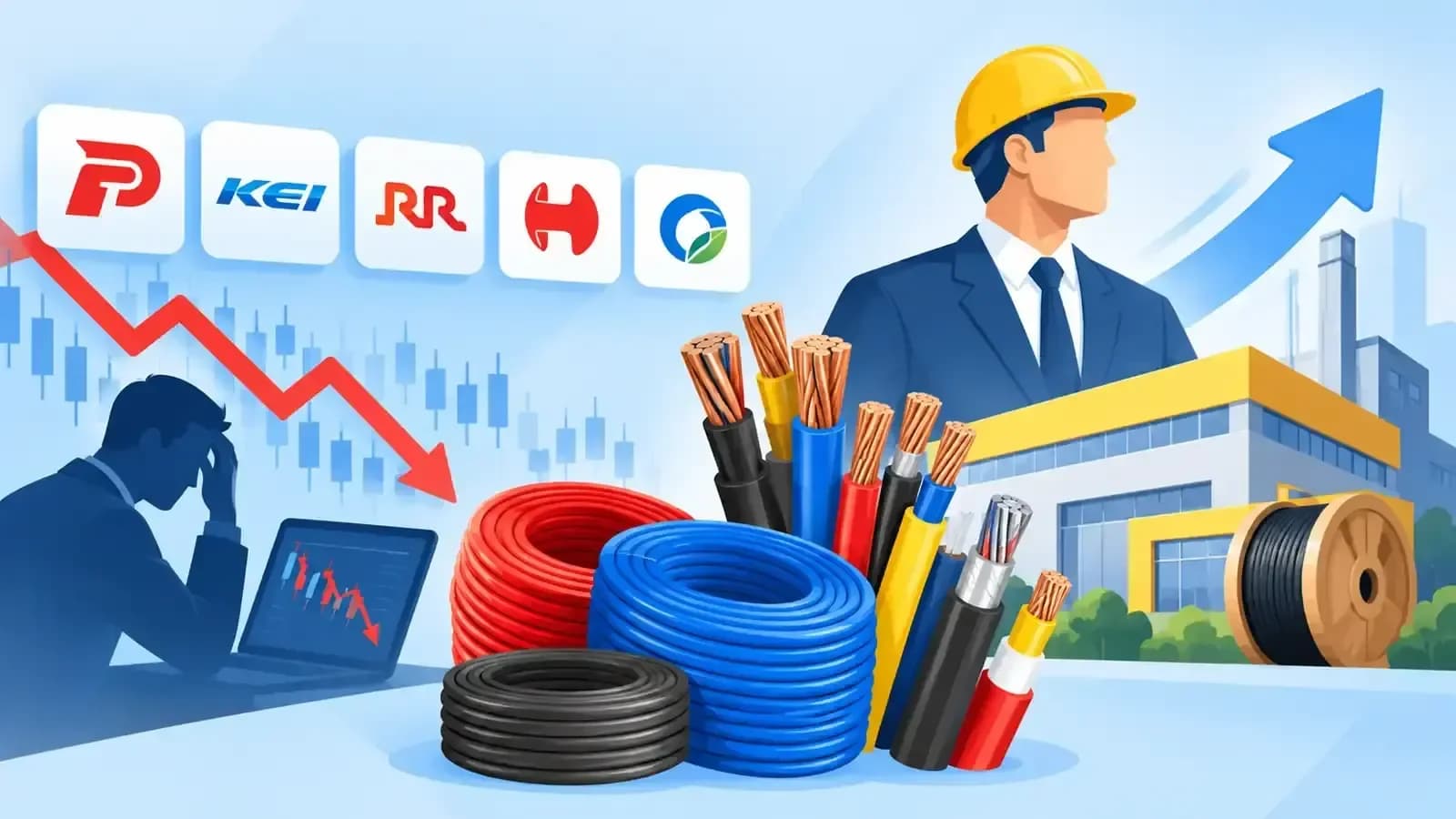
Polycab India, the market leader with an estimated 26-27% share of the organized segment, closed FY25 with total revenue of INR 22,408.3 crore, reflecting a robust 24% year-on-year increase. The company's growth was fueled by higher volumes across both B2B and B2C channels, expansion of its retail distribution footprint, and a richer product mix including fire survival, extra high-voltage (EHV), and hybrid cable categories.
RR Kabel posted FY25 revenue of INR 7,618.2 crore, up 15.5% year-on-year, with net profit at INR 311.6 crore, an increase of 4.5%. Following its IPO, RR Kabel has been aggressively expanding its retail footprint and export reach, targeting UL-certified markets in North America and Australia.
KEI Industries reported total revenue of INR 9,735.9 crore in FY25, marking a 20% year-on-year increase. Net profit after tax grew in tandem by 20% to INR 696.4 crore. KEI's growth continues to be driven by a well-balanced portfolio spanning EHV cables, control and instrumentation cables, stainless steel wire ropes, and building wires, supported by a strong institutional order book and rising retail sales.
CLSA's Top Picks and Competitive Advantages
CLSA recently initiated coverage on India's cables and wires sector, identifying it as entering a multi-year structural growth cycle.
CLSA described Polycab India as well positioned to benefit from its market leadership, execution capabilities, and product breadth. The company's scale, distribution network, and premium product portfolio should allow it to consolidate market share as India's cables market becomes increasingly organized. Polycab's net cash position improved to ₹41.9 billion in FY26, providing financial flexibility for growth initiatives.
For RR Kabel, CLSA believes the integrated manufacturing model and growing international presence position it well to capitalize on structural demand trends. The company's operating EBITDA increased 99% year-on-year with margin expansion of 205 basis points, driven by improved business mix, cost discipline, and execution efficiencies. InvestorPresentations
On KEI Industries, CLSA took a more balanced stance, seeing strong fundamentals with fair valuations. The brokerage believes KEI has built a strong foundation to capitalize on future opportunities and that capacity expansion is expected to translate into higher growth.
Winding Wires: The High-Margin Growth Engine
Winding wires are emerging as preferred beneficiaries compared to other segments due to several unique competitive advantages. Unlike other cable segments that may serve peripheral applications, winding wires are critical to the core functionality of power generation, transmission, and distribution equipment.
The winding wire industry is moving toward higher-value specialized products including continuously transposed conductors, paper-insulated conductors, rectangular wires, corona-resistant wires, and EV-grade winding wires. These products involve stringent qualification requirements and higher entry barriers, supporting improved profitability for organized manufacturers.
The increasing demand for specialized winding wires is positively impacting profit margins across major cable manufacturers. Polycab India's EBIT margins for the Wires & Cables business stood at 13.3% in Q1 FY27, with the company maintaining medium- to long-term margin guidance of 11% to 13%. RR Kabel achieved margin expansion of 205 basis points in operating EBITDA, while KEI Industries improved its EBITDA margin to 11.81% in FY26 from 10.92% in the previous year. Transcripts +1
Strategic Positioning for the USD 30.08 Billion Opportunity
The three leading cable companies are pursuing distinct strategic paths to capture the market opportunity by 2035. Polycab India has embarked on Project Spring, a five-year strategic roadmap focused on scaling exports to over 10% of total revenue, expanding manufacturing capabilities, and deepening presence in high-potential overseas markets. The company plans to invest between INR 6,000 crore and INR 8,000 crore over the next five years under this initiative.
RR Kabel is pursuing Project Rise, a comprehensive 3-year growth strategy focused on operational excellence, margin expansion, and market share gains. The company has completed a ₹500 crore comprehensive self-funded CAPEX plan focused on power cable capacity doubling. Transcripts
KEI Industries has set an ambitious ₹25,000 crores revenue target by 2030, requiring 20% CAGR from next year onwards. The company is investing ₹800-1,000 crores over 3 years in capacity expansion to support this growth trajectory. Transcripts
Capital Allocation and Competitive Evolution
The capital allocation strategies reflect each company's competitive positioning. Polycab India invested ₹14.8 billion in FY26, a 54% increase from the previous year, with the largest capex program among peers focused on comprehensive business expansion. RR Kabel has completed focused investments on power cable capacity doubling and margin improvement, while KEI Industries is pursuing a balanced approach with greenfield and brownfield expansion. InvestorPresentations
As the market approaches 2035, competitive dynamics will likely evolve toward greater specialization alongside continued consolidation. Polycab India is best positioned for overall market leadership due to scale, diversification, and financial strength. RR Kabel is well-positioned for premium segment leadership if margin expansion continues. KEI Industries holds a strong position in EHV specialty and export markets if execution succeeds.
The USD 30.08 billion market opportunity provides sufficient room for multiple winners, though competitive intensity will increase as the market matures. The companies that successfully execute their expansion strategies while maintaining operational excellence and financial discipline will be best positioned to capture this generational growth opportunity in India's electrification revolution.