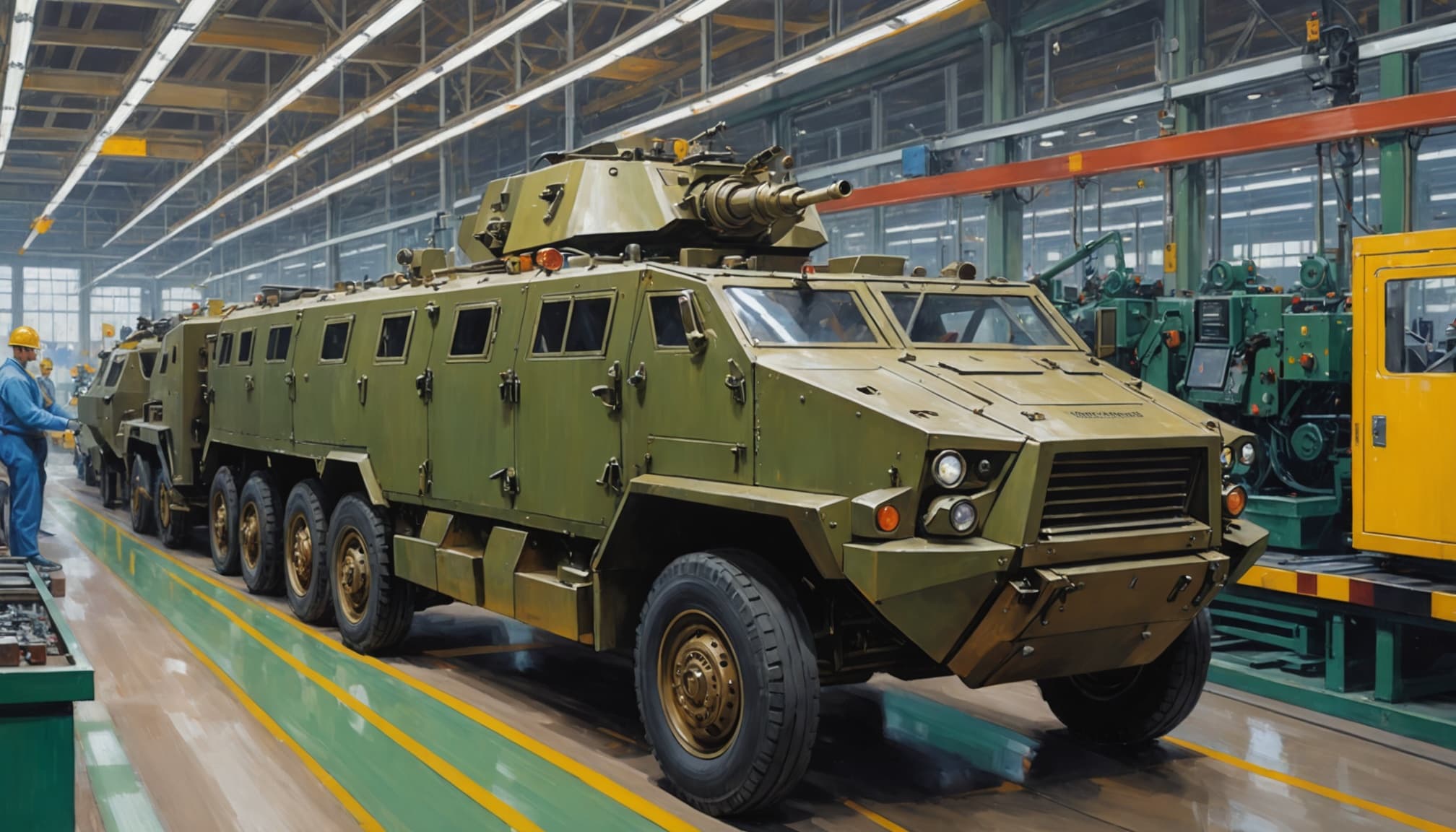
India's private defence manufacturers are pursuing distinct global expansion strategies—acquisitions, greenfield manufacturing, and technology partnerships.
Tata Advanced Systems builds manufacturing hubs in Morocco and India for scale and cost efficiency. Bharat Forge leverages partnerships with Rafael, AM General, Rolls-Royce, and Thales for technology access and export markets. Each approach offers different risk-reward profiles, execution timelines, and control levels, reflecting the diverse paths India's defence sector is taking toward global competitiveness.
Solar Industries: The Acquisition Gamble
Solar Industries India Ltd announced its largest overseas acquisition—100% of South Africa's Omnia Holdings for ₹12,951 crore ($1.355 billion) in all-cash. This deal fundamentally alters Solar's revenue composition. Omnia reported $1.41 billion (≈₹11,800 crore) revenue in FY26, with operations across 23 countries and 70+ distribution centers. For context, Solar's defence revenue reached ₹2,634 crore in FY2026, up from ₹396 crore in FY24, with defence now representing approximately 24% of total revenue. The acquisition immediately adds substantial international scale and diversifies Solar into agriculture and mining chemicals beyond its traditional explosives and defence focus. Transcripts
The market reaction was sharp—shares plunged 13.64% intraday to ₹19,250 on announcement day. Investors flagged the ₹12,951 crore cash outflow, potential balance sheet strain, and integration complexity. Solar's debt-to-equity ratio stands at a conservative 0.23x as of March 2026, but funding this deal through internal accruals and long-term debt will test that leverage profile. Management categorically ruled out equity dilution. Goldman Sachs estimates the deal could be earnings-accretive by 11-25% by FY28, but that depends entirely on successful integration and synergy realization.
Omnia's operating margin of 9.0% is significantly lower than Solar's 27-28% EBITDA margin, suggesting near-term margin dilution. However, the acquisition provides backward integration into critical raw materials like nitric acid and ammonium nitrate, potentially improving long-term margins. Capital allocation will now span 23 countries, requiring disciplined prioritization across agriculture, mining explosives, and defence segments. The deal marks Solar's transformation from an Indian exporter to a global chemicals multinational—but at the cost of execution risk and financial leverage.
Tata Advanced Systems: Building Global Manufacturing Hubs
Tata Advanced Systems (TASL) pursues greenfield manufacturing with technology partnerships. In Morocco, TASL established a 20,000 sq. ft. facility in Berrechid to produce 150 WhAP 8x8 armoured vehicles for the Royal Moroccan Armed Forces. The local content target starts at 33-35% and aims for 50% as Moroccan engineers complete training programs. This local sourcing qualifies TASL for African procurement preferences and reduces logistics costs by eliminating ~7,000+ km shipping from India for West and North African markets. The facility serves as an export hub for other African countries, with 50% excess capacity available for third-country orders beyond the initial 150-vehicle contract.
In India, TASL operates the C-295 Final Assembly Line in Vadodara—the first private sector aircraft FAL in India. The contract covers 56 aircraft for the Indian Air Force, with 40 manufactured domestically and 16 delivered from Spain. The first Made-in-India C295 rolls out in September 2026, with deliveries continuing through August 2031. This provides a 40-aircraft domestic baseline for fixed cost amortization, though export orders would significantly improve unit economics. Similarly, the Hyderabad facility for Rafale fuselage production with Dassault Aviation has capacity for 24 fuselages annually, with first sections expected in FY2028. This represents the first-ever Rafale fuselage production outside France, positioning India as a critical node in Dassault's global supply chain.
TASL's model requires significant upfront capital but offers full control over operations and technology transfer. The Morocco facility was operationalized three months ahead of schedule, demonstrating execution capability. However, greenfield projects typically take 24-42 months to generate first cash flow, creating a longer path to profitability compared to acquisitions.
Bharat Forge: The Partnership Powerhouse
Bharat Forge's defence subsidiary, Kalyani Strategic Systems (KSSL), pursues technology partnerships over ownership. The joint venture with Israel's Rafael—Kalyani Rafael Advanced Systems (KRAS)—manufactures MRSAM missile kits, with a $100 million order for 1,000 BARAK 8/MRSAM kits. KRAS is India's first private sector missile sub-systems manufacturing facility, with 51% held by Kalyani Group and 49% by Rafael. This provides access to advanced missile technology and export markets through Rafael's global network, with more than 70% indigenous content in the MRSAM missile.
Partnerships with US companies expand Bharat Forge's reach further. The collaboration with AM General and Mandus Group targets ₹1,000 crore in export revenue from mobile artillery platforms, integrating 155mm and 105mm artillery systems onto mobile platforms. This opens access to NATO and US-allied markets previously restricted to domestic Western OEMs. Similarly, the agreement with Rolls-Royce Marine North America for naval propulsors creates a domestic supply chain ecosystem for controllable pitch propellers and shafting systems. The recent partnership with Thales for 70-mm rocket systems targets first production by early 2027, with technology transfer and access to Thales' 55-country market.
Bharat Forge's defence revenue grew 87.43% YoY to ₹495.58 crore in Q1 FY27, with a ₹5,200 crore defence order book. The partnership model requires less capital than acquisitions but creates dependence on foreign partners for critical technology. However, it provides faster market access and shared development risks, with typical IRR of 20-35% for partnerships compared to 15-25% for acquisitions or greenfield projects.
The Strategic Trade-offs
Each expansion model presents distinct risk-reward profiles. Solar's acquisition strategy offers immediate scale and market access but carries high integration complexity and financial risk. The ₹12,951 crore cash deal represents ~6.4% of Solar's market cap, testing its balance sheet despite a conservative 0.23x debt-to-equity ratio. Tata's greenfield model provides full control and operational efficiency but requires patience—24-42 months to first cash flow—and significant upfront capital. Bharat Forge's partnership approach offers balanced risk with shared investment and immediate technology access, but limits control and creates partner dependence.
The choice depends on strategic objectives. Acquisitions suit companies seeking rapid global transformation with strong financial positions. Greenfield manufacturing fits those prioritizing long-term control and sustainability. Partnerships work well for companies with limited capital seeking technology access and market entry. India's domestic defence production growth from ₹84,643 crore in FY2020-21 to ₹1.78 lakh crore in FY2025-26—a 110% increase—provides the scale that enables all three models to succeed. The Defence Acquisition Council's allocation of 94.19% of ₹4.22 lakh crore capital acquisition proposals to indigenous sources de-risks order books for private manufacturers. Meanwhile, the private sector's contribution of ₹17,353 crore to defence exports in FY2025-26—45.16% of total exports despite only 24% of domestic production—demonstrates the export competitiveness emerging from these diverse strategies.
India's private defence manufacturers are no longer following a single path. Solar's bold acquisition, Tata's manufacturing build-out, and Bharat Forge's partnership network represent three distinct approaches to global expansion. Each carries different risks and rewards, but all reflect the growing ambition and capability of India's defence industrial base. The success of these strategies will determine whether Indian companies can transform from domestic suppliers into genuine global defence players.