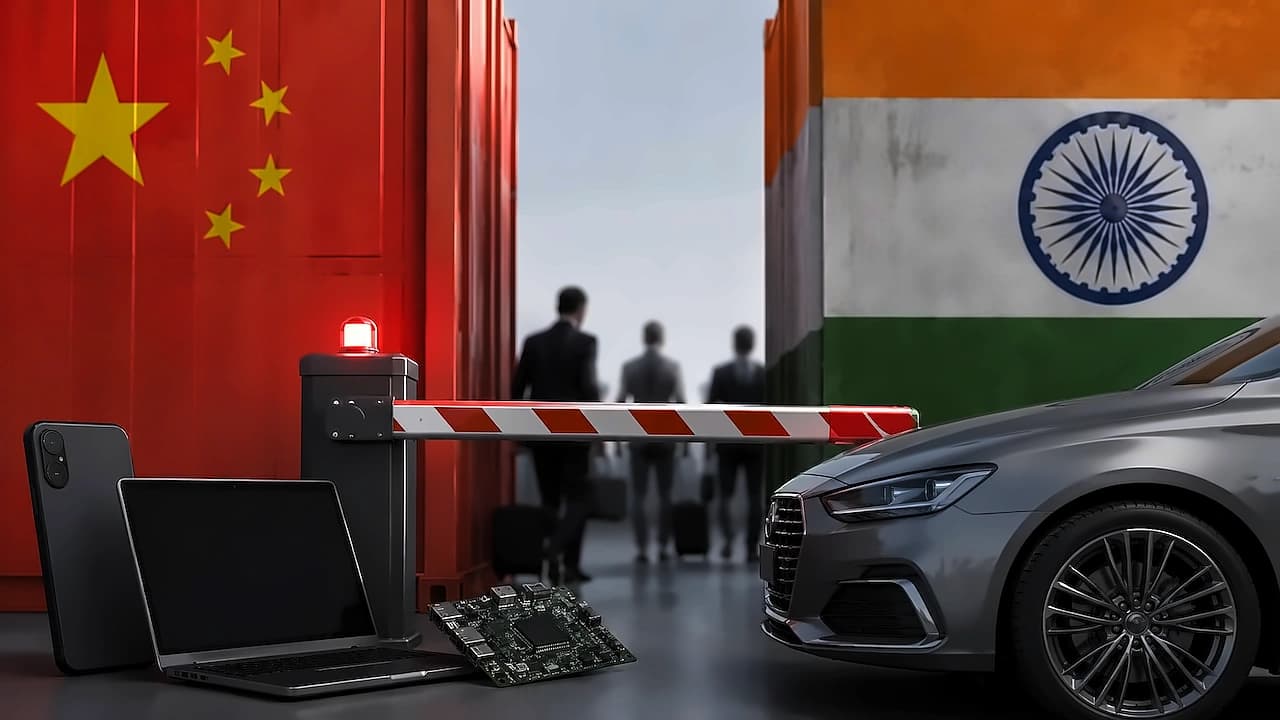
India's chemical companies are pouring billions into lithium-ion battery materials plants, but a dangerous mismatch is emerging. Chinese technology transfer restrictions and stalled domestic cell manufacturing are creating a perfect storm that threatens to leave these massive investments running well below capacity.
The Chinese Technology Trap
The restrictions require State Council licenses for transferring lithium-ion battery technologies, specifically targeting cathode materials like lithium iron phosphate, nickel, cobalt, and manganese hydroxides, along with graphite anode materials and related production technologies. While mainstream EV applications using batteries with 100-280 Wh/kg energy density remain exempt from import restrictions, the technology for manufacturing these cells now stands restricted.
This has hit Indian companies hard. Amara Raja Energy and Mobility's deal with China's Gotion for lithium-ion cell manufacturing and Exide Industries' 2022 agreement with SVOLT Energy now face significant hurdles. Reliance Industries has reportedly paused its lithium-ion cell manufacturing plans entirely after failing to secure essential Chinese expertise. The Chinese government has explicitly advised its companies against transferring advanced EV technology to countries like India that could become future competitors.
The Ola Electric Domino Effect
The delays in domestic cell manufacturing are creating a cascade of problems.
The company now plans to limit battery cell production to 5 GWh till FY2029, shelving its earlier promise of reaching 20 GWh by mid-2026.
This represents a 75% reduction in potential demand for cathode, anode, electrolyte, and separator materials from what was anticipated to be a flagship domestic customer. The broader PLI-ACC scheme shows similarly dismal results—only 1.4 GWh of the targeted 50 GWh capacity has been commissioned as of October 2025, with zero incentives disbursed against the targeted ₹29 billion.
The Utilization Crisis
The lack of domestic cell manufacturing capacity has created a direct causal chain of underutilization for Indian battery materials plants. Battery materials facilities are designed to supply cell manufacturers, but with domestic cell manufacturing at minimal levels, these plants lack their primary customer base.
The structural challenges are reflected in key metrics. Against an estimated 1.03 million jobs, the PLI-ACC scheme has generated only 1,118 jobs (0.12%). Investments of approximately ₹28.7 billion account for just 25.58% of the targeted ₹112.5 billion. India's dependence on imported lithium battery cells remains close to 100%.
Why Invest Despite the Gaps?
Despite these challenges, Indian chemical companies are making massive investments. Himadri Speciality Chemical is investing ₹4,800 crore over 5-6 years for 200,000 MTPA of Lithium Iron Phosphate Cathode Active Material. PCBL Chemical has committed over ₹2 billion for nano silicon technology for batteries. Balaji Amines is positioning itself as India's only manufacturer of electronic-grade dimethyl carbonate, a critical electrolyte component.
The strategic rationale centers on the Foreign Entity of Concern regulations implemented by the United States and other Western nations. These regulations effectively exclude Chinese-controlled entities from receiving incentives for battery materials supplied to markets with EV subsidies. With China controlling 80% of global lithium-ion battery manufacturing and 60-90% of critical mineral processing capacity, battery manufacturers are actively adopting "China+1" sourcing strategies.
The ROCE Squeeze
The timing mismatch between capacity expansion and delayed cell production is creating significant pressure on return on capital employed. Tata Chemicals' ROCE has declined from 12.37% in FY2023 to -3.09% in FY2026, significantly below the 12% chemicals industry average. PCBL Chemical's consolidated revenue fell to ₹8,190 crore in FY26 from ₹8,404 crore in FY25, with EBITDA declining 22% to ₹1,081 crore.
Companies are accepting these short-term capital inefficiencies for long-term strategic positioning. Battery manufacturers require 12-24 months of testing before commercial orders, making early entry critical for securing long-term contracts. Once approved, supplier relationships can last for years due to the critical nature of battery chemistry for performance and safety.
The Cost Competitiveness Gap
The cost differentials between Indian and Chinese battery materials producers are substantial and structural. Chinese manufacturing costs for battery facilities range from $55-72 million per GWh (₹457-625 crore), while Indian estimates range significantly higher. China's capital expenditure requirements are approximately 70% of Indian requirements.
The Chinese government extended $230.9 billion in support to the EV industry between 2009 and 2023, with subsidies tripling between 2018 and 2020. China controls 90% of global cathode production and 97% of anode production, giving it significant upstream advantages through vertical integration.
Policy Responses and Future Outlook
The government has begun responding to these challenges. The Ministry of Heavy Industries has approved revised timelines for Ola Electric, extending the original timeline by two years and unlocking up to ₹7,240 crore in cumulative PLI incentives with quarterly disbursements. The National Critical Mineral Mission, approved in January 2025 with ₹16,300 crore in proposed expenditure, aims to secure long-term supplies of critical minerals and strengthen India's battery value chain.
However, India remains at least 5-10 years away from establishing a robust and competitive cell manufacturing industry. The next 2-3 years will be critical as these companies navigate the valley of death between capacity commissioning and demand realization. Success will depend on execution excellence, global customer development, and strategic patience—balancing the need for capital efficiency with the imperative of securing early-mover advantages in a rapidly evolving geopolitical and technological landscape.