The Strait of Hormuz blockade in late February 2025 fundamentally altered India's energy security calculus. When Iran effectively shut this critical maritime chokepoint following conflict with the United States and Israel, global LNG supply fell by more than 20%. For India, where nearly two-thirds of LNG imports transited through Hormuz in 2025, the impact was immediate and severe. QatarEnergy declared force majeure on deliveries, suspending supply obligations after attacks crippled production at its Ras Laffan industrial complex—the world's single largest LNG export facility.
The economic shock was equally dramatic.
This volatility exposed a critical vulnerability: India imports nearly half of its natural gas requirements, with Qatar and the UAE together accounting for 55-60% of LNG imports. Unlike crude oil, where India maintains strategic petroleum reserves, the country has hardly any strategic LNG reserves.
Perhaps most alarming was India's minimal strategic gas buffer. The country operates approximately 22-24 LNG storage tanks across regasification terminals, with an estimated storage capacity of roughly 2-2.5 billion cubic metres. This represents only about 10-12 days of national gas consumption.
This structural gap transformed the MEIDP from a theoretical aspiration to an active national security priority.
The Deepwater Engineering Challenge
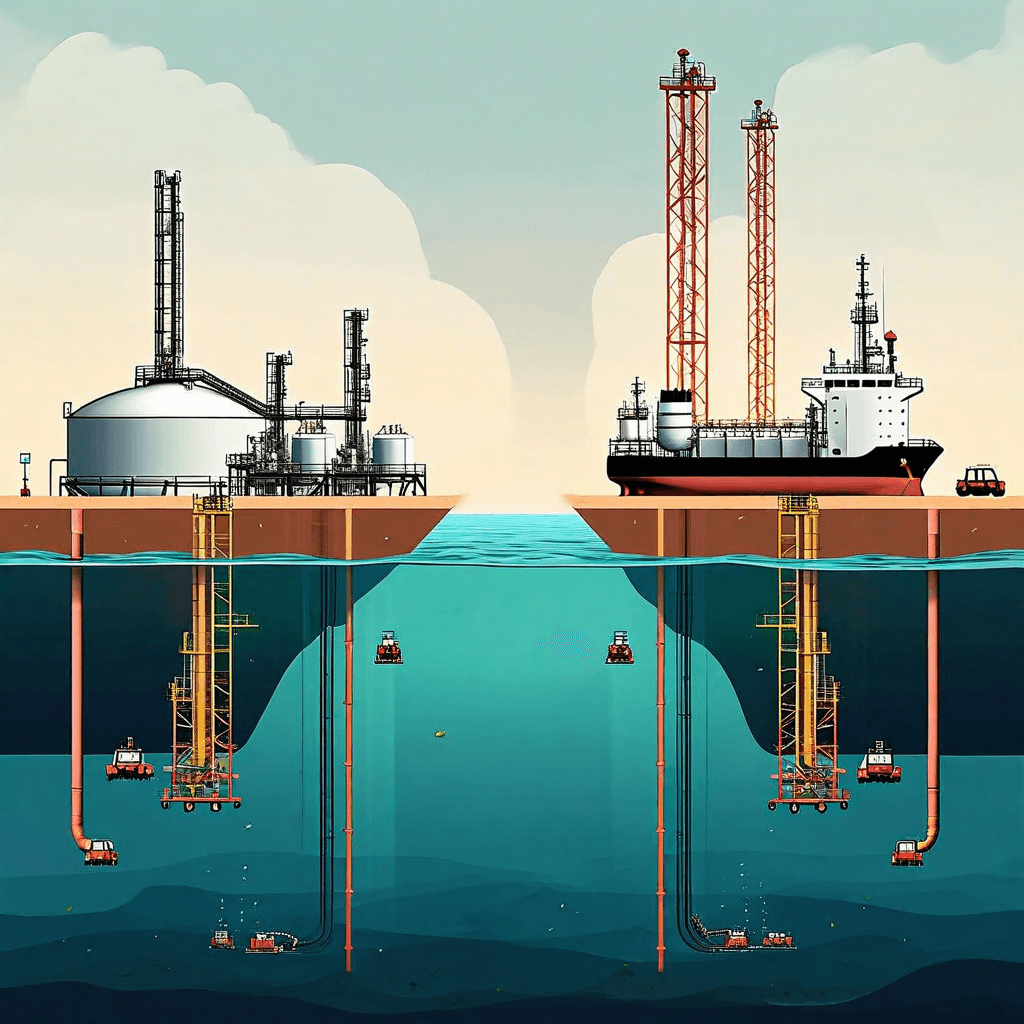
The proposed Middle East-India Deep-water Pipeline (MEIDP) represents one of the most technically ambitious infrastructure projects ever attempted.
The project requires specialized pipe-laying vessels, with only 5-7 vessels worldwide currently capable of operating at these extreme depths, including the Saipem 7000 and Heerema Balder.
Technical requirements are extraordinary. Pipeline wall thickness must reach 44-52mm in the deepest sections, using X80/X100 grade steel to withstand hydrostatic pressures of 345 bar. The J-Lay method will be primary for ultra-deepwater sections, requiring vessels with tension capacity of 600+ metric tons and dynamic positioning accuracy within 0.5-1.0 meters. The route crosses complex geological features including the Owen Fracture Zone—a transform fault between Arabian and Indian plates—and the Indus River Fan outfall at 2,500m depth.
South Asia Gas Enterprise (SAGE) has already conducted early technical validation, laying approximately 3,000 metres of test pipeline along the proposed route at a cost of around ₹25 crore. This tactical test pipeline assessed seabed conditions, current patterns, corrosion potential, and marine life. Findings have already influenced design parameters, with wall thickness increased from 40-48mm to 44-52mm and concrete coating enhanced from 80-100mm to 100-120mm based on actual seabed data.
Financial Architecture and Capital Structure Impact
The estimated ₹40,000 crore ($4.7-4.8 billion) capital expenditure requires sophisticated multi-layered financing. The proposed structure splits equity (40% of total cost) and debt (60%), with the Indian government taking 20-25% equity, Oman 15-20%, GAIL 15-20%, Indian Oil Corp 5-10%, and other PSUs and private sector participants making up the balance. Debt financing will come from multilateral development banks ($800M-1.0B at 5.5-6.5%), export credit agencies ($600M-800M at 6.0-7.0%), Indian financial institutions ($800M-1.0B at 7.5-8.5%), and international commercial banks ($600M-800M at 8.0-9.0%).
For GAIL, taking a 25-30% equity stake (₹10,000-12,000 crores) would significantly impact its capital structure. The company currently maintains a conservative debt-to-equity ratio of 0.27 with total debt of ₹10,781 crores .
During the 5-7 year construction period, ROCE could decline from current 11.90% to 8-10% due to capital dilution, though post-commissioning projections show improvement to 14-16%.
Indian Oil Corporation presents a different risk profile. With higher existing leverage (debt-to-equity of 0.77) and more volatile returns—ROCE swung from 25.55% in FY24 to 9.84% in FY25—IOC is likely to take a smaller 5-10% stake, focusing more on offtake agreements rather than lead sponsorship . The company's strong free cash flow generation of ₹29,594 crores in FY25 provides capacity for participation without over-leveraging .
Economic Viability and Market Impact
The project's economics are compelling. Pipeline gas from Oman could be 40-55% cheaper than LNG, representing savings of $5-8 per MMBtu. The MEIDP would deliver 31 mmscmd of natural gas, representing approximately 17-19% of India's projected LNG import requirement of 180-200 mmscmd by 2030. Annual system-wide savings could reach ₹56,000 crores, distributed across CGD companies (₹14,000 crores), power generators (₹16,800 crores), fertilizer plants (₹11,200 crores), industrial consumers (₹8,400 crores), and government tax revenue (₹5,600 crores).
For gas distribution companies, margin expansion could be significant. Current LNG procurement costs of ₹40-48/SCM could decline to ₹25-30/SCM with pipeline gas, potentially expanding CGD company margins by 200-500 basis points. The fertilizer sector, with structural demand of 46-50 mmscmd, would benefit from predictable pricing, while city gas distribution expansion would accelerate as cheaper gas drives demand growth.
GAIL's transmission business stands to gain substantially. The company operates India's largest natural gas pipeline network, spanning over 16,421 kilometers and controlling approximately 65% of the market. The unified tariff structure effective January 2026, with rates of ₹54.00/MMBTU (up to 300 km) and ₹102.86/MMBTU (beyond 300 km), provides regulatory clarity. The 12% tariff increase approved for GAIL, raising rates from ₹58.61 to ₹65.69 per mmBtu, will have a positive financial impact of approximately ₹1,200 crore annually—though this falls short of the ₹3,400 crore benefit GAIL originally requested.
Geopolitical Risks and Strategic Evolution
Despite avoiding the Strait of Hormuz by routing through the Arabian Sea via Oman and UAE, geopolitical risks remain. The pipeline crosses the Owen Fracture Zone, an active transform fault with slip occurring at 2-3 mm/year—the slowest rate on Earth. While seismic risk is considered low to moderate, the design must withstand 7.0+ magnitude events. The route also traverses areas with potential for submarine landslides and strong deepwater currents of 0.5-1.5 m/s.
Government-level negotiations with Oman will be critical, covering gas supply volumes, pricing mechanisms, contract duration, and force majeure frameworks. Oman's position as a politically stable Gulf producer and established LNG exporter makes it a credible anchor partner, but bilateral negotiations have historically been the stumbling block for similar projects. The MEIDP joins a long history of proposed but unrealized cross-border energy infrastructure in South Asia.
India's energy security policy is evolving beyond the pipeline project. The absence of strategic gas reserves compared to China's 80 bcm capacity is driving parallel investments in storage infrastructure. Petronet LNG plans to add seven new LNG storage tanks across terminals in Odisha, Kerala, and Gujarat, increasing storage capacity by approximately 70%. Underground gas storage facilities, widely deployed in Europe and Central Asia, are also being considered to extend the national buffer materially.
The MEIDP represents the most high-profile element of India's energy security response, but it sits within a broader reform agenda. The convergence of three factors—demonstrated technical feasibility from advances in deepwater pipe-laying technology, a geopolitical shock severe enough to generate political will, and a formal government directive to state-owned entities—has created unprecedented momentum. With 5-7 years of construction ahead and substantial capability development required for GAIL and Engineers India, the project represents a transformative opportunity to secure India's energy future while building world-class deepwater expertise.