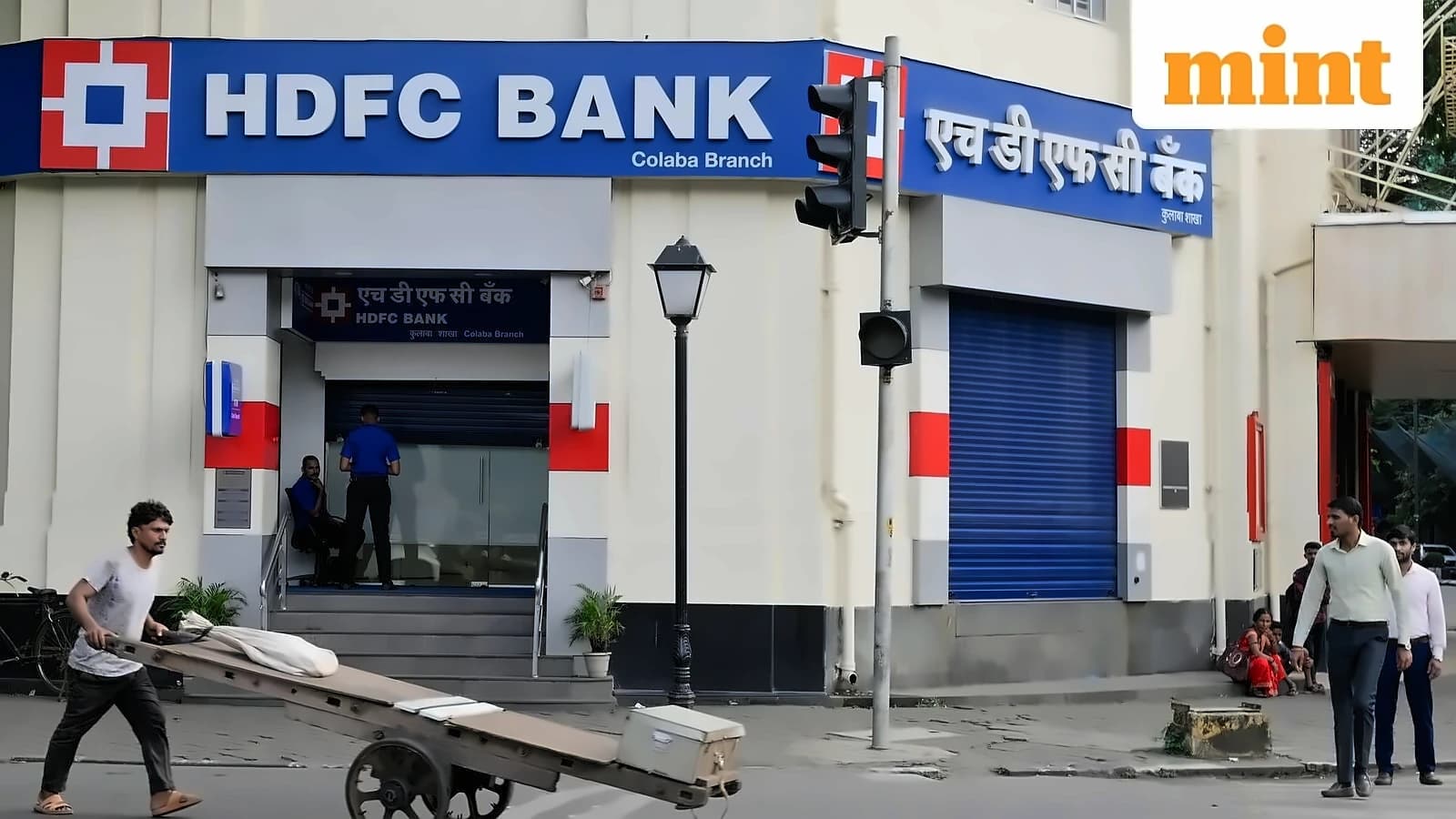
March 18, 2026, marked a turning point for HDFC Bank. Part-time Chairman Atanu Chakraborty resigned abruptly, citing that certain developments at the bank had not aligned with his personal values and ethics. This was the first time a part-time chairman had left midway through his term, sending shockwaves through the market. The stock plunged 8% to a 52-week low of ₹772, with ADRs falling over 7% overnight to $26.62.
The governance shock was compounded in August when CEO Sashidhar Jagdishan announced he would not seek reappointment beyond his term ending October 26, 2026. This created a rare dual leadership vacuum at India's largest private sector bank. The board has since submitted two candidates to the Reserve Bank of India for the MD & CEO position—Kaizad Bharucha (Deputy Managing Director) as the internal candidate and an experienced private-sector banker as the external option.
The market's reaction has been severe. HDFC Bank shares have fallen approximately 28.5% in 2026 compared with a 10.5% decline in the Nifty 50, and the stock now trades near its 52-week low of ₹681.90. More critically, the valuation gap with ICICI Bank has widened dramatically—HDFC Bank now trades at a 26% discount to ICICI Bank on price-to-book basis compared to just an 11% discount on March 18, 2026.
Why the CEO Appointment Triggers a Management Reshuffle
When a new CEO takes charge at a bank of HDFC's scale, they typically reorganize the top team and business structures to better achieve growth, profitability, and governance objectives. Jefferies expects this pattern to play out at HDFC Bank, with the appointment potentially followed by changes to the top team and business structures.
The board has already taken steps to strengthen the senior leadership structure. V. Srinivasa Rangan has been reappointed as a whole-time director for one year, Jimmy Tata (Chief Credit Officer) has been appointed to the board as a whole-time director for three years, and a fourth whole-time director position has been created to deepen the leadership bench. Additionally, Puneet Sharma will become Chief Financial Officer effective December 1, 2026, and Jigar Shah will take over as General Counsel from October 1, 2026. Others +1
Jefferies believes completing this reorganization promptly could allow the bank to focus more clearly on execution across three critical areas: improving deposit growth, recovering fee income, and optimizing the loan book composition. The brokerage has set a target price of Rs 880 based on 1.6 times September 2028 adjusted book value, implying approximately 24% upside from current levels.
The Deposit Mobilization Challenge
HDFC Bank has significantly lagged peers in retail LCR deposit growth, expanding at 12% compared to 15% for ICICI Bank and 14% for SBI, despite offering competitive rates. This underperformance stems from multiple factors.
The merger with HDFC Limited created structural challenges. The bank inherited primarily term deposits rather than low-cost CASA deposits, diluting the CASA ratio by approximately 3-4 percentage points. Some inherited deposits from corporates, trusts, and institutions were priced higher than preferred, leading management to be "circumspect" about participating in such deposits. Transcripts +3
Customer behavior has also shifted. During the high interest rate cycle, customers preferred locking in rates through time deposits rather than maintaining CASA balances. Additionally, lower disposable income in middle-to-lower segments due to inflation and spending needs has impacted deposit accumulation. Transcripts +2
However, HDFC Bank has made a strong comeback in FCNR-B deposits, mobilizing $11-12 billion within two months—representing approximately 8-9% market share. These deposits account for about 3% of total deposits and 8% of LCR non-retail deposits. This should help the bank refinance high-cost deposits and borrowings at slightly lower rates, providing some relief to funding costs.
Fee Income Deceleration and Bancassurance Risk
Fee growth has slowed dramatically to 8% and 11% year-on-year in the past two quarters, well below the bank's typical range of 14-17%. The primary culprit has been third-party product distribution, which grew only 3.5% on a full-year basis, significantly lagging overall customer growth. Transcripts +2
Credit card fees have also faced pressure. Management has recalibrated the credit card strategy, shifting focus from traditional receivables to relationship building. Credit cards are now viewed as enablers for deposits rather than primarily as net receivable assets, with credit card spends contributing 20-25% of total deposit growth. This strategic shift, combined with more customers transacting and paying on due dates rather than revolving balances, has impacted fee income. Transcripts +2
The concentration risk in bancassurance is particularly concerning. Bancassurance fees account for approximately 8% of HDFC Bank's FY27 normalized pre-tax profit. A 30% decline in this income stream would translate into a 2% hit to overall profit—a material impact for a bank of HDFC's scale. With third-party products (primarily bancassurance and mutual funds) representing 23.30% of Total Fee Income in FY 2025-26, diversification away from this concentration is critical.
NIM Pressure and the Loan Mix Problem
The shift toward faster-growing corporate and secured lending, along with increased PSU loan exposure, has weighed on net interest margins through lower loan repricing. Management acknowledged that larger ticket corporate loans and SME loans have become very competitive, particularly from public sector institutions where "growth is an objective and not necessarily margin or returns," resulting in very low pricing. Transcripts
HDFC Bank's significant exposure to floating-rate loans—approximately 69-70% of the loan book linked to external benchmarks like EBLR—creates additional complexity. When the rate reduction cycle began with an unexpected 125 basis point cut, about 70% of the floating-rate book was impacted, affecting NIM dynamics. While the bank maintains a matched modified duration of the balance sheet to minimize rate cycle impact, the high floating-rate exposure means asset yields decline rapidly in falling rate environments while deposit costs reprice more slowly. Transcripts +2
The result is a persistent NIM gap with peers. HDFC Bank's NIM of 3.35-3.46% lags ICICI Bank's 4.30% by approximately 95 basis points. This gap reflects both the loan mix composition and competitive dynamics in different segments.
The Path to Rerating: What Must Change
Jefferies has outlined a clear roadmap, with the bank needing to close gaps in three critical areas.
On deposits, HDFC Bank must accelerate retail LCR deposit growth to 14-15% to match or exceed ICICI Bank and SBI within 12-18 months. The CASA ratio needs improvement to 38-40% within 18-24 months through better customer engagement and cross-selling. The Loan-Deposit Ratio should be reduced to 85-90% pre-merger levels by FY27 through superior deposit growth relative to loan growth. Transcripts +3
For fee income, the bank must return to the 14-17% YoY growth range within 4-6 quarters. This requires accelerating third-party products growth to 15-20% through improved distribution and product mix, while reducing bancassurance dependence from 23.3% of total fee income to 18-20% through growth in other fee categories. Credit card fees need stabilization and recovery through a balanced transactor/revolver strategy.
On the loan mix front, NIM needs to improve to 3.7-3.9% through strategic optimization. This includes increasing SME/Business Banking to 25-30% of advances over 24-36 months (leveraging the bank's leadership position as #1 in 15/28 states), sustaining gold loan growth at 25-30%, and accelerating unsecured personal loans to 15-18% growth with disciplined underwriting focused on the 75-80% salaried customer base. Transcripts +2
The Timeline for Recovery
The path to rerating will unfold in phases. Phase 1 (Q4 FY26, October-December 2026) should bring CEO appointment and management team stabilization. Phase 2 (Q1-Q2 FY27, January-June 2027) should show early execution signs with deposit growth improvement and fee income stabilization. Phase 3 (Q3 FY27 - Q2 FY28, July 2027 - June 2028) needs sustained execution with NIM improvement, loan mix optimization, and consistent earnings beats. Phase 4 (Q3 FY28 onwards, July 2028+) should deliver sustained outperformance versus peers and P/B multiple expansion to 1.8-2.0x.
The stakes are enormous. With the stock down nearly 30% in 2026 and trading at a significant valuation discount to peers, the CEO transition represents not just a leadership change but a potential inflection point for India's banking giant. The right appointment, followed by prompt management reorganization and sharp execution focus, could unlock substantial value. The wrong choice or delayed action could extend the valuation pain for shareholders.
As Jefferies noted, "Clarity on smooth succession will be positive for bank and sector". The market is waiting for that clarity—and the execution that must follow.