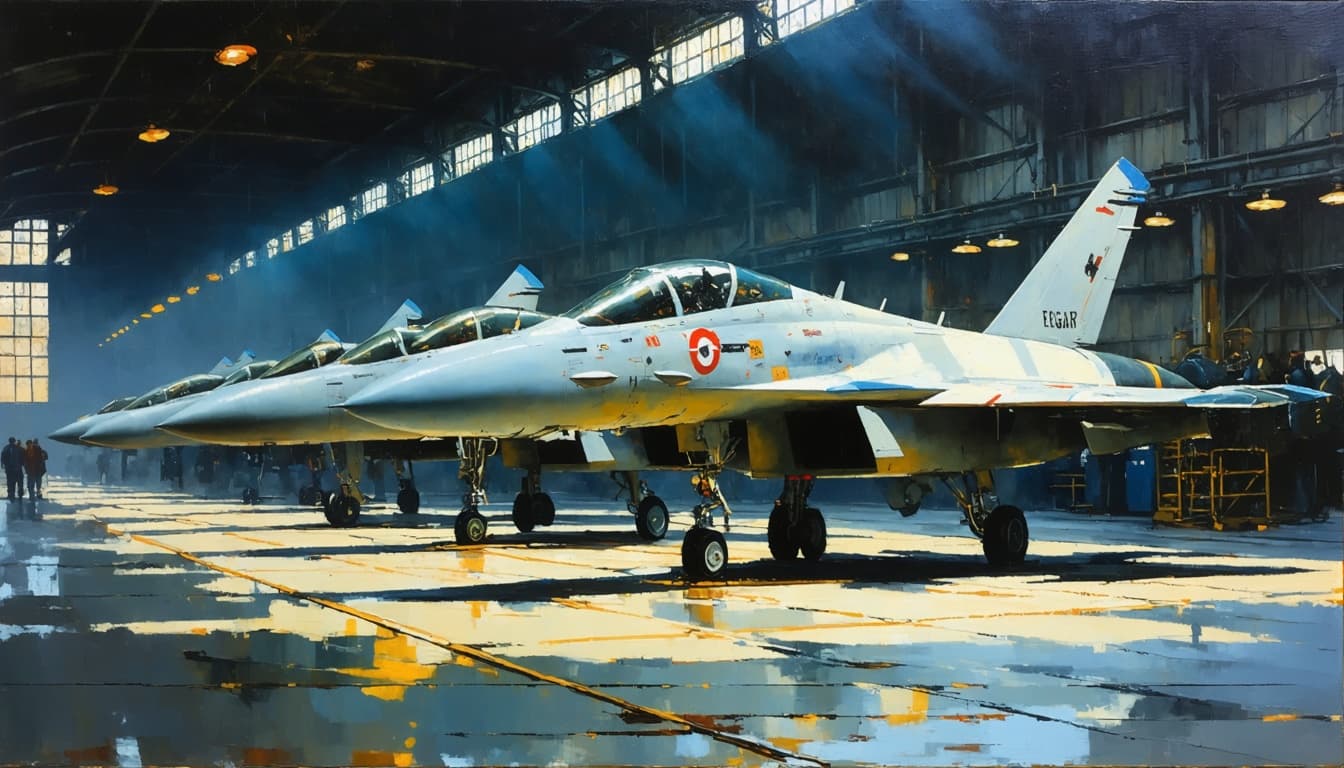
Hindustan Aeronautics Limited has delivered a remarkable 45% stock rally from its 52-week low of ₹3,487.20, now trading at 29.3x forward earnings—above its 26x historical average. This premium valuation reflects growing investor confidence that the company is finally turning the corner on its most critical program: the Tejas MK1A fighter jet. With an order book of ₹2.54 lakh crore (8x trailing sales) and a ₹4.5 trillion addressable pipeline estimated by Antique Stock Broking, HAL's story hinges on one fundamental question—can it execute?
The Engine Bottleneck: From Constraint to Catalyst
The primary overhang on HAL's stock has been the Tejas MK1A delivery delays, largely driven by GE Aerospace engine supply constraints. In FY26, HAL received just 6 engines, severely limiting production. But the dynamics have shifted dramatically. GE has committed to supplying 15-20 engines in FY27, with a structured delivery cadence of 2 engines per month from August onwards. This 3.3x increase in engine availability directly enables HAL to target 15-20 aircraft deliveries this fiscal year, with Nomura projecting a ramp-up to 16 aircraft in FY28 and 20 in FY29. Transcripts
The causal relationship between engine supply and revenue recognition is straightforward. Each engine received translates to aircraft completion within 30-45 days. With 15-20 engines expected in FY27, this creates a clear revenue recognition pipeline of approximately ₹5,500-7,300 crore from Tejas MK1A alone. The 180-aircraft order worth approximately ₹98,370 crore provides 7-8 years of revenue visibility, but converting that order book into actual revenue depends entirely on sustained engine supplies. Transcripts +1
Margin Dynamics: The Lumpy Delivery Challenge
HAL's Q1 FY27 results highlighted the inherent volatility in its business model. Gross margin declined 280 basis points year-on-year to 65.3%, while EBITDA margin came in at 27.7%—below the guided 30-31% range. This variation stems from the lumpy nature of aircraft deliveries. Unlike percentage completion accounting, HAL recognizes revenue only upon delivery, creating quarterly volatility as large aircraft shipments shift between periods. Transcripts
The margin bridge to the guided 30-31% will be driven by the Tejas ramp-up. As production scales from 6 aircraft in FY27 to 20 in FY29, HAL benefits from operating leverage—fixed costs get absorbed across higher output. Additionally, the company has built substantial inventory in advance, with purchase orders placed 1-2 years ahead for key components. This forward positioning, combined with contractual protections including material escalation clauses and exchange rate variation provisions, provides a hedge against raw material inflation. Transcripts +1
The CAPEX Engine: Scaling from 24 to 30 Aircraft
HAL's ability to meet delivery schedules rests on a ₹14,000 crore five-year CAPEX plan. The company has already commissioned a third production line at Nashik, adding 8 aircraft of annual capacity. Combined with two existing lines in Bangalore, HAL currently has capacity for 24 aircraft annually, with plans to scale to 30. The investment spans manufacturing infrastructure for LCA Mk2 and GE-414 engines, ROH facilities for SU-30 and AL-31FP engines, and a greenfield helicopter project at Tumakuru. Transcripts +2
The causal link between capacity expansion and order inflow operates bidirectionally. Expanded capacity demonstrates execution capability, making HAL more credible for large orders. Simultaneously, the strong order pipeline justifies the capacity investments. HAL expects ₹90,000 crore in orders over the next two years, including ₹20,000 crore annually for ROH. The company's state-owned status provides inherent advantages—government trust, integrated manufacturing ecosystem, and financial stability—that private competitors struggle to match. Transcripts +1
The Regulatory Hurdle: Dubai Crash and Testing Delays
The Tejas program has faced additional challenges beyond engine supplies. The Dubai air show crash in November 2025 triggered a comprehensive safety review and additional testing requirements. Investigations traced incidents to software glitches in the digital flight control systems, requiring refinements that have delayed deliveries from the original FY24 target to August-September 2026.
However, the IAF has adopted a balanced approach—willing to accept the initial batch with temporary limitations on non-essential features, provided core combat capabilities remain intact. Software fixes have been developed and are undergoing flight validation. HAL management maintains confidence in the revised timeline, with 21-22 aircraft structures already built and ready for completion upon engine receipt. Transcripts
The Valuation Question: Premium or Overhang?
Citi Research has suggested that successful Tejas deliveries could trigger a re-rating by removing the key overhang. The stock's 45% rally from March lows reflects improving execution visibility from GE engine supply normalization. Analyst projections of 6, 16, and 20 Tejas deliveries in FY27, FY28, and FY29 provide a credible ramp-up path that underpins investor confidence.
The government's thrust on defense modernization and indigenization underpins HAL's order pipeline. Expected orders include 143 Advanced Light Helicopters and 40 Dornier aircraft upgrades in FY27. The IAF currently operates 29 squadrons against an authorized strength of 42, creating a 300+ aircraft replacement opportunity over the next decade. Transcripts
The Execution Test
The ₹4.5 trillion addressable pipeline will test HAL's execution capabilities and capital allocation efficiency. Key monitorables include the actual commencement of Tejas deliveries in FY27, consistency of GE engine supplies at 2 per month, and margin recovery toward the 30-31% guidance. The company's ability to scale production while maintaining quality and margins will determine whether the current premium valuation is justified.
HAL stands at an inflection point. The pieces are in place—massive order book, production capacity scaling, engine supply normalization, and strong government backing. The next 6-12 months will be critical as actual deliveries begin and validate the projections that underpin the stock's premium valuation. Success could cement HAL's position as India's defense aerospace champion for decades to come.