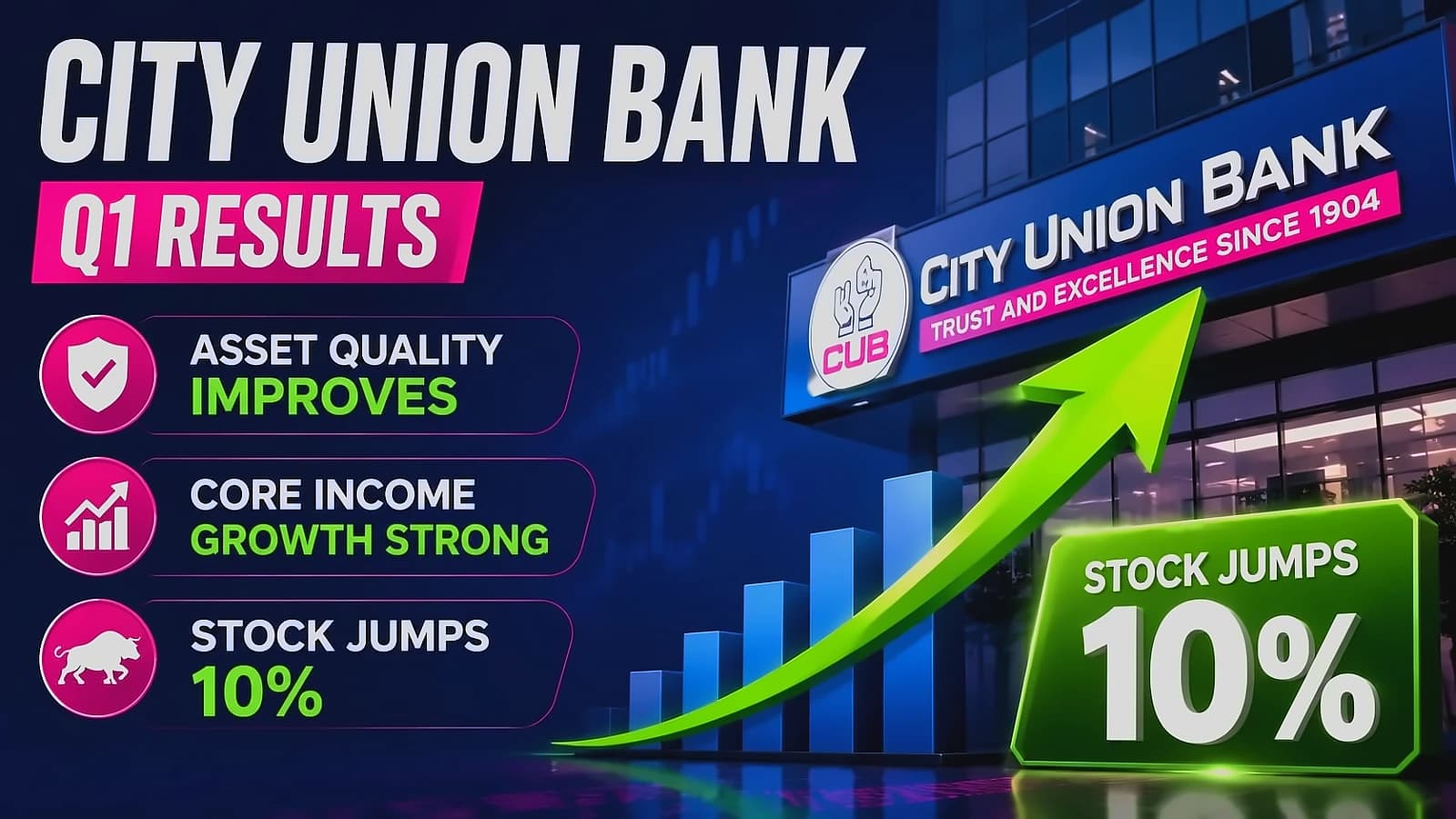
City Union Bank’s Net Interest Income (NII) surged 31% year-on-year to ₹820 crore in Q1 FY2027, driven primarily by robust credit expansion and improved yield management. Interest income climbed 24% to ₹1,985 crore, supported by a substantial 25% jump in advances to ₹67,645 crore.
The bank maintained a healthy credit-deposit ratio of 86%, indicating efficient deployment of the 21% deposit growth to ₹79,342 crore. This balanced growth ensured that the bank could fund its credit expansion without relying excessively on expensive wholesale deposits. Beyond volume, the bank benefited from strategic repricing of assets in a rising rate environment and a focused shift toward higher-yielding segments like MSMEs, which now comprise 37% of the portfolio. Treasury gains also contributed positively to the overall income, rising to ₹52 crore from ₹29 crore in the previous quarter, adding further momentum to the income statement and demonstrating the bank's ability to generate non-core income effectively.
Margin Mastery: NIM Expands to 3.78%
The bank achieved a notable 24 basis points expansion in Net Interest Margin (NIM) to 3.78% from 3.54% in the prior year, successfully reversing a multi-year downtrend that had seen margins decline to 2.91% in the previous fiscal year. This improvement stemmed from a combination of yield enhancement and cost optimization. On the asset side, the bank benefited from better pricing on new disbursements and a favorable asset mix that emphasized higher-yielding loans. On the liability side, strategic management of deposit costs played a crucial role. While the CASA ratio moderated slightly to around 26.6%, the 18% growth in CASA deposits to ₹21,094 crore provided a vital low-cost funding buffer that helped stabilize overall funding costs. The overall cost of deposits was optimized to approximately 5.70%, allowing the bank to protect spreads despite industry-wide pressure on funding costs.
Asset Quality Transformation: A Clean-Up Success Story
The most striking aspect of Q1 FY2027 was the exceptional improvement in asset quality, which served as a major catalyst for investor confidence. Gross NPAs declined sharply to 1.73% from 2.99% a year earlier, a reduction of 126 basis points that represents one of the best improvements in the sector. In absolute terms, Gross NPAs fell by approximately ₹447 crore to around ₹1,170 crore. Net NPAs improved even more dramatically, dropping to 0.61% from 1.20%. This wasn't a one-quarter event; the bank has delivered sequential improvement in asset quality for 12 consecutive quarters, demonstrating the sustainability of its risk management practices. The causal mechanisms behind this success were multi-pronged. Enhanced recovery mechanisms, including technical write-offs and specialized recovery teams, played a significant role in cleaning up the balance sheet. The bank maintained a strong Provision Coverage Ratio (PCR) of 85%, including technical write-offs, providing a substantial buffer against future slippages. Prudent underwriting standards, proactive monitoring systems with early warning indicators, and a strategic focus on secured lending further reduced the incidence of fresh NPAs. This cleanup directly boosted profitability, as provisions fell 35% sequentially to ₹78 crore from ₹120 crore, releasing capital and reducing credit costs significantly.
Profitability and Operational Efficiency
The impact of core income growth and lower provisions flowed straight to the bottom line, resulting in record profitability. Operating profit increased 29% to ₹581 crore, closely tracking the NII expansion, which indicates effective cost control despite the rapid balance sheet growth. Net profit rose 25% to ₹383 crore, marking the highest quarterly profit ever achieved by the bank. The reduction in provisions was a key driver here, contributing roughly ₹42 crore directly to profit before tax. The bank demonstrated strong operational leverage, with operating expenses growing at a slower pace than income, showcasing the scalability of its business model.
Profitability metrics were robust across the board, with Return on Assets (ROA) at 1.57% and Return on Equity (ROE) at 14.37%.
The 12-quarter track record of asset quality improvement provides confidence that the current profitability is not just cyclical but supported by structural improvements in risk management and underwriting standards.
Market Reaction: Investors Reward the Turnaround
The market responded enthusiastically to these results, with the stock surging 7.54% to ₹238.14 on the announcement day. The shares touched a new 52-week high of ₹245.38 during the session, reflecting strong buying interest from both institutional and retail investors. This rally, which contributed to a 44.23% one-year return, reflects strong investor confidence in the bank’s turnaround story and its ability to sustain high growth while maintaining asset quality. The 7.5% year-to-date gain correlates directly with the reported fundamentals—specifically the dramatic reduction in NPAs and the NIM expansion. Among the performance drivers, asset quality improvement likely carried the most weight with investors, given the banking sector's inherent sensitivity to risk and the direct impact of NPAs on valuation multiples. The 126 bps drop in GNPA signaled a fundamental de-risking of the balance sheet, justifying a valuation re-rating. Core income growth validated the scalability of the business model, while margin expansion confirmed operational efficiency. The stock’s valuation, with a P/E of 16.54x and P/B of 1.56x, appears reasonable given the growth profile and asset quality, suggesting further potential if the bank sustains this performance through FY2027.