Coffee Day Enterprises Ltd pulled off a financial resurrection in FY26 that few saw coming.
Revenue climbed 5.7% to ₹1,094 crore, and EBITDA surged 27% to ₹198 crore. This wasn't a miracle; it was a calculated, gritty turnaround driven by hard choices on debt, operations, and strategy.
The Debt Anchor: Cutting the Chain
The single biggest driver of CCD's return to profitability was a comprehensive debt restructuring. Under the RBI's Prudential Framework for Resolution of Stressed Assets, the company secured in-principle approval from all lenders to restructure its obligations.
The impact was immediate and substantial: finance costs dropped from ₹109.77 crore in FY25 to ₹92.31 crore in FY26, saving roughly ₹17.5 crore annually. This interest cost reduction directly bolstered the bottom line, turning a significant fixed burden into manageable, predictable payments. AnnualReports +1
Beyond the restructuring, the company booked one-time gains that provided a crucial cushion. A debt settlement with Phoenix ARC and Clix Capital for a subsidiary yielded an exceptional gain of ₹18.58 crore. Another ₹16.40 crore came from the sale of invoked shares. While these are non-recurring, they were instrumental in bridging the gap from loss to profit in the early stages of the turnaround. AnnualReports
Strategic Retreat: Rationalizing the Network
CCD's operational strategy in FY26 was defined by subtraction, not addition.
This wasn't about shrinking for the sake of it; it was a ruthless prioritization of profitability over footprint. Closing unprofitable outlets immediately removed fixed costs like rent and staffing, improving overall margins even as total store count dipped. AnnualReports
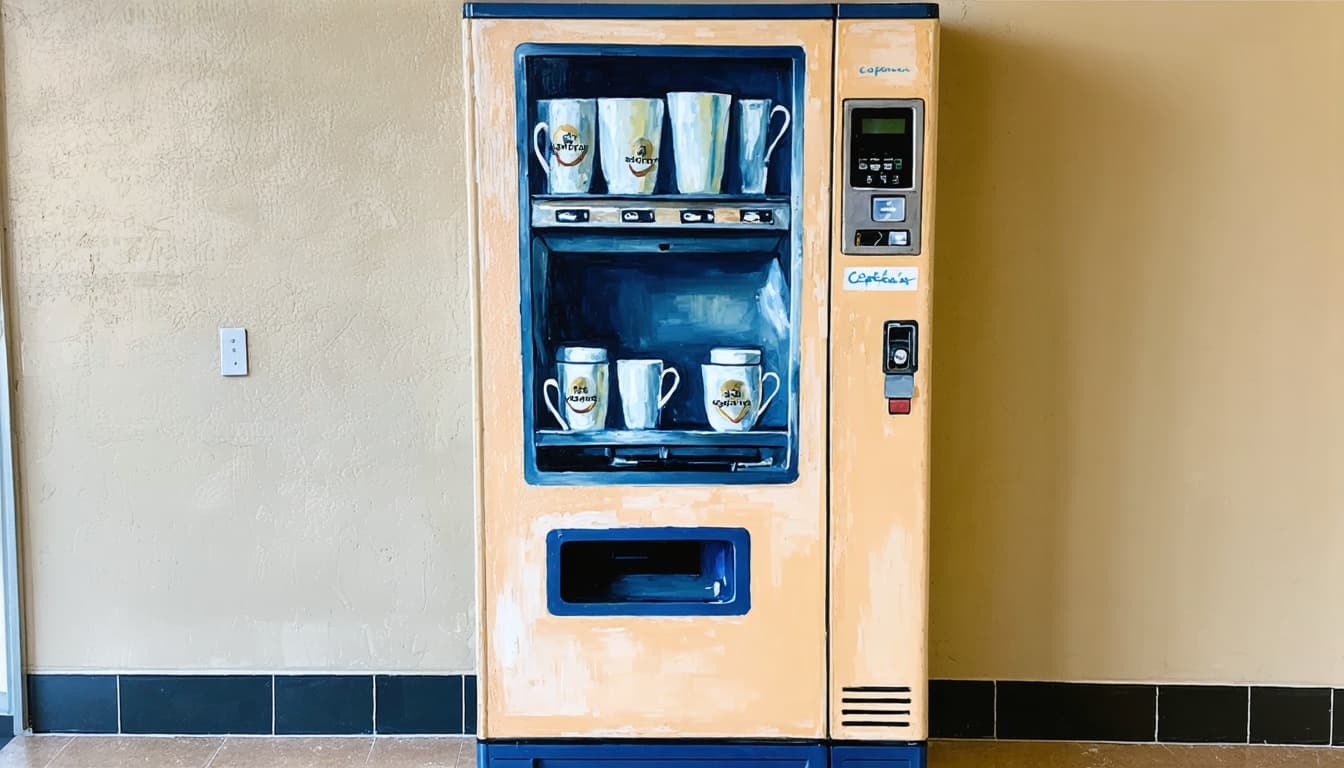
Simultaneously, CCD doubled down on its more efficient formats.
Vending is an asset-light, scalable model with lower overheads and 24/7 revenue potential. By shifting the mix toward vending and away from full-service cafes, CCD improved its capital efficiency and generated revenue from channels with inherently better unit economics. AnnualReports
This strategic pivot also involved a complete exit from international operations. The company liquidated loss-making foreign subsidiaries in Europe, including entities in Austria and the Czech Republic. This deconsolidation eliminated ongoing losses and recognized gains on derecognition, further simplifying the business. The message was clear: CCD was retreating to its profitable domestic core to survive and rebuild. AnnualReports +1
Operational Efficiency: Margins Over Volume
The revenue growth to ₹1,094 crore was modest at 5.7%, but the quality of that revenue improved dramatically. The coffee and related business segment, which accounts for over 97% of revenue, saw its EBITDA jump 32% to ₹201.95 crore. This margin expansion was the real story. The company managed to grow EBITDA (88% consolidated) at nearly eight times the rate of revenue growth, indicating significant operational leverage. AnnualReports +1
However, this efficiency came with trade-offs. Same-store sales growth (SSSG) for the full year remained negative at -1.72%, though it improved to a positive 2.6% in Q4 FY26. Average Sales Per Day (ASPD) inched up only marginally to ₹21,101. This suggests that the profit recovery was driven more by cost control, network optimization, and financial engineering than by a surge in customer demand or organic volume growth. The company accepted slower top-line growth in exchange for stronger profitability and financial stability. AnnualReports
Leadership and Governance: A Steady Hand
The turnaround was orchestrated under a unified leadership structure. In August 2025, Malavika Hegde was appointed Chairperson of both Coffee Day Enterprises Ltd and Coffee Day Global, succeeding S.V. Ranganath. Hegde, who had been leading the company since 2020, brought continuity and a deep understanding of the business's challenges. Her reappointment as Whole-time Director for a five-year term extending to 2030 provided the long-term leadership stability essential for a multi-year recovery plan.
Governance reforms also played a supporting role. The company implemented a structured digital database for unpublished price-sensitive information and strengthened compliance with SEBI regulations. While these moves don't directly drive sales, they reduce regulatory risk and improve investor confidence—a critical factor for a company emerging from a deep crisis. The release of pledged shares by promoters further reduced financial encumbrance, signaling a commitment to cleaning up the balance sheet. Others +1
Competitive Positioning: The 3A Advantage
Despite the turmoil, CCD retained its core competitive strengths. Its business model is built on the "3A" strategy: Affordability, Accessibility, and Acceptability.
Its vast network of cafes and vending machines ensures accessibility across urban and semi-urban India. And its vertical integration, owning coffee plantations spanning 20,000 acres, provides cost efficiency and quality control that competitors relying on third-party sourcing cannot match.
This positioning allowed CCD to maintain its customer base even during the restructuring. The company didn't need to win back market share through aggressive marketing; it focused on serving its existing customers more profitably. The shift toward vending machines aligns perfectly with the "Accessibility" pillar, putting coffee in more convenient locations for on-the-go consumption.
The Road Ahead: Sustainability Questions
CCD's FY26 turnaround is a remarkable achievement, but questions about sustainability linger. The profit recovery was significantly aided by one-time gains and debt restructuring benefits that may not repeat. The core operational metrics—negative same-store sales growth for the year and modest revenue growth—suggest the underlying business is still facing headwinds. The cafe chain market in India is growing, but competition from both global giants and agile local chains is intense.
The company's ability to sustain profitability will depend on converting the operational efficiencies gained from network rationalization into genuine top-line growth. With the debt burden now more manageable and the international distractions gone, CCD can focus on driving organic growth through its core domestic business. The Q4 improvement in same-store sales growth to 2.6% offers a glimmer of hope that the operational recovery is gaining traction. AnnualReports
For now, CCD has proven it can survive. The next chapter will be about whether it can thrive. The strategic decisions made in FY26—exiting unprofitable ventures, restructuring debt, and focusing on the core—have bought the company time and stability. The challenge for FY27 and beyond will be to use that foundation to reignite sustainable growth while maintaining the hard-won profitability.