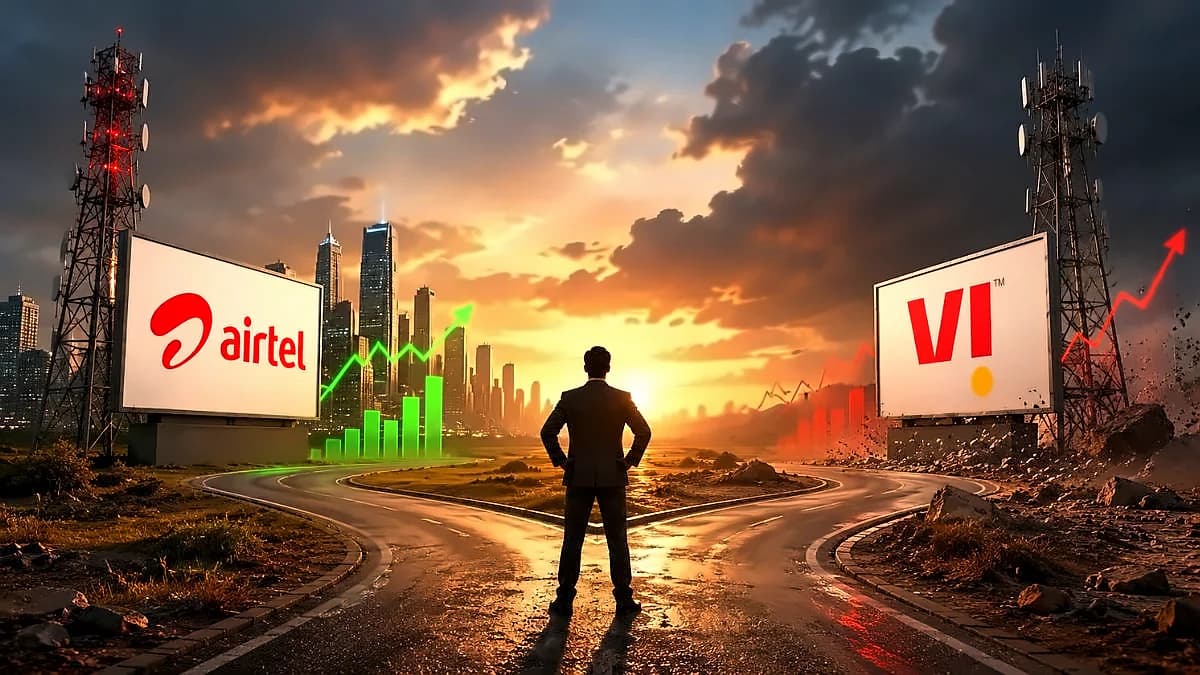
In a milestone that signals a fundamental shift in India's corporate hierarchy, Bharti Airtel has overtaken HDFC Bank to become India's second-most valuable listed company. Airtel's market cap hit approximately ₹11.8 lakh crore, edging past HDFC Bank's ₹11.7 lakh crore.
The divergence tells a story of two very different sectors, business models, and competitive landscapes.
Structural Factors: Telecom Consolidation vs. Banking Fragmentation
The Indian telecom sector has transformed from a fragmented battlefield into a stable duopoly. After Reliance Jio's disruptive entry in 2016 triggered brutal price wars, weaker players exited or consolidated. Today, Jio and Airtel control over 70% of the market in subscriber share and even more in revenue terms. This structural shift enabled pricing discipline and margin expansion. The industry has moved from subscriber growth to ARPU (Average Revenue Per User) expansion—a critical transition that rewards quality over quantity.
In contrast, HDFC Bank faces a fragmented banking landscape with resurgent public sector banks. PSU banks have dramatically improved their asset quality, with GNPA falling from 14.6% in FY18 to below 4% in FY26. Their ROE has climbed from 3-5% to 14-17%, approaching private bank levels.
This competitive pressure on market share and pricing power simply doesn't exist in Airtel's telecom world.
Merger Headwinds and Governance Overhang
HDFC Bank's struggles are rooted in its historic 2023 merger with HDFC Ltd. While creating a financial behemoth with ₹18-20 lakh crore in assets, the integration has been messy. The merger negatively impacted CASA (Current Account Savings Account) mix by 3-4 percentage points as the bank received primarily term deposits from HDFC Ltd. This structural shift increased funding costs and pressured net interest margins, which compressed from ~4%+ pre-merger to ~3.4% immediately post-merger. Transcripts
While the bank quickly appointed veteran Keki Mistry as interim chairman and RBI issued a rare public note affirming no material governance concerns, the uncertainty created a valuation discount. The stock fell 27% over three months, among the worst performers in the banking sector. Airtel faced no such leadership turmoil.
Margin Mechanics: 57.8% EBITDA vs. 3.54% NIM
The most striking difference lies in the fundamental economics of these businesses.
This 54-percentage-point gap reflects fundamentally different business models.
Airtel's India mobile business generates a 60.6% EBITDA margin, Africa operations deliver 49.5%, and the homes business achieves 50.2%. These high margins stem from telecom's operating leverage—once network infrastructure is deployed, incremental customers generate revenue at very high marginal costs. The company's diversified revenue mix across these high-margin segments creates a powerful compounding engine. AnnualReports +2
HDFC Bank's spread-based banking model faces structural constraints. NIMs are pressured by regulatory oversight, competitive intensity, and the merger-related deposit mix shift. While the bank maintains superior asset quality with gross NPAs at just 1.15%, the path to margin recovery remains uncertain. Management expects NIM stabilization in Q4 FY26/Q1 FY27, with gradual recovery beginning mid-FY27—but this timeline lacks the visibility investors crave.
Africa's Explosive Growth and India's Mobile Moderation
Airtel's Q4 FY26 results revealed a tale of two stories. Africa delivered standout performance with 41% year-on-year revenue growth (22.3% in constant currency), while India home broadband grew 9.5% sequentially. These segments helped consolidated revenues and EBITDA beat UBS estimates by 1-3%. Africa's EBITDA margin expanded 223 basis points to 49.5%, demonstrating operating leverage as scale increases. AnnualReports
However, India mobile revenues grew just 8% year-on-year and a tepid 0.6% sequentially—the first ARPU decline in five years, slipping to ₹257 from ₹259 in the previous quarter. This moderation reflects market saturation and the absence of coordinated tariff hikes. With wireless teledensity at 88.71%, growth increasingly depends on upgrading existing users rather than adding new subscribers. The competitive intensity, particularly from Jio's aggressive pricing and investment strategy, constrains pricing power despite the duopoly structure.
Dividend Signals and Capital Allocation Divergence
Airtel's 50% dividend increase from ₹16 to ₹24 per share signals a transformative shift in free cash flow generation. This progressive dividend policy reflects management's confidence in sustainable FCF as the company moves past heavy 5G investment phase.
HDFC Bank maintains a disciplined but conservative dividend policy with payout ratios consistently between 20-25% of profits. The bank's capital allocation priorities focus on technology investments (more than quadrupled to approximately $1 billion), distribution expansion (branches nearly doubled to 9,700), and responsible growth that doesn't overstretch beyond appropriate risk-reward parameters. While prudent, this approach lacks the shareholder return visibility that Airtel's progressive dividend policy provides. AnnualReports +2
Competitive Dynamics: Stable Duopoly vs. Rising Pressure
BofA Securities captures the essence of the competitive divergence: "We expect Bharti's FCF to continue to inch up going ahead as competition is stable-to-declining and we don't foresee any material capex increase ahead". This stable-to-declining competitive environment in telecom supports Airtel's market share gains and pricing power recovery.
HDFC Bank faces intensifying competition from resurgent PSU banks with improving asset quality, converging ROE, and significant valuation advantages. The bank's market share and pricing power are under pressure, explaining its valuation compression versus Airtel's re-rating. The structural difference—telecom duopoly versus banking fragmentation—creates divergent competitive dynamics that will likely continue driving the relative performance gap.
Brokerage Sentiment and Catalyst Visibility
JP Morgan, with a March 2027 price target of ₹2,250, identifies three specific catalysts for Airtel: "Growth in adjacencies, deleveraging and rising dividends should be the key catalysts for the stock". Goldman Sachs retains a Buy with a ₹2,210 target, forecasting strong FCF generation. Multiple brokerages maintain Buy ratings with targets ranging from ₹2,200-2,500, reflecting confidence in Airtel's growth trajectory.
For HDFC Bank, the narrative is transitioning from "Integration Pain" to "Earnings Acceleration," but the timing remains uncertain. Analysts project 12-month targets of ₹1,200-1,400, representing significant re-rating potential but dependent on catalyst execution. The near-term earnings visibility challenges from merger integration, competitive pressures, and governance overhang create a risk-reward profile that currently favors telecom over banking.
The Path Forward
The market cap flip between Airtel and HDFC Bank represents more than a numerical milestone—it signals a structural re-rating of Indian telecom against banking. Airtel benefits from industry consolidation, pricing power recovery, diversified high-margin segments, and clear catalyst visibility. HDFC Bank navigates merger integration, competitive pressures, and earnings uncertainty.
For investors, the key question isn't which company is fundamentally better—it's which business model offers superior visibility on earnings growth and shareholder returns in the current environment. Right now, the market's answer is clear: telecom's stable duopoly with visible deleveraging and dividend growth trumps banking's turnaround story with uncertain catalysts. As Airtel continues its journey toward ₹300 ARPU and HDFC Bank works through its integration challenges, this great flip may have further to run.