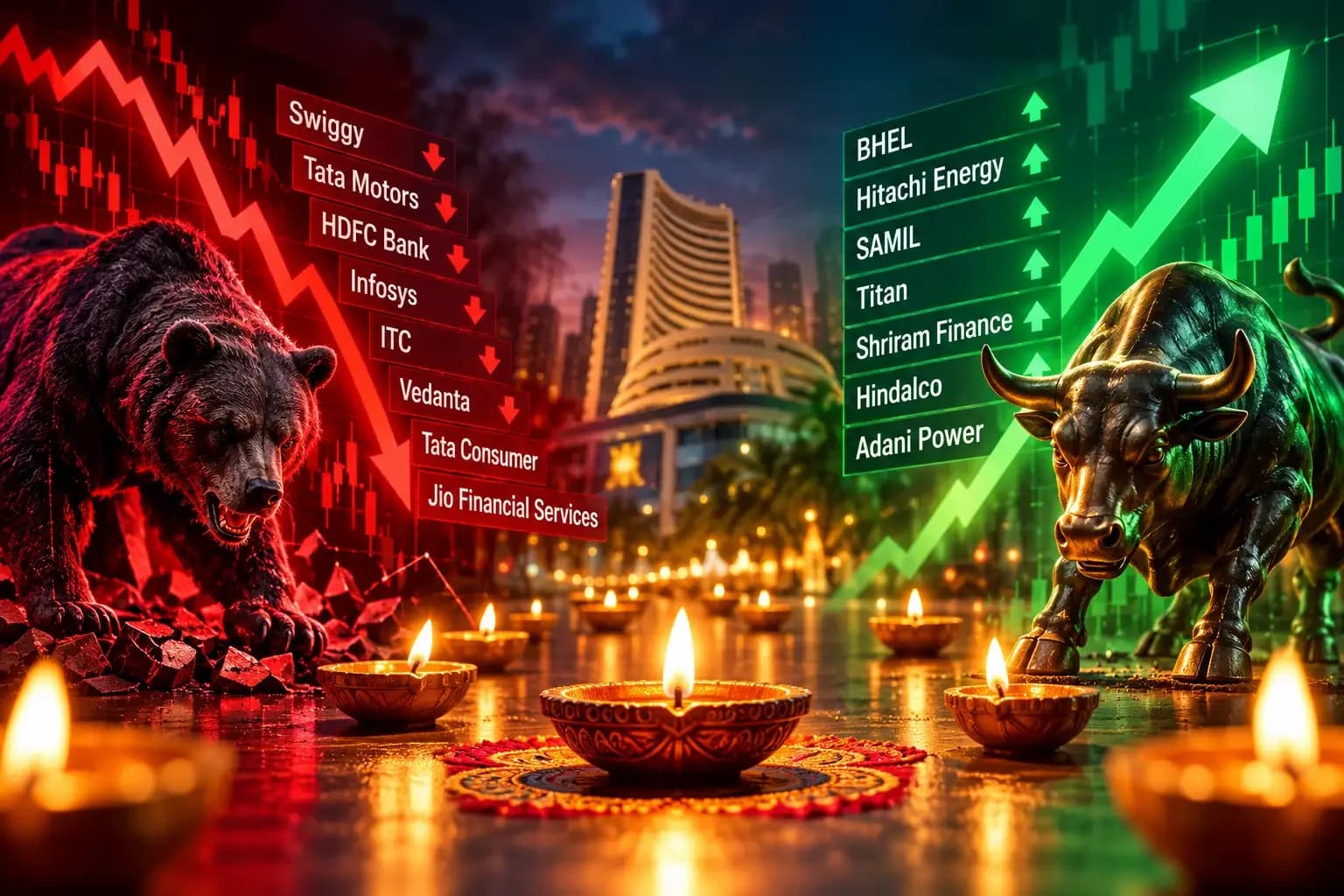
The party in AI-linked Indian smallcaps has hit a rough patch.
This isn't just random volatility. It's a direct consequence of what analysts are calling the "anti-AI trade" — a global reassessment of whether the massive spending on artificial intelligence infrastructure can actually deliver the returns investors have priced in.
The trigger came from Wall Street. The Nasdaq Composite is down 7.5% over the month, and Nvidia has taken a beating. But the pain has spread far beyond US tech stocks. Indian companies exposed to the global AI and data-centre ecosystem are now under the microscope because their valuations had already baked in years of explosive growth. When the growth story gets questioned, the premium multiples get punished first.
Why Sterlite and HFCL Fell the Hardest
Both Sterlite and HFCL had become darlings of the AI trade, and that's exactly why they're correcting so sharply now. Sterlite's order book has expanded 4.6-fold since March to about ₹35,274 crore, including roughly $1.2 billion (around ₹11,400 crore) in deals with hyperscalers — those massive cloud and tech companies building data centres. HFCL isn't far behind, with about ₹18,500 crore of its order book tied to optical fibre and data-centre interconnect work. Transcript
Here's the problem: a significant chunk of that order book depends on US hyperscalers continuing to spend aggressively on AI infrastructure.
That's concentration risk. When investors start worrying about debt-funded AI capex, pressure on hyperscalers' free cash flows, and rising financing costs, they immediately question whether those purchase orders will keep flowing at the expected pace.
The contracts themselves aren't being cancelled. Sterlite's hyperscaler agreements include reciprocal risk-sharing with capped liabilities, and purchase orders are released periodically against yearly allocations. But a slowdown in hyperscaler spending would show up as smaller or delayed orders, not as broken contracts. With only about ₹3,021 crore of Sterlite's ₹35,274 crore order book scheduled for Q3 execution, most of the revenue visibility sits in future quarters. That's where the uncertainty bites. Transcript +1
HFCL faces similar dynamics. Data centres account for 65-75% of its revenue, and exports make up 63%.
The stock had climbed over 370% from its January low to its October peak — that kind of run-up leaves plenty of room for a correction when sentiment turns. Transcript +1
The Premium Multiple Problem
Valuation matters, especially when growth expectations get reset.
These are nosebleed levels. When you're paying 65-90 times earnings, the market expects perfection. Any execution delay, margin miss, or growth deceleration hits the stock price twice — once through lower earnings and again through a lower multiple.
Take Black Box as an example. It's growing revenue at 22% and profit at 31%, yet trades at 66x earnings. If earnings come in 15% below expectations and the PE compresses to 56x, the stock could fall nearly 28%. For E2E Networks, trading at 88x, the same earnings miss combined with a de-rating to 60x could trigger a 42% decline. These aren't forecasts, but they illustrate how little room for error exists at these valuations.
The broader smallcap universe isn't exactly cheap either. The Nifty Smallcap 100 trades at about 34.5x PE, roughly 19% above its 5-year median of 29.1x. The Nifty Smallcap 250 commands a 66% premium to the Nifty 100. This premium was justified when AI spending seemed limitless. Now, as investors question the sustainability of that spending, the premium is being reassessed — starting with the names most directly exposed to the AI capex cycle.
Direct vs Indirect Exposure
Not all smallcaps are created equal. The market is drawing a sharp distinction between companies with direct AI infrastructure exposure and those with indirect or no exposure.
Aditya Infotech, for instance, delivered Q2 revenue growth of 90% and raised its full-year guidance. Its business is video surveillance through CP PLUS, with only a minor AI link through a stake in a cloud storage analytics company. Sansera Engineering is a precision components manufacturer serving automotive, aerospace, and non-auto segments. Its Q2 revenue grew 32% and profit 52%, driven by a record non-auto backlog and expansion into new segments like defence and medical equipment. Neither company's earnings call even mentioned AI or data centres. Transcript +1
Acutaas Chemicals operates in pharmaceutical CDMO and semiconductor chemicals, with growth driven by long-term contracts with innovator companies. Again, no direct AI exposure. These stocks are moving on their own earnings momentum, not on the vagaries of US hyperscaler capex. The market is rewarding execution and visible growth, not thematic hype.
Execution Risks Lurk Beneath the Surface
Even for the AI beneficiaries, execution risks are mounting. Sterlite faces local challenges around land, power, water, and community opposition. Management flagged that scaling up higher-fibre-count products will take another 1.5-2 years. The company plans ₹1,000 crore of annual capex through FY29 to expand capacity, but that spending itself depends on sustained demand. Transcript +2
HFCL is running at 100% fibre utilisation and is doubling preform capacity, but the expansion won't be fully commissioned until October 2028. That's a long wait when order books need execution now. The company also faces billing delays on BharatNet projects due to complex milestone verification processes. Working capital is absorbing more cash, with receivables rising and interest costs up 15% year-on-year. Transcript +3
Netweb Technologies, despite reporting 338% revenue growth, saw its cash conversion cycle widen to 94 days as inventory built up to support its order book. Finance costs surged to ₹238 million from just ₹9 million a year ago. A newsletter cited by Univest flagged negative H1 operating cash flow of ₹639 crore. E2E Networks has a nearly ₹1,000 crore contract with a single sovereign AI customer running through 2029 — great for visibility, but terrible for concentration risk. Transcript +2
Black Box needs to book about $1 billion in H2 to meet its full-year booking target of $1.31-1.5 billion, after recording $637 million in H1. Management has front-loaded hiring, pressuring near-term margins. These are the operational realities that can trip up even the best growth stories. Transcript +2
The Road Ahead
The global AI investment cycle isn't ending — it's maturing. Hyperscaler capex is still expected to exceed $600 billion in 2026 and approach $1 trillion by 2027. But the easy money phase is over. Investors are now demanding to see returns on that massive spending, and they're scrutinising balance sheets, free cash flow generation, and the sustainability of debt-funded growth.
For Indian smallcaps, this means the market will increasingly differentiate between companies with genuine earnings visibility and those riding a thematic wave. The correction in Sterlite and HFCL serves as a warning: when valuations get ahead of fundamentals, even solid order books can't protect against a sentiment shift.
The names that survive this transition will be those that can execute flawlessly, diversify their customer base, and demonstrate that their growth isn't entirely dependent on a single capex cycle. The others risk becoming cautionary tales in what could be a prolonged period of valuation consolidation for AI-linked smallcaps.