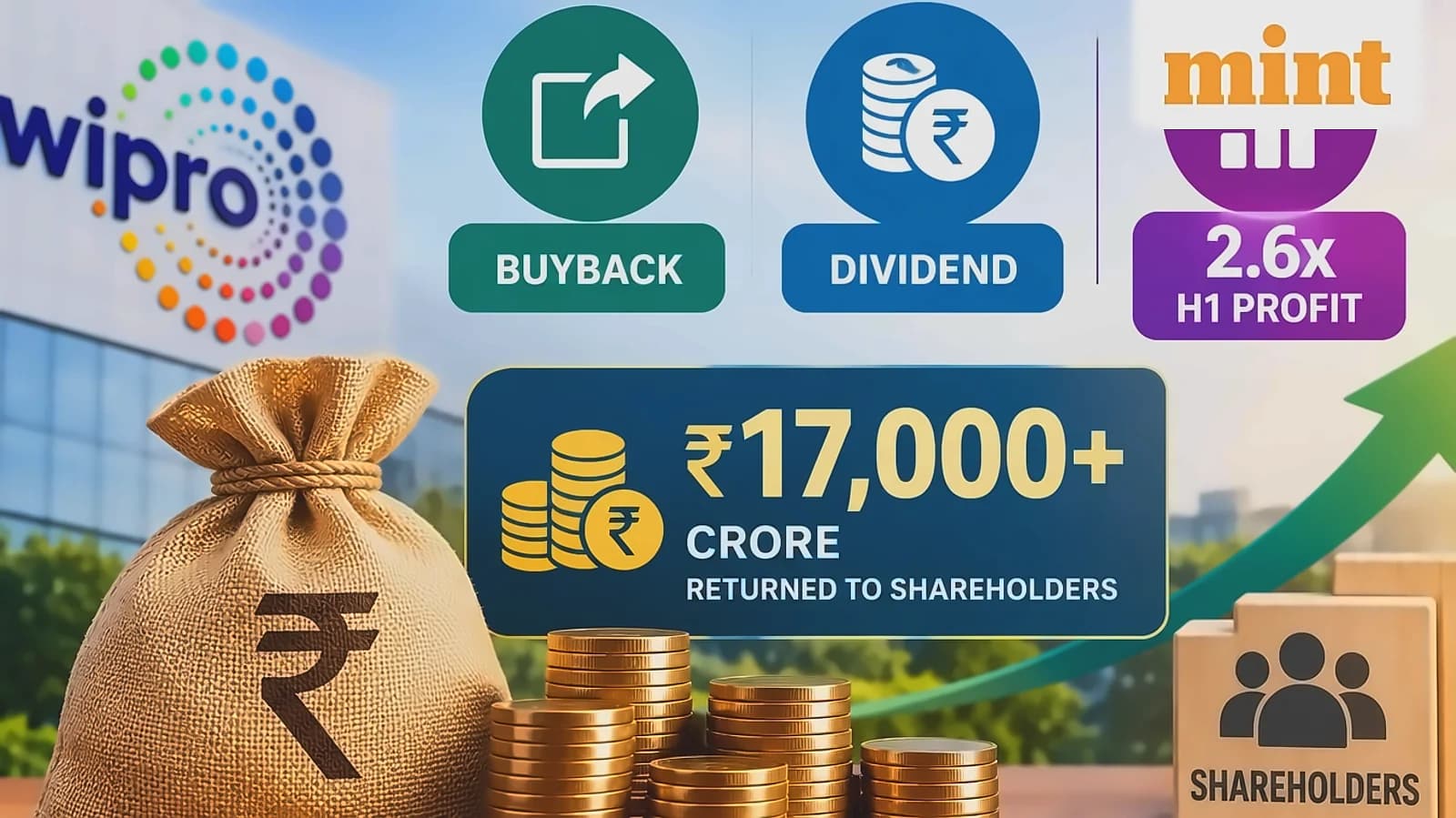
Wipro returned ₹17,029 crore to shareholders in the first half of FY27, well above its net profit, according to reports from Live Mint. The Bengaluru-based software company's shareholder payouts were 2.6 times higher than its H1 profit of ₹6,556 crore. The company completed a major share buyback of 60 crore shares at ₹250 apiece in June, resulting in a total cash outflow of ₹15,051 crore. Additionally, Wipro paid a dividend of ₹1,978 crore, taking the total shareholder payout to ₹17,029 crore for the period.
For the September quarter, Wipro posted a net profit of ₹3,200 crore, down 2% from the same period last year and 9% from the June quarter, as reported by Live Mint. The company generated ₹8,592 crore in cash from operating activities in the six months ended September 2026, compared with ₹7,499 crore in the corresponding period last year. Revenue from operations stood at ₹24,752.7 crore, marking a 1.1% increase from the June quarter and 9% rise from the year-ago quarter. In constant currency terms, revenue remained flat quarter-on-quarter but increased by 0.6% year-on-year.
The IT services operating margin for Q2 FY27 stood at 16.5%, up 0.5 percentage points quarter-on-quarter but down 0.2 percentage points year-on-year, according to Live Mint. Revenue from the IT services segment was $2,611.5 million, down 0.1% quarter-on-quarter but up 0.3% year-on-year. The company expects revenue from its IT services business to range between $2,571 million and $2,625 million in Q3 FY27, translating to sequential revenue guidance of -1.5% to +0.5% in constant currency terms. However, total deal bookings fell to $2.6 billion in the September quarter from $4.7 billion a year earlier, marking a sharp decline.
Wipro is leveraging its ₹43,580 crore gross cash position to pursue strategic acquisitions that enhance its AI and consulting capabilities, as reported by NDTV Profit. CEO Srini Pallia emphasized during the Q2FY27 analyst call that the company seeks opportunities that strengthen its consulting-led and AI-powered strategy within priority sectors. The company cited successful acquisitions like Harman DTS (design-to-manufacturing capabilities) and Mindsprint (food and agriculture expertise) as examples of strategic value creation. Wipro has not disclosed specific acquisition budget, target size, or timeline for major deals, but Pallia reaffirmed the company's dual organic and inorganic growth strategy.
Wipro is significantly expanding its AI capabilities with an AI-native unit employing over 2,000 engineers, including forward-deployed specialists, according to NDTV Profit. The company is developing AI services and solutions across five key areas: AI data centres, AI foundry services, physical AI, AI devices, and design-to-manufacturing. This parallel investment in internal AI capabilities raises strategic questions about which capabilities should be developed organically versus acquired through external purchases, as the company continues to evaluate its acquisition strategy for the next phase of growth.